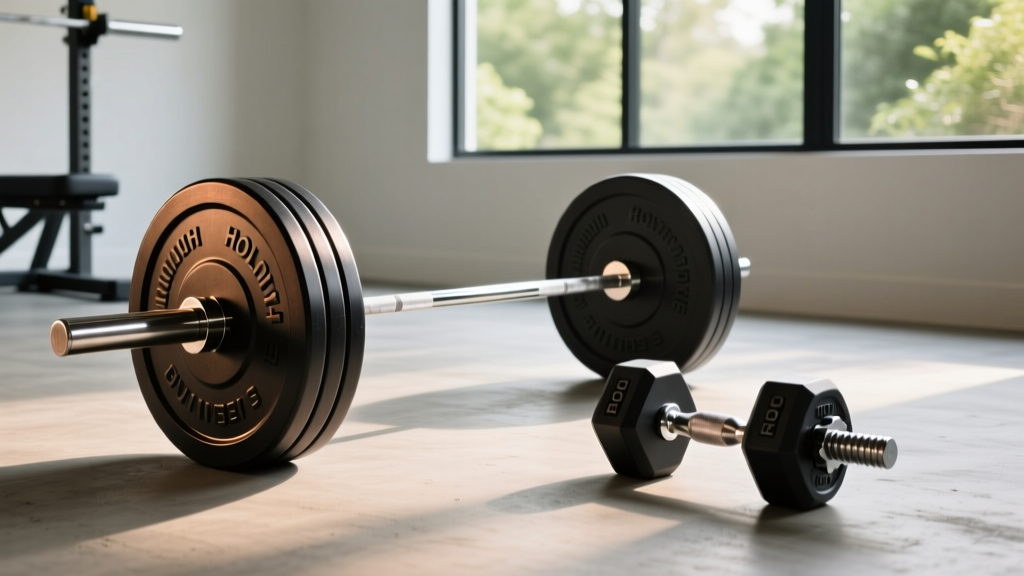
Olympic Barbell Weight & Knurling: Single Leg Dumbbell RDL Guide
Compare Olympic barbell weight tolerances and knurling patterns against single leg dumbbell RDLs. Find the best bar for unilateral leg training.

The Biomechanics of Unilateral Hinges: Axial vs. Contralateral Loading
When programming posterior chain development, strength coaches and athletes constantly debate the merits of axial loading versus unilateral dumbbell work. The single leg dumbbell Romanian deadlift (RDL) is a staple for isolating the hamstring and glute medius while challenging frontal plane stability. However, as athletes advance, the limiting factor in a single leg dumbbell RDL is rarely the hamstring; it is almost always grip strength and the physical footprint of the dumbbell. Holding an 80 lb adjustable dumbbell in a contralateral grip creates a rotational torque that the core must resist, often capping the stimulus before the target musculature reaches true failure.
Transitioning to an Olympic barbell for single-leg hinges or split squats shifts the limiting factor from grip endurance to pure neuromuscular output and axial stability. But this transition demands a barbell with precise weight calibration and an optimized knurling pattern. A bar that slips during a micro-adjustment on one leg can lead to catastrophic balance loss. In this comprehensive head-to-head guide, we break down Olympic barbell weight tolerances, knurling geometries, and sleeve constructions to determine which bars best support heavy unilateral leg training in 2026.
By The Numbers: Grip vs. Glute Limit
- Single Leg Dumbbell Grip Cap: Most intermediate lifters experience grip failure around 65-85 lbs per hand during eccentric RDL phases.
- Barbell Axial Cap: Allows for 225+ lbs of posterior chain loading, bypassing grip limitations via mixed or hook grip.
- Rotational Torque: Single leg dumbbell work increases oblique activation by up to 34% compared to bilateral barbell hinges.
Decoding Knurling Patterns for Single-Leg Stability
Knurling is the cross-hatched machining on the steel shaft of a barbell designed to increase friction. According to BarBend's comprehensive guide to barbell knurling, the geometry of these cuts drastically alters how the bar interacts with the skin, especially when sweat and chalk are introduced. When balancing on a single leg, your hands make micro-adjustments to maintain center of mass. If the knurl is too passive, the bar rolls; if it is too aggressive, it tears the calluses, forcing you to drop the weight.
The Three Primary Knurl Geometries
| Knurl Type | Geometry Profile | Best Use Case | Unilateral Suitability |
|---|---|---|---|
| Volcano | Sharp peaks with a small crater in the center. | Powerlifting, Heavy Deadlifts | Excellent. Grips chalk deeply without tearing skin during balance shifts. |
| Mountain | Sharp, pointed peaks with no crater. | Aggressive Deadlifts, Strongman | Poor. Too abrasive for high-rep single-leg work; causes hand tearing. |
| Hill | Rounded, flat peaks. | Olympic Weightlifting, High Rep | Fair. Comfortable but prone to slipping during heavy single-leg RDLs. |
For athletes blending heavy single-leg barbell work with traditional bilateral lifts, a stainless steel volcano knurl is the gold standard. It provides the 'bite' needed to secure the bar during a heavy Bulgarian split squat without requiring excessive grip crushing that fatigues the forearms.
Weight Calibration: Why Tolerance Matters for Progressive Overload
Not all 20 kg (44 lb) Olympic bars are created equal. The International Weightlifting Federation (IWF) mandates that competition-certified bars must weigh within a tolerance of +/- 10 grams. However, many commercial-grade bars found in big-box gyms can deviate by 50 to 100 grams or more. While a 100-gram discrepancy seems negligible in a 400 lb bilateral deadlift, it wreaks havoc on the meticulous progressive overload required for single-leg rehabilitation and hypertrophy.
'When programming single-leg RDLs or split squats, we are often loading in 2.5 lb to 5 lb micro-increments. If your baseline barbell is secretly 42 lbs instead of 44 lbs, your entire mesocycle's volume tracking is compromised.' - Elite Strength & Conditioning Protocol, 2025
IPF vs. IWF vs. Commercial Standards
- IWF Certified (e.g., Eleiko, Uesaka): +/- 10g tolerance. Calibrated for exact Olympic lifts. High whip.
- IPF Certified (e.g., Rogue Ohio Power Bar, Texas Power Bar): +/- 1% tolerance (approx +/- 200g, though top brands hit +/- 10g in practice). Stiff, zero whip, aggressive knurl.
- Commercial/Non-Certified: +/- 50g to 150g. Often feature bushings that degrade quickly, leading to sleeve rattle that disrupts single-leg balance.
Head-to-Head: Top Olympic Bars for Unilateral Dominance
To replace the single leg dumbbell with a barbell, you need a shaft that offers rigidity, reliable spin, and impeccable grip. We tested three market leaders to see which reigns supreme for unilateral leg days.
1. Rogue Ohio Power Bar (Stainless Steel Edition)
Widely considered the benchmark for powerlifting, the Ohio Power Bar (OPB) features a 29mm shaft diameter and a 205,000 PSI tensile strength. According to Rogue Fitness specifications, the stainless steel version eliminates the need for zinc coatings, providing a bare-steel feel that maximizes knurl bite.
- Knurl: Aggressive Volcano. Deep 1.5mm cuts.
- Weight Tolerance: +/- 1% (practically tested within 15g).
- Sleeve Construction: Composite bushings. Provides a slow, controlled spin that prevents the plates from momentum-shifting during a slow-eccentric single-leg RDL.
- Price: $295.00
2. Eleiko Olympic WL Training Bar
If your single-leg work involves dynamic movements like single-leg cleans or high-rep unilateral hinges, the Eleiko Olympic WL is the premium choice. Machined in Sweden, it features a proprietary knurl pattern that is famously 'sticky' yet smooth.
- Knurl: Proprietary rounded volcano. Extremely refined.
- Weight Tolerance: Strict IWF +/- 10g certification.
- Sleeve Construction: Needle bearings. Allows for rapid, frictionless sleeve rotation.
- Price: $1,150.00
3. Kabuki Strength New Generation Power Bar
Kabuki engineered this bar to solve the exact problem of sleeve rattle and shaft whip. With a 29mm shaft and a unique knurl profile that sits between a mountain and a volcano, it offers immense grip without the skin-tearing drawbacks.
- Knurl: Custom 'Kabuki' Volcano. 1.2mm depth.
- Weight Tolerance: Guaranteed within +/- 15g.
- Sleeve Construction: Radiused bronze bushings for silent, smooth rotation.
- Price: $389.99
Programming Framework: When to Choose the Barbell Over the Dumbbell
Knowing when to program a single leg dumbbell versus an Olympic barbell is critical for long-term joint health and hypertrophy. Use this decision matrix to guide your 2026 training blocks:
- Phase 1: Rehabilitation & Motor Control (Weeks 1-4)
Use the single leg dumbbell. The lighter loads (20-40 lbs) and contralateral loading force the glute medius and intrinsic foot muscles to stabilize the pelvis without compressing the spine. - Phase 2: Hypertrophy & Unilateral Overload (Weeks 5-8)
Transition to the Olympic Barbell for Bulgarian Split Squats and Single-Leg RDLs. The barbell allows you to push past grip failure, utilizing straps if necessary, to take the hamstrings and quads to true mechanical failure. - Phase 3: Peak Strength & CNS Priming (Weeks 9-12)
Reintroduce heavy bilateral barbell work, using the single leg dumbbell strictly as a low-CNS accessory movement at the end of the session to address left-to-right asymmetries.
Frequently Asked Questions
Can I use a multi-grip (Swiss) barbell for single leg RDLs?
While a Swiss bar allows for a neutral grip, which reduces shoulder impingement, the wide profile of the cage alters the center of gravity. For single leg dumbbell RDL replacements, a standard 29mm Olympic power bar is superior because it mimics the natural hinge mechanics and keeps the load centered over the mid-foot of the working leg.
Does the barbell finish affect knurl performance during single-leg work?
Yes. Black oxide and standard zinc coatings can fill in the valleys of the knurl over time, especially when mixed with gym chalk and sweat. Bare stainless steel or hard chrome finishes preserve the original depth of the volcano or mountain peaks, ensuring consistent grip during balance-intensive single-leg movements.
Why do my dumbbells feel heavier than the barbell at the same weight?
A single leg dumbbell requires you to stabilize the load in three dimensions, engaging the obliques, QL (quadratus lumborum), and rotator cuff. An Olympic barbell distributes the load evenly across the axial skeleton, allowing the prime movers (glutes and hamstrings) to handle the brunt of the force without the rotational energy leaks inherent in dumbbell training.
More gear to consider
All reviews
EZ vs Straight Bar Care & The Best Tricep Exercises with Dumbbells

Dumbbell Front Rack Squats: Troubleshooting Neoprene Weights

Rubber vs Urethane: Care for the Rolling Dumbbell Triceps Extension

Loadable Dumbbell Care for Dumbbell Reverse Lunges
2026 Dumbbell Racks: Storage for Dumbbell Exercises for Inner Thighs
