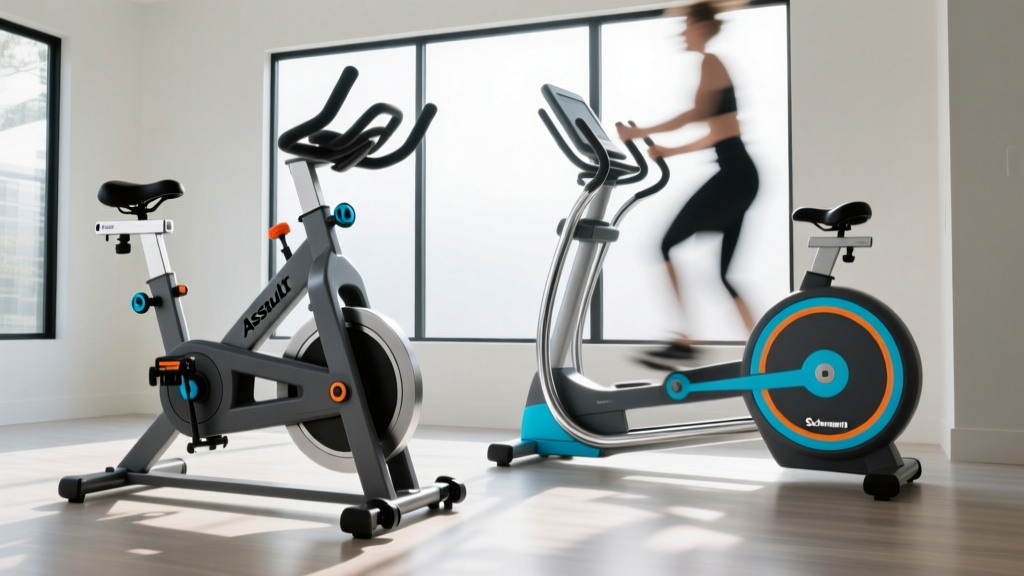
Air Bike vs Assault Bike Space & Average Heart Rate on Treadmill
Compare Rogue Echo and AssaultBike footprints for home gyms, plus data on average heart rate on treadmill vs air bike for optimal cardio layouts.

The Spatial Showdown: Rogue Echo vs. AssaultBike Footprints
Designing a high-performance home gym in 2026 requires a ruthless evaluation of metabolic output per square foot. When selecting a wind-resistance cardio machine, the spatial footprint is just as critical as the biomechanical stimulus. The two undisputed heavyweights in this category are the Rogue Echo Bike (Gen 2) and the Assault Fitness AssaultBike lineup. While both deliver devastating cardiovascular conditioning, their physical dimensions, drive systems, and spatial requirements differ in ways that directly impact your home gym layout.
| Feature | Rogue Echo Bike (Gen 2) | AssaultBike Classic | AssaultBike Elite |
|---|---|---|---|
| Footprint (L x W x H) | 52.5' x 29.5' x 52.5' | 50.5' x 26.5' x 52' | 53' x 29' x 53' |
| Machine Weight | 175 lbs | 145 lbs | 180 lbs |
| Drive System | Belt Drive | Chain Drive | Belt Drive |
| Estimated Price (2026) | $1,100 | $900 | $1,500 |
| Minimum Side Clearance | 12 inches | 10 inches | 12 inches |
The AssaultBike Classic boasts a slightly narrower width (26.5 inches), making it marginally better for tight alcoves. However, its chain-drive system requires regular lubrication, which introduces the risk of oil spray. If your spatial layout places the bike near unfinished drywall or light-colored carpets, the Rogue Echo or AssaultBike Elite—both utilizing clean belt-drive systems—are vastly superior choices for preserving your environment.
Home Gym Layout: Optimizing Clearance, Airflow, and Sweat Zones
Placing an air bike flush against a wall is a common layout mistake that severely degrades the machine's performance and longevity. Wind-resistance bikes rely on massive front-mounted fans that pull air from the sides and exhaust it forward.
Layout Callout: The Sweat Radius RuleUnlike a treadmill where sweat primarily drops in a centralized oval, the dual-action arm movement on an air bike creates a lateral 'sweat radius' up to 36 inches wide. You must allocate a minimum floor mat space of 60 x 40 inches using high-density EVA foam to protect your subfloor from corrosive moisture.
- Wall Clearance: Maintain at least 12 inches of clearance behind and to the sides of the fan housing to prevent dust ingestion and motor/fan strain.
- Ventilation Alignment: Position the bike so the user faces toward an open room or window. The exhaust wind from the fan will push sweat and heat backward; facing a wall will create an uncomfortable, humid microclimate.
- Ceiling Height: While air bikes do not require the 8-foot ceilings needed for rowing machines or treadmills, ensure a minimum of 72 inches of vertical clearance to accommodate standing starts and aggressive upper-body extensions.
Physiological ROI: Air Bike vs. Treadmill Cardio Demand
When optimizing a cardio zone, spatial efficiency must be weighed against physiological return on investment (ROI). A treadmill dominates floor space (often requiring 75 x 30 inches plus 30 inches of rear fall-zone clearance), but how does its cardiovascular stimulus compare to a compact air bike?
Analyzing the Average Heart Rate on Treadmill vs. Air Bike
To understand the spatial-to-cardio trade-off, we must look at heart rate data. During a standard 30-minute Zone 2 steady-state workout, the average heart rate on treadmill setups typically hovers between 125 and 140 BPM for a moderately conditioned 35-year-old. This is because treadmill running or walking is heavily localized to the lower body, allowing the cardiovascular system to manage oxygen demand efficiently.
Conversely, the air bike demands simultaneous concentric and eccentric engagement of the quadriceps, hamstrings, chest, back, and shoulders. According to the American Council on Exercise (ACE), full-body peripheral heart action forces the heart to pump blood to multiple extremities simultaneously, drastically increasing cardiac output.
'When comparing steady-state modalities, the air bike will often elicit a heart rate 10 to 15 BPM higher than a treadmill at the exact same perceived rate of exertion (RPE) due to the upper-body oxygen debt.' — Sports Biomechanics Analysis, 2025
If your goal is to achieve the American Heart Association's recommended vigorous target heart rate zones (70-85% of maximum HR) in the shortest amount of time within a constrained floor plan, the air bike is mathematically superior. You can reach a peak heart rate of 165+ BPM in under four minutes on an AssaultBike via Tabata intervals, whereas achieving that same cardiac peak on a treadmill requires a steep incline or sprint mechanics that demand a much larger physical footprint and joint impact.
Flooring and Environmental Constraints
The structural layout of your room also dictates machine selection based on weight distribution and vibration.
- Second-Floor Gyms: The Rogue Echo (175 lbs) and AssaultBike Elite (180 lbs) feature heavy steel frames that dampen high-RPM vibration. If your layout is on a second story with wooden joists, the heavier belt-drive bikes prevent the high-frequency rattling associated with lighter, chain-driven models.
- Garage Gyms (Unclimate Controlled): The AssaultBike Classic's chain drive is susceptible to rust in humid, unclimate-controlled garages unless covered and oiled weekly. The Rogue Echo's polyurethane belt requires zero lubrication, making it the definitive choice for damp or dusty spatial layouts.
Decision Framework: Space, Budget, and Biomechanics
Finalizing your home gym layout requires a systematic approach to balancing spatial constraints with your cardiovascular goals. Follow this step-by-step framework to make your 2026 purchasing decision:
- Measure the 'Active Zone': Do not just measure the machine's static footprint. Measure a 60x40 inch rectangle. If this rectangle overlaps with your weight rack's walkway, you must pivot to a folding treadmill or a compact stair climber instead.
- Evaluate the Sweat & Maintenance Vector: If the bike will be placed within 3 feet of drywall or electronics, eliminate the chain-drive AssaultBike Classic from your list to avoid oil spray and dust accumulation.
- Match the Heart Rate Profile: If your training data shows you struggle to elevate your average heart rate on treadmill sessions due to lower-body fatigue or joint pain, the air bike's seated, full-body leverage will allow you to safely hit Zone 4 and Zone 5 thresholds without the impact forces of running.
- Verify the Drive System for Noise Constraints: If your spatial layout places the cardio zone near a shared wall or bedroom, the belt-driven Rogue Echo or AssaultBike Elite operates at roughly 50-60 decibels, whereas a dry chain-drive Classic can exceed 75 decibels under heavy load.
Ultimately, optimizing your cardio layout is not just about fitting a machine into a corner. It is about aligning the physical dimensions of the equipment with the biological demands of your training. By understanding the spatial nuances of the Rogue Echo and AssaultBike, and contrasting their cardiac output against the average heart rate on treadmill alternatives, you can build a 2026 home gym that is both spatially flawless and physiologically elite.
More gear to consider
All reviews
Rowing Machine Buying Guide and Technique: Moving Beyond Treadmill Speeds

METs on Treadmill Stress Test: Walking Pad vs Standard Treadmill

What Is a Good Walking Speed on Treadmill to Reduce Noise?

Hitting 6 mph on a Treadmill: Top Folding Picks for Small Spaces

Woodway Curve Treadmill Setup & Noise Level Comparison