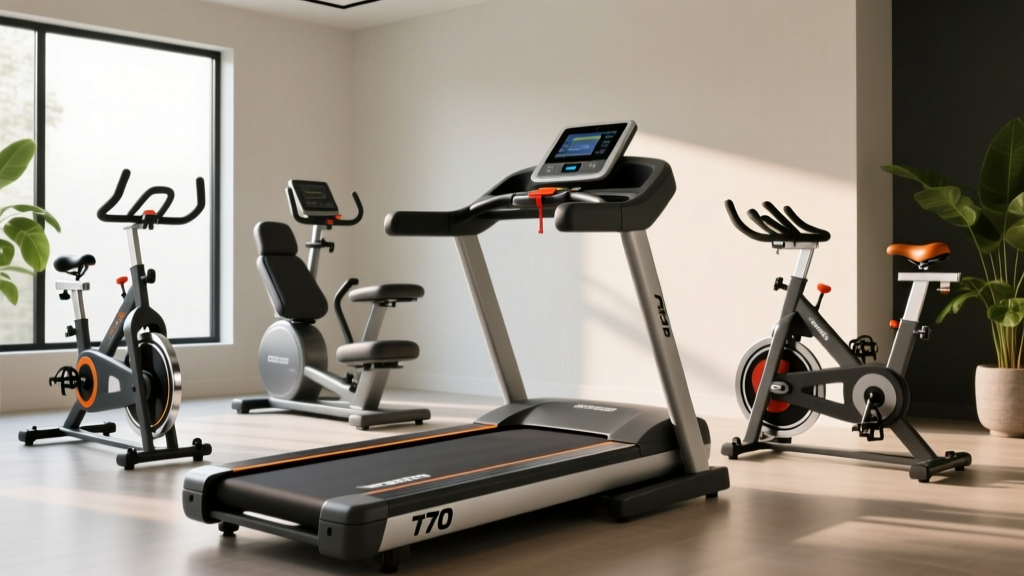
Stationary Bike Types vs NordicTrack Commercial X22i Treadmill
Analyzing 2026 market trends for upright, recumbent, and spin bikes compared to premium incline trainers like the NordicTrack Commercial X22i treadmill.

The 2026 Cardio Equipment Market: Bikes vs. Premium Incline Trainers
As the home fitness industry matures in 2026, consumer purchasing behavior has shifted from pandemic-era panic buying to strategic, data-driven investments. Today's buyers are heavily focused on biomechanical longevity, spatial efficiency, and cross-training versatility. A major focal point of our latest market analysis involves comparing the diverse category of stationary bike types—upright, recumbent, and spin—against the benchmark of premium heavy-duty incline trainers, specifically the NordicTrack Commercial X22i treadmill.
Understanding the market share, mechanical failure modes, and return on investment (ROI) for these distinct cardio modalities is critical for both home gym builders and commercial facility managers. This trend report breaks down the engineering realities, pricing structures, and physiological outcomes of these machines in the current fitness landscape.
2026 Market Data Highlight
According to recent industry analyses, the global indoor cycling segment has stabilized at a 28% share of the home cardio market, while premium incline treadmills (priced above $2,500) have seen a 14% year-over-year growth, driven by the rising popularity of low-impact, high-incline hiking simulations. Buyers are increasingly pairing a secondary bike with a primary incline trainer to optimize recovery.
Stationary Bike Types: Upright, Recumbent, and Spin Market Share
When evaluating stationary bike types, upright, recumbent, and spin models each serve distinct demographic and physiological needs. The engineering and price points in 2026 reflect highly specialized use cases.
Upright Bikes: The Space-Saving Staple
Upright bikes mimic the geometry of a traditional road bike but with a wider, more supportive saddle and a heavier flywheel. In 2026, magnetic eddy-current resistance has completely replaced friction pads in the mid-to-high-tier market.
- Market Leaders & Pricing: Models like the Sole B94 ($899) and Schwinn 290 ($1,199) dominate the residential space.
- Biomechanics & Use Case: Ideal for general cardiovascular health and moderate-intensity steady-state (MISS) cardio. They require a footprint of roughly 43 x 24 inches, making them highly spatial-efficient.
- Common Failure Modes: The most frequent edge-case failure in upright bikes involves the seat post slider. If users frequently adjust the seat height without cleaning the track, dust and sweat accumulate, causing the locking pin to grind and eventually fail to engage.
Recumbent Bikes: Rehab and Senior Demographics
Recumbent bikes feature a bucket-style seat with a backrest and front-mounted pedals. This design shifts the user's center of gravity, eliminating lumbar strain and reducing hip flexion angles.
- Market Leaders & Pricing: The Life Fitness RSX Club Series ($2,499) and NuStep recumbent cross-trainers ($3,200+) are the gold standards for rehab and senior living facilities.
- Biomechanics & Use Case: Essential for users with spinal stenosis, sciatica, or those recovering from lower-body joint surgeries. The American Council on Exercise (ACE) frequently recommends recumbent modalities for populations requiring strict lumbar support.
- Common Failure Modes: Recumbent bikes utilize a long aluminum or steel rail for seat adjustment. In high-humidity environments (like garage gyms), these rails can oxidize. If not treated with dry silicone lubricant bi-annually, the seat carriage will bind, rendering the adjustment mechanism useless.
Spin Bikes: The High-Intensity Enthusiast
Indoor cycling bikes (spin bikes) are engineered for high-cadence, high-resistance interval training. They feature aggressive drop-bar geometries and direct-drive magnetic or belt-driven flywheels.
- Market Leaders & Pricing: The Keiser M3i ($2,295) remains the commercial benchmark, while the Peloton Bike+ ($2,495) leads the connected-fitness residential market.
- Biomechanics & Use Case: Designed for High-Intensity Interval Training (HIIT) and sprint work. They demand significant core engagement and ankle stability.
- Common Failure Modes: Sweat corrosion is the number one killer of spin bikes. Highly acidic sweat drips directly onto the bottom bracket and flywheel housing. Over 12 to 18 months, this causes premature bearing seizure and belt snapping if the bike is not meticulously wiped down and the bottom bracket is not serviced.
The Premium Treadmill Benchmark: NordicTrack Commercial X22i Treadmill
While bikes dominate the low-impact and space-saving categories, the NordicTrack Commercial X22i treadmill remains the undisputed market benchmark for high-calorie expenditure and immersive incline training. Priced at $2,999 (plus a mandatory $39/month iFIT subscription in 2026), the X22i represents the pinnacle of residential incline trainer engineering.
Engineering Specifications & Performance
The X22i is not a standard treadmill; it is an incline trainer. Its defining feature is the massive -6% to 40% incline range, powered by a robust 4.0 Continuous Horsepower (CHP) Smart motor. The 22-inch pivoting HD touchscreen allows users to follow global hiking trails with automatic incline/decline adjustments.
- Dimensions: 76.5" L x 39.2" W x 71.6" H (requires a minimum 10-foot ceiling clearance for tall users at max incline).
- Belt Size: 22" x 60" commercial-grade treadbelt, utilizing advanced cushioning to reduce joint impact by up to 30% compared to outdoor asphalt.
- Caloric Output: Walking at a 40% incline at 3.0 mph can yield a caloric burn of 600-800 calories per hour, rivaling or exceeding high-intensity spin classes but with significantly less joint impact.
Real-World Edge Cases and Maintenance
Despite its premium build, the NordicTrack Commercial X22i treadmill has specific mechanical vulnerabilities that buyers must manage. The 40% incline puts immense torque on the incline lift motor. If a user weighing over 250 lbs frequently runs (rather than walks) at maximum incline for sessions exceeding 45 minutes, the internal plastic gear inside the lift actuator can strip due to thermal overload. Furthermore, the 22-inch belt requires strict adherence to silicone lubrication schedules; neglecting this causes excessive friction, which draws higher amperage through the drive motor and can trip standard 15-amp household breakers.
Comparative Analysis: Biomechanics, ROI, and Floor Space
To understand how these machines fit into a 2026 home gym ecosystem, we must compare their physical footprints, physiological outputs, and long-term value. The following matrix highlights the core differences between the primary stationary bike types and the X22i incline trainer.
| Modality | Avg. Footprint | Joint Impact | Caloric Burn (1hr Moderate) | Primary Demographic |
|---|---|---|---|---|
| Upright Bike | 7.2 sq ft | Very Low | 400 - 550 kcal | General fitness, space-constrained |
| Recumbent Bike | 11.5 sq ft | Minimal | 350 - 450 kcal | Rehab, seniors, lumbar issues |
| Spin Bike | 8.5 sq ft | Low | 500 - 750 kcal | HIIT enthusiasts, athletes |
| NordicTrack X22i | 20.8 sq ft | Moderate (Cushioned) | 600 - 900+ kcal | Hikers, runners, high-calorie burn |
Cross-Training Integration: Why Buyers Are Choosing Both
According to the CDC Physical Activity Guidelines, adults require a mix of moderate and vigorous aerobic activity, alongside muscle-strengthening activities. In 2026, the most sophisticated home gym owners are not choosing between a bike and a treadmill; they are integrating them for periodized cross-training.
"The modern home gym strategy relies on modality rotation. We see clients using the NordicTrack Commercial X22i treadmill for high-incline, low-impact Zone 2 cardio on Mondays and Thursdays, while utilizing a Keiser M3i spin bike for VO2 max interval work on Wednesdays. This prevents the repetitive strain injuries associated with doing the exact same movement pattern six days a week."
— 2026 Consumer Reports Exercise Equipment Guide (Consumer Reports)
The Active Recovery Synergy
For runners and hikers who use the X22i to simulate mountainous terrain, the eccentric loading on the quadriceps and calves is immense. Following a brutal 40% incline session on the treadmill, stepping onto a recumbent or upright bike the next day allows for active recovery. The cycling motion promotes blood flow and flushes lactic acid from the lower extremities without the impact forces of a treadmill belt or the gravitational load of an incline.
Final Verdict: Aligning Equipment with Physiological Goals
The decision between investing in stationary bike types (upright, recumbent, spin) versus a premium incline trainer like the NordicTrack Commercial X22i treadmill ultimately comes down to spatial availability, budget, and primary physiological goals. If spatial constraints are tight and joint preservation is paramount, a high-end spin or recumbent bike offers incredible ROI. However, if the goal is maximum caloric expenditure, functional hiking preparation, and immersive global training, the X22i remains an unparalleled piece of engineering in the 2026 cardio market.
Buyers must also factor in the total cost of ownership: the X22i requires a dedicated 20-amp circuit, strict belt maintenance, and a recurring software subscription, whereas premium bikes generally require only occasional sweat-cleanup and bottom-bracket servicing. Evaluate your ceiling height, your joint health, and your long-term consistency before making the final investment.
More gear to consider
All reviews
Elliptical vs Treadmill with Arm Workout: Maintenance & Longevity

Quiet Cardio Guide: Noise Levels & Treadmill Before or After Weights

ProForm Front Runner Treadmill Review: Best for Small Spaces?

Home Gym Layout: Man Running on Treadmill vs Stationary Bike Types
Life Fitness Treadmill Mat: Feature Comparison & Buying Mistakes