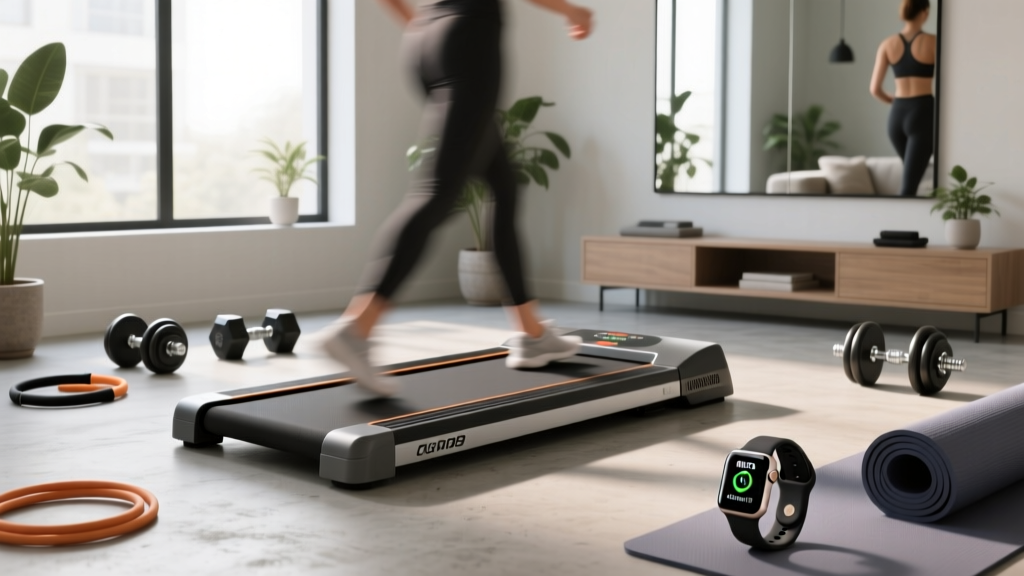
NordicTrack Commercial 2450 Treadmill NTL19125.2 vs Portable Cardio
We break down the budget and value of the NordicTrack Commercial 2450 treadmill NTL19125.2 compared to building a compact portable cardio equipment setup.

The Flagship Dilemma: Big Iron vs. Smart Portability
When outfitting a home gym in 2026, fitness enthusiasts typically face a polarizing choice: invest in a flagship, commercial-grade centerpiece or curate a versatile stack of compact portable cardio equipment options. On one side of the ring sits the NordicTrack Commercial 2450 treadmill NTL19125.2, a 350-pound behemoth boasting a 4.0 CHP motor and a 14-inch HD touchscreen. On the other side is the modern 'portable stack'—a combination of foldable walking pads, under-desk cycles, and smart jump ropes designed for small apartments and nomadic lifestyles.
But which route actually delivers the best return on investment (ROI) for your health and your wallet? In this budget breakdown and value analysis, we dissect the true 3-year cost of ownership, biomechanical limitations, and spatial footprint of both approaches to help you make a data-driven decision.
Quick Verdict Summary
Choose the NTL19125.2 if: You have dedicated space, require structured incline/decline programming for marathon training, and want an immersive, guided iFIT experience.
Choose Portable Cardio if: You live in an apartment, prioritize NEAT (Non-Exercise Activity Thermogenesis) throughout the workday, and want to avoid mandatory monthly software subscriptions.
Budget Breakdown: NordicTrack Commercial 2450 Treadmill NTL19125.2
The sticker price of a flagship treadmill is merely the entry fee. To understand the true value of the NordicTrack Commercial 2450 treadmill NTL19125.2, we must calculate the Total Cost of Ownership (TCO) over a standard 3-year lifecycle.
Upfront and Hidden Costs
- Base Hardware: $2,799 (MSRP, though seasonal sales occasionally drop this to $2,499).
- iFIT Subscription (Family Plan): $396/year. Over three years, that is $1,188. (Note: The machine's interactive features, including automatic incline/decline adjustments and global routes, are heavily gated behind this iFIT Membership paywall).
- Maintenance: Silicone belt lubricant ($15/year) and potential motor board or roller replacements post-warranty ($150-$300).
- Delivery & Assembly: Threshold delivery is often free, but professional in-home assembly and old-equipment haul-away can cost $150.
Estimated 3-Year TCO: ~$4,300 - $4,500.
The Value Proposition
What do you get for $4,500? You get a -3% to 15% incline/decline range, a 22-inch by 60-inch commercial running belt, and a 4.0 CHP motor that can sustain 12 mph sprints without thermal throttling. For serious runners targeting VO2 max improvements and Zone 2 endurance blocks, this machine is a legitimate substitute for outdoor terrain.
The Compact Portable Cardio Equipment Alternative
The 'portable stack' philosophy rejects the idea that cardio requires a massive, stationary footprint. Instead, it leverages compact portable cardio equipment options to integrate movement into your daily environment. Here is a highly effective, budget-friendly 2026 stack:
- UREVO Strol 2E Walking Pad ($399): Features a foldable handlebar, 10% incline, and a top speed of 7.6 mph. It slides under a standard sofa or bed.
- DeskCycle 2 Under-Desk Elliptical ($199): Magnetic resistance pedal machine designed for use while working at a standing or sitting desk.
- CrossRope Smart Jump Rope System ($129): Interchangeable weighted ropes for high-intensity interval training (HIIT) in a 6x6 foot space.
3-Year TCO for the Portable Stack
Estimated 3-Year TCO: ~$727. There are no mandatory subscriptions required to operate these devices, and maintenance is virtually non-existent (occasional battery replacements for digital displays).
Head-to-Head Value Matrix (2026 Pricing)
| Metric | NordicTrack 2450 (NTL19125.2) | Portable Cardio Stack |
|---|---|---|
| Upfront Cost | $2,799 | $727 |
| 3-Year Subscription | $1,188 (iFIT) | $0 |
| Floor Space Required | 20 sq. ft. (Permanent) | 3 sq. ft. (Stored) |
| Max Incline / Decline | 15% / -3% | 10% (Pad) / 0% (Bike) |
| Top Speed Capability | 12.0 mph | 7.6 mph (Pad) |
| Resale Value (Year 3) | ~$800 - $1,200 | ~$250 |
Biomechanics and Fitness Yield: What Does the Science Say?
From a purely financial standpoint, the portable stack wins. But does it deliver the same physiological adaptations? According to the CDC Physical Activity Guidelines, adults need at least 150 minutes of moderate-intensity or 75 minutes of vigorous-intensity aerobic activity per week.
The Case for the Flagship Treadmill
The NTL19125.2 excels at vigorous-intensity training. The 4.0 CHP motor and heavy flywheel provide a stable, shock-absorbing surface necessary for sustained running at 8+ mph. Furthermore, the 15% incline is critical for glute activation and simulating hill climbs, a key component of marathon and ultramarathon training blocks. If your goal is to lower your resting heart rate through high-end Zone 4 and Zone 5 threshold work, the portable stack simply cannot safely accommodate those biomechanical demands.
The Case for Portable Cardio (The NEAT Factor)
Where the portable stack shines is in boosting NEAT (Non-Exercise Activity Thermogenesis). Research from the Mayo Clinic highlights that NEAT—the energy expended for everything we do that is not sleeping, eating, or sports-like exercise—can account for a massive variance in daily caloric expenditure. A walking pad tucked under a standing desk allows a remote worker to accumulate 10,000 to 15,000 steps a day without changing into gym clothes or dedicating a solid hour to 'working out.' For general cardiovascular health, weight management, and metabolic flexibility, the consistent, low-friction usage of a walking pad often yields better long-term adherence than an intimidating, high-intensity treadmill regimen.
'The best cardio machine is the one you will actually use. A $3,000 treadmill that becomes a $3,000 clothes rack has an infinite cost-per-use, whereas a $400 walking pad used daily for two years costs less than $0.60 per session.'
— FitGearPulse Editorial Team, 2026 Home Fitness Report
Space, Logistics, and Hidden Failure Modes
When evaluating value, you must consider the physical environment and the mechanical failure modes inherent to each category.
Spatial and Structural Limits
The NordicTrack 2450 weighs 350 lbs. Add a 200 lb runner, and you are placing 550 lbs of dynamic, bouncing force on your floor joists. If you live in a second-story apartment or an older home, this can cause structural vibrations and noise complaints. The portable stack, weighing less than 70 lbs combined, eliminates this risk entirely and can be stored in a closet or under a bed.
Mechanical Failure Modes
- NTL19125.2 Risks: The primary failure point on heavy-duty treadmills is the motor control board, which can fry if the running belt is not lubricated every 3-6 months, causing excess friction and amp-draw spikes. Additionally, the 14-inch HD touchscreen is a proprietary Android tablet; if the motherboard fails out of warranty, replacement costs exceed $400, and the machine's interactive features are bricked.
- Portable Stack Risks: Walking pads utilize smaller, less robust motors (typically 2.0 to 2.5 HP). They are not designed for running; attempting to jog at 7 mph on a walking pad will rapidly degrade the belt and overheat the motor controller. The DeskCycle relies on simple magnetic resistance, meaning it has virtually zero mechanical failure points.
Final Verdict: Which Setup Maximizes Your ROI?
The value analysis ultimately hinges on your specific fitness profile and living situation in 2026.
Invest in the NordicTrack Commercial 2450 treadmill NTL19125.2 if: You are a dedicated runner, triathlete, or fitness enthusiast who requires structured, high-intensity interval training and hill simulations. You have a dedicated, ground-floor room with adequate clearance, and you view the $396 annual iFIT subscription as a valid replacement for a boutique gym membership or personal trainer.
Build the Compact Portable Cardio Stack if: You are a busy professional, apartment dweller, or someone whose primary goal is metabolic health, daily step accumulation, and avoiding the 'all-or-nothing' trap of traditional gym routines. By spending under $800 total, you eliminate subscription fatigue, reclaim 20 square feet of living space, and seamlessly integrate cardiovascular health into your daily workflow.
More gear to consider
All reviews
The Ultimate Treadmill Motor HP & Deck Def. Buying Guide

ProForm Treadmill Safety Key & Belt Lubrication Guide
NordicTrack Intermix Acoustics 2.0 Treadmill & Portable Cardio Care

ProShox 2 Treadmill vs Elliptical: 2026 Home Cardio Trends

Cycling Machine vs Treadmill: Air & Assault Bike Guide