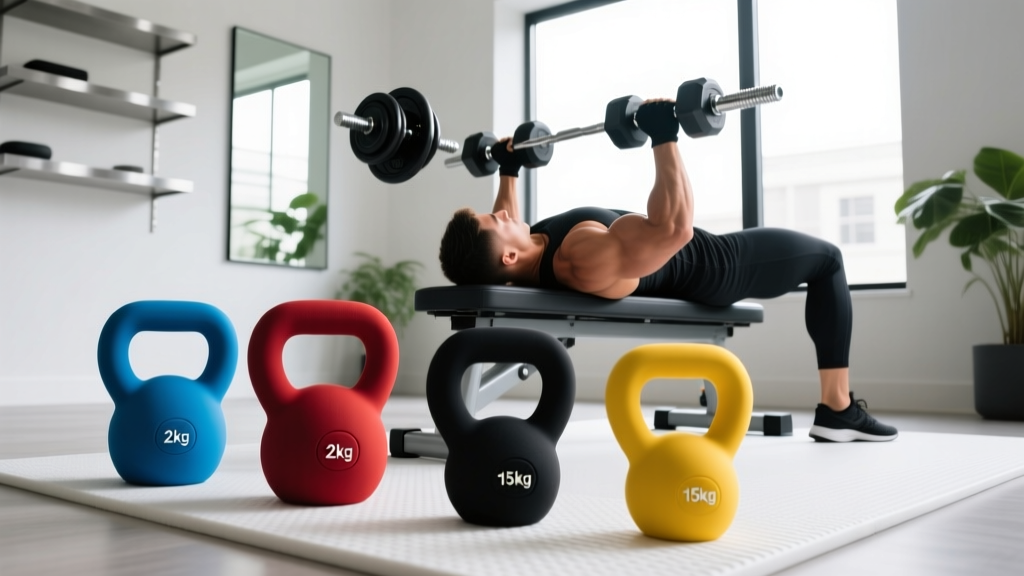
Neoprene Dumbbell Comparison & Dumbbell Bench Press Tutorial
Compare top neoprene dumbbells for home gyms and master your form with our expert dumbbell bench press tutorial for maximum chest hypertrophy.

The Material Science of Neoprene: Why It Dominates Home Gyms
When outfitting a home gym in 2026, the debate over dumbbell coatings usually centers on raw cast iron, rubber, urethane, and neoprene. Neoprene (polychloroprene) has carved out a massive niche for residential use due to its unique balance of cost, floor protection, and tactile grip. Unlike cheap vinyl coatings that crack under temperature fluctuations, or premium urethane that can cost upwards of $3.50 per pound, neoprene typically sits in the $1.50 to $2.50 per pound range. It boasts a durometer hardness rating of roughly 65 to 75 on the Shore A scale, making it soft enough to protect engineered hardwood or rubber matting, yet dense enough to resist tearing during standard handling.
However, not all neoprene dumbbells are manufactured equally. The integrity of the cast iron core, the precision of the mold, and the chemical bonding agent used to adhere the coating to the metal handle dictate the lifespan of the equipment. Below, we break down the top contenders on the market and follow up with a comprehensive dumbbell bench press tutorial to ensure you are maximizing your hypertrophy while protecting your joints.
Head-to-Head: Top 3 Neoprene Dumbbells for Home Use
To help you make an informed purchasing decision, we tested and analyzed the three most popular neoprene-coated dumbbells currently available for home gym setups. We evaluated them based on handle knurling depth, coating durability, and price-to-value ratio.
| Brand & Model | Avg. Price / lb (2026) | Handle Profile | Shape & Core | Best Use Case |
|---|---|---|---|---|
| Yes4All Neoprene Hex | $1.45 - $1.65 | Medium Chrome, Contoured | Hexagonal, Solid Cast Iron | Budget-conscious home gyms, high-rep endurance work |
| SPRI Elite Neoprene | $2.20 - $2.60 | Ergonomic, Color-Coded | Round/Hex Hybrid, Steel Core | Commercial-grade home studios, group fitness, lighter pressing |
| Amazon Basics Neoprene Hex | $1.25 - $1.50 | Standard Chrome, Straight | Hexagonal, Cast Iron | Entry-level buyers, general fitness, circuit training |
Deep Dive: Failure Modes & Edge Cases
Before you buy, you must understand the failure modes specific to neoprene. The most common point of failure is seam splitting at the junction where the handle meets the weighted head. This occurs when users drop the dumbbells laterally. Unlike urethane, which has high tensile elasticity, neoprene can tear away from the metal core if subjected to sheer impact forces. Furthermore, if the internal cast iron core is not properly sandblasted and primed before the polychloroprene is injection-molded, moisture can become trapped, leading to hidden oxidation (rust) that eventually bleeds through the coating and compromises the grip.
Expert Warning: Never drop neoprene dumbbells from the top of a bench press movement. The lateral sheer force will split the coating. Always control the descent and set them on the floor or a rack manually.The Ultimate Dumbbell Bench Press Tutorial
Having the right gear is only half the battle. The dumbbell bench press is a superior movement for chest hypertrophy compared to the barbell bench press because it allows for a greater range of motion (ROM) and independent limb stabilization, reducing bilateral asymmetries. According to biomechanics data cataloged by ExRx.net, the dumbbell variation heavily recruits the pectoralis major (sternal head) while demanding significant activation from the anterior deltoids and triceps brachii.
Step 1: The Setup and Scapular Retraction
Proper setup is non-negotiable for shoulder health and force production. Lie back on a flat bench with your feet planted firmly on the floor, driving through your heels to create full-body tension. Before you unrack the weights, retract your scapulae (pinch your shoulder blades together) and depress them (pull them down toward your hips). This creates a stable, slightly arched platform on the bench, protecting the rotator cuff and placing the pectorals in a mechanically advantageous stretched position.
Step 2: The Knee-Drive Unrack Technique
When using heavier neoprene dumbbells (e.g., 50 lbs and above), do not attempt to curl them into position. Use the knee-drive method:
- Rest the dumbbell heads on your lower thighs, near the knees.
- Lean back onto the bench while simultaneously driving one knee up to 'kick' the dumbbell into the starting position, followed immediately by the other.
- Lock the weights out directly over your shoulder joints, not over your face or lower chest.
Step 3: The Eccentric Descent
Lower the weights with a controlled tempo, aiming for a 2 to 3-second eccentric phase. As you descend, your elbows should not flare out at a 90-degree angle to your torso, which places immense shear stress on the supraspinatus tendon. Instead, tuck your elbows at approximately a 45 to 60-degree angle relative to your torso. Lower the dumbbells until you feel a deep, comfortable stretch in the pectorals, typically when the handles are level with your chest.
Step 4: The Concentric Ascent
Drive the weights back up explosively but under control. Focus on bringing your biceps toward your chin rather than just pushing the weights to the ceiling. This mental cue enhances pectoral adduction. Stop just short of locking out the elbows at the top to maintain constant mechanical tension on the chest muscles, a key driver of hypertrophy as noted in NSCA kinetic chain research.
Grip Nuance for Neoprene Handles: Neoprene handles are often slightly thicker (32mm - 35mm) than raw steel Olympic handles. Ensure your wrists remain perfectly stacked over your forearms. If the thicker grip causes wrist extension (bending backward), wrap your thumbs fully around the handle and squeeze tightly to irradiate tension through the forearm stabilizers.Programming for Hypertrophy vs. Endurance
Because home gyms often have limited weight increments (usually jumping in 5 lb or 10 lb increments with fixed neoprene sets), you must manipulate volume and tempo rather than just adding weight to the bar.
- Hypertrophy (Muscle Growth): Aim for 3-4 sets of 8-12 repetitions. Utilize a Reps in Reserve (RIR) target of 1-2. If your 50 lb dumbbells become too easy for 12 reps, slow the eccentric phase to 4 seconds per rep rather than jumping immediately to the 60 lb pair, which might compromise your form.
- Muscular Endurance: Aim for 2-3 sets of 15-20 repetitions with shorter rest periods (45-60 seconds). This is where lighter neoprene sets (15-30 lbs) excel, particularly for metabolic conditioning circuits.
- Rest-Pause Sets: To maximize fiber recruitment with limited weights, perform a set to failure, rack the dumbbells for 15 seconds, and perform another mini-set to failure. Repeat this 3 times.
Final Thoughts on Gear and Technique
Investing in high-quality neoprene dumbbells like the Yes4All or SPRI Elite lines provides a durable, floor-friendly solution for residential training spaces. However, the gear is only as effective as the biomechanics driving it. By mastering the scapular setup, utilizing the 45-degree elbow tuck, and controlling the eccentric phase outlined in this dumbbell bench press tutorial, you will stimulate maximum chest growth while keeping your shoulder joints healthy for years to come. For further reading on upper-body exercise mechanics and joint safety, the ACE Fitness Exercise Library remains an excellent peer-reviewed resource for home athletes.
More gear to consider
All reviews
Budget Dumbbell Racks: Storing Weights for the Dumbbell Woodchopper

Budget Dumbbell Racks for a Quick 5 Minute Arm Workout with Dumbbells
Power Rack vs Squat Stand: Deltoid Muscle Dumbbell Workouts & Squats

Dumbbell Rack Trends 2026: Storage for Heavy RDLs & Muscles Worked
Olympic Barbell Knurling & Dumbbell Exercises for Bigger Biceps
