Meta Quest Treadmill vs Under Desk Walking Pad: Office Value Review
Is a meta quest treadmill setup worth it? We review under desk treadmills for office use, comparing VR omnidirectional rigs to budget walking pads.

The 'Meta Quest Treadmill' Dilemma: Omnidirectional vs. Under-Desk
As remote work and virtual reality fitness converge in 2026, a new search trend has exploded among home-office workers: the meta quest treadmill setup. Gamifying your daily step count while answering emails or attending virtual meetings sounds like the ultimate productivity hack. However, when users search for a 'meta quest treadmill,' they are often met with two drastically different equipment categories: $2,000+ omnidirectional VR treadmills (like the KAT VR or Virtuix Omni) and $200-$500 under-desk walking pads.
If your primary goal is office use—burning calories while working, reading, or playing stationary VR games like Puzzling Places or Walkabout Mini Golf—do you really need to sacrifice half your home office space and budget on a dedicated VR rig? In this comprehensive budget breakdown and under desk treadmill for office use review, we analyze the true value of merging VR with traditional walking pads, complete with exact measurements, noise metrics, and ergonomic requirements.
Budget Breakdown: Building Your VR Office Walking Setup
To understand the value proposition, we must look at the total cost of ownership for a VR-compatible walking setup in a standard home office. Below is a 2026 market comparison of the three primary routes you can take.
| Setup Configuration | Hardware Cost (2026) | Space Required | Office Multitasking | VR Immersion Level |
|---|---|---|---|---|
| Omnidirectional VR Treadmill + Meta Quest 3 | $2,200 - $3,500 | 8x8 ft minimum | Poor (Requires harness) | High (Room-scale walking) |
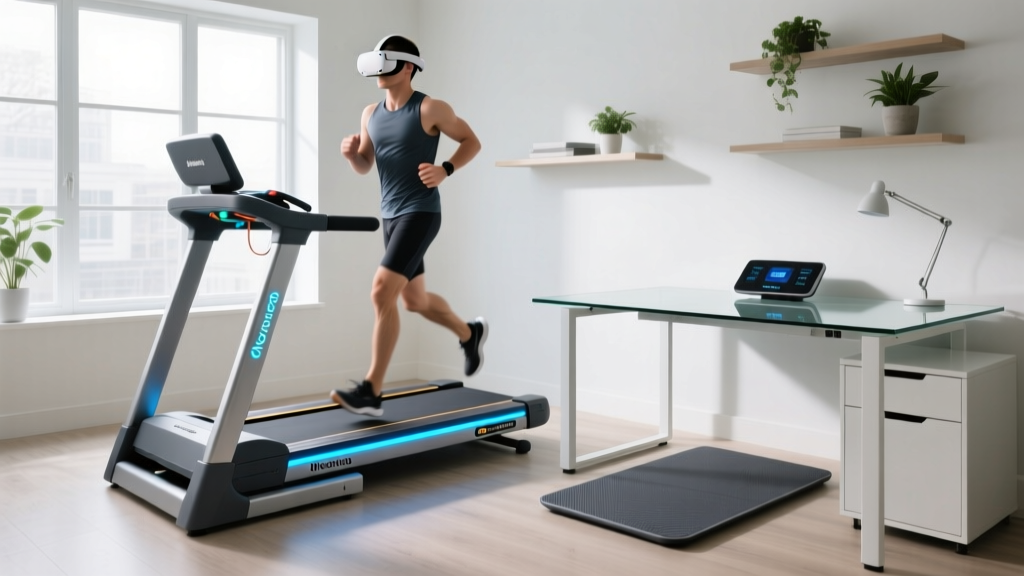
| Premium Under-Desk Treadmill + Meta Quest 3 | $900 - $1,300 | 4x2 ft (Desk footprint) | Excellent (Keyboard/Mouse) | Medium (Stationary mode) |
| Budget Walking Pad + Meta Quest 3S | $450 - $650 | 4x2 ft (Desk footprint) | Good (Light typing) | Medium (Stationary mode) |
The Value Verdict: Unless you are a hardcore VR fitness enthusiast dedicated solely to games like Thrill of the Fight or Les Mills Bodycombat, the omnidirectional treadmill offers terrible ROI for office workers. A premium under-desk treadmill paired with a Meta Quest 3 or 3S provides 90% of the casual VR utility at less than a third of the cost, while actually allowing you to use your keyboard and mouse.
Under Desk Treadmill for Office Use Review: Top 2026 Picks for VR
Not all walking pads can handle the lateral sway of VR gaming or the continuous runtime of an 8-hour workday. When using a Meta Quest headset, your brain's vestibular system is disconnected from your physical surroundings, causing you to drift left or right. Therefore, belt width and motor continuity are critical. Here are the top models evaluated for dual office/VR use.
1. LifeSpan TR1200-DT5 (Best for Heavy, All-Day Office Use)
The LifeSpan TR1200-DT5 remains the gold standard for serious under-desk treadmill users. Unlike budget walking pads that use friction-heavy PVC belts, the TR1200 features a 20-inch wide belt and a 2.0 CHP (Continuous Horsepower) motor designed to run for up to 10 hours a day.
- Price: ~$1,099
- Belt Width: 20 inches (Crucial for VR drift safety)
- Motor: 2.0 CHP (Will not overheat during 3-hour VR sessions)
- Noise Level: ~52 dB at 2.0 mph (Quiet enough for Zoom calls)
- VR Verdict: The 20-inch width is the safest option for VR users who tend to sway laterally while immersed in virtual environments.
2. UREVO Strol 2E (Best Budget for Casual VR & Typing)
UREVO has dominated the budget space, and the Strol 2E offers a surprising amount of stability for its price point. It features a dual-zone design and a foldable handrail, which is incredibly useful when you need to step off quickly after taking off your VR headset.
- Price: ~$279
- Belt Width: 15.7 inches (Narrow; requires strict VR stationary discipline)
- Motor: 2.5 HP Peak (1.25 CHP; limit VR sessions to 90 mins to prevent overheating)
- Noise Level: ~58 dB at 2.5 mph
- VR Verdict: Great for casual VR media consumption or light office walking, but the narrow belt is a tripping hazard if you play active VR games.
3. WalkingPad R2 (Best for Tight Office Spaces)
The WalkingPad R2 is famous for its 180-degree fold-in-half design. If your home office doubles as your living room or bedroom, the ability to slide the treadmill under a sofa when not in use is invaluable. It also includes a physical handrail, providing a tactile anchor point when your eyes are covered by a Meta Quest headset.
- Price: ~$449
- Belt Width: 17.3 inches
- Motor: 1.25 CHP
- Weight Capacity: 240 lbs
- VR Verdict: The handrail is a massive safety plus for VR users. You can keep one hand on the rail to maintain spatial awareness while walking in virtual space.
Ergonomics and Safety: Merging VR with Office Walking
Combining a Meta Quest headset with an under-desk treadmill introduces unique ergonomic and safety challenges that most standard reviews ignore. According to research on workplace ergonomics from Cornell University's Human Factors and Ergonomics Research Group, improper desk height and repetitive strain can negate the health benefits of walking desks. When you add a VR headset to the mix, the complexity multiplies.
Calculating Your Desk Height for VR and Walking
Standard office desks are 29 inches high. Most under-desk treadmills add 4.5 to 5.5 inches of deck height. If you place a treadmill under a standard desk, your walking surface will be 34 inches high, forcing your elbows into an upward angle that causes severe shoulder impingement over time.
The Fix: You must use an adjustable standing desk. To calculate your ideal desk height:
- Stand on the treadmill deck in your walking shoes.
- Bend your elbows to a 90-degree angle (forearms parallel to the floor).
- Measure from the treadmill belt to your elbow. For most adults between 5'6" and 6'0", this measurement falls between 42 and 46 inches.
- Ensure your standing desk can reach this height while maintaining stability. Desks that wobble at 45 inches will cause motion sickness when viewed through a VR lens.
Health ROI: Does the VR Treadmill Setup Actually Work?
The primary argument for investing in a meta quest treadmill setup is the gamification of cardiovascular health. The CDC recommends at least 150 minutes of moderate-intensity aerobic activity per week for adults. Walking at 1.5 to 2.5 mph on an under-desk treadmill while immersed in a relaxing VR environment like Nature Treks VR easily qualifies as moderate activity, elevating the heart rate to 90-110 BPM without inducing the sweat that ruins a workday.
Furthermore, Meta's official safety guidelines emphasize the importance of clearing your physical play space. By confining your VR walking to a dedicated, cable-managed under-desk setup, you eliminate the tripping hazards associated with living room VR fitness, making it a highly sustainable, long-term health investment.
Frequently Asked Questions (FAQ)
Can I play active VR fitness games on an under-desk treadmill?
No. Under-desk treadmills are designed for forward walking at speeds between 0.5 and 4.0 mph. Active VR games that require jumping, lateral lunging, or rapid pivoting (like Beat Saber or Supernatural) are extremely dangerous on a moving belt and will likely void the treadmill's warranty due to impact damage to the deck.
Will the treadmill noise interfere with my Meta Quest audio?
Most premium under-desk treadmills operate between 50 and 60 decibels at walking speeds. The Meta Quest 3's built-in spatial speakers can easily mask this low-frequency hum. However, if you are taking a VoIP call via the headset while walking, you may need a noise-canceling microphone to filter out the belt friction.
Do I need a mat under the treadmill for my home office?
Absolutely. A high-density EVA foam or rubber equipment mat is mandatory. It protects your hardwood or carpet from the treadmill's vibration, dampens the acoustic noise transferred to the floor below, and prevents the treadmill from 'walking' forward across the room during long VR sessions.
Final Verdict: Where is the True Value?
If you are searching for a 'meta quest treadmill' to enhance your home office, skip the $3,000 omnidirectional rigs. They are cumbersome, require massive spatial footprints, and isolate you from your physical workspace. Instead, allocate $400 to $1,100 toward a high-quality under-desk treadmill like the LifeSpan TR1200-DT5 or the WalkingPad R2. Pair it with your Meta Quest 3 in Stationary Mode, and you will unlock a highly effective, budget-friendly way to hit your daily step goals while remaining fully integrated into your remote work environment.
More gear to consider
All reviews
Does Walking on a Treadmill Help You Lose Weight? 2026 Guide

Cardio Treadmill Workouts: 2026 Belt Maintenance & Lubrication Guide

Rowing Buying Guide: Technique vs. Benefits of Treadmill Walking

What Is Inclination in Treadmill Tech? Portable Cardio Value Guide

Optimizing Weight Loss Through Treadmill: Curved vs Motorized 2026