Medicine Ball Weight Selection Guide & Yoga Mat Substitute Tips
Master medicine ball weight selection for your fitness level and discover the best yoga mat substitute for safe, impact-resistant floor workouts at home.

Medicine ball training is a cornerstone of functional fitness, bridging the gap between raw strength and explosive power. Whether you are aiming to increase your rotational velocity for golf and tennis, build bulletproof core stability, or simply add a dynamic cardio element to your home gym, the medicine ball is an unparalleled tool. However, beginners frequently make two critical errors that stall their progress and invite injury: selecting the wrong weight for their specific movement pattern, and performing high-impact floor exercises on inadequate padding.
If you have ever felt your tailbone bruising during Russian twists or your lower back aching during lying chest throws, your flooring is likely the culprit. In this comprehensive guide, we will break down the exact science of medicine ball weight selection and provide a practical framework for finding the perfect yoga mat substitute to protect your joints and your hardwood floors during intense floor-based circuits.
The Beginner’s Medicine Ball Weight Selection Framework
Walking into a fitness store or browsing online retailers in 2026 reveals a dizzying array of weighted spheres. The most common beginner mistake is assuming that heavier is always better. According to guidelines published by the National Strength and Conditioning Association (NSCA), power development requires a delicate balance between load and velocity. If the ball is too heavy, your movement slows down, shifting the stimulus from explosive power to grinding, joint-stressing strength.
Step 1: Match the Weight to the Movement Velocity
To select the correct weight, you must first categorize your primary exercises into one of three buckets:
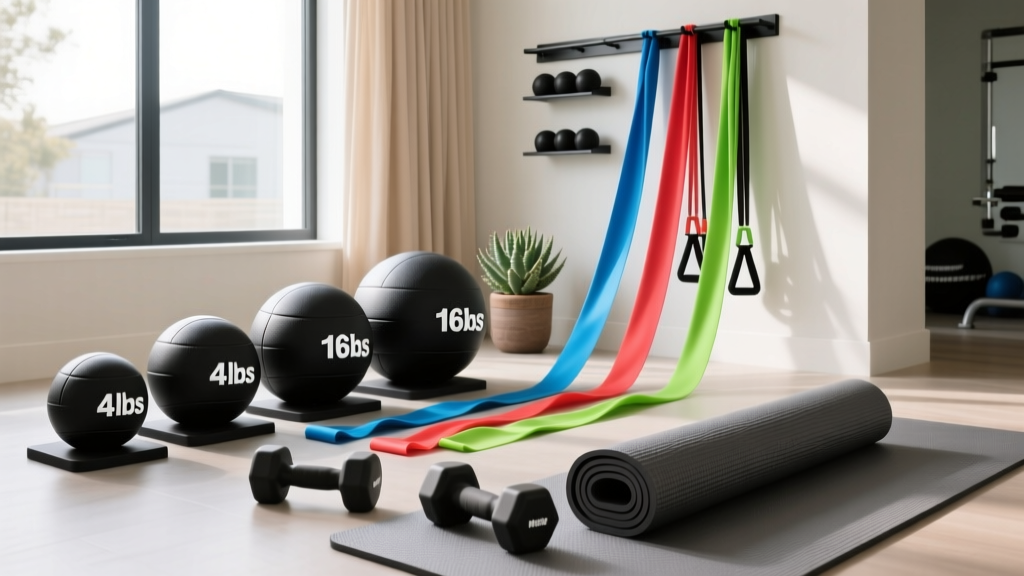
- High-Velocity Throws & Rotations: Exercises like lateral wall tosses, overhead soccer throws, and rotational chops require speed. For these, beginners should stick to the 4 lb to 8 lb range. The goal is to move the implement as fast as possible without compromising spinal posture.
- Core & Floor Control: Movements like Russian twists, V-ups, and dead bugs require sustained muscular tension. A 8 lb to 12 lb ball provides enough resistance to challenge the rectus abdominis and obliques without pulling on the cervical spine.
- Heavy Slams & Squats: For pure force production exercises like overhead slams, wall sits, and goblet squats, you can safely jump to the 15 lb to 25 lb range. These movements rely on large muscle groups (glutes, lats, quads) that can handle heavier absolute loads.
Step 2: Understand Material and Bounce Characteristics
Not all medicine balls are created equal. The material dictates how the ball behaves upon impact, which directly influences safety and exercise selection.
- Sand-Filled Slam Balls (No Bounce): Models like the Rogue Echo Slam Ball ($45–$85 depending on weight) are filled with sand and feature a thick, textured rubber shell. They are designed to absorb impact. Never use these for wall throws, as the lack of rebound will force you to chase the dead weight across the floor.
- Rubber Medicine Balls (High Bounce): Classic models like the CAP Barbell Classic Medicine Ball ($25–$50) feature a bouncy rubber exterior. These are excellent for partner tosses and plyometric push-ups, but can be dangerous for heavy slams as the unpredictable rebound can strike the face.
- Leather/Synthetic Wall Balls (Low Bounce): Used primarily for CrossFit-style wall ball shots, these are softer, larger, and designed to be caught against the chest. They typically range from $60 to $120.
Medicine Ball Weight Selection Matrix
| Exercise Category | Beginner Weight | Intermediate Weight | Best Ball Type | Primary Muscle Focus |
|---|---|---|---|---|
| Lateral Wall Throws | 4 - 6 lbs | 8 - 12 lbs | Bouncy Rubber / Wall Ball | Obliques, Hips |
| Overhead Floor Slams | 10 - 15 lbs | 20 - 30 lbs | Sand-Filled Slam Ball | Lats, Core, Glutes |
| Russian Twists | 6 - 8 lbs | 10 - 15 lbs | Sand-Filled or Rubber | Transverse Abdominis |
| Lying Chest Press | 8 - 10 lbs | 12 - 20 lbs | Sand-Filled Slam Ball | Pectorals, Triceps |
The Flooring Dilemma: Finding the Perfect Yoga Mat Substitute
When performing floor-based medicine ball exercises like lying chest throws, V-ups, or overhead slams, joint protection is non-negotiable. Many beginners attempt these on a standard 3mm PVC yoga mat, only to find it completely compresses under the concentrated load of a 15-pound ball and their body weight. The American Council on Exercise (ACE) emphasizes that maintaining spinal neutrality and protecting bony prominences (like the sacrum and tailbone) is critical during weighted core work.
If you are building a budget-friendly home gym, working out in a garage, or simply need a more durable yoga mat substitute for high-impact med ball routines, you must prioritize density and thickness over thin stickiness. Here are the top three alternatives that outperform standard yoga mats for weighted floor work.
1. Interlocking EVA Foam Tiles (3/4-Inch Thickness)
Standard puzzle mats are usually 1/2-inch thick and bottom out under heavy loads. Upgrading to 3/4-inch (18mm) high-density EVA foam tiles provides the necessary shock absorption for dropping slam balls and cushioning the spine during V-ups. Brands like BalanceFrom or ProSourceFit offer 24-square-foot kits for around $35 to $50. They are modular, meaning you can easily expand your flooring as your home gym grows, and they can be wiped clean with standard gym disinfectant.
2. High-Density Folding Gymnastics Mat
If you need a portable yoga mat substitute that you can fold away into a closet after your workout, a 1.5-inch to 2-inch thick folding gymnastics mat is the gold standard. Priced between $60 and $90, these mats feature a durable vinyl shell encasing high-density EPE foam. They provide exceptional protection for the tailbone during Russian twists and completely eliminate the risk of a dropped slam ball denting your hardwood or laminate flooring.
3. The Household Hack: Layered Wool Moving Blankets
If you are on a strict zero-dollar budget and need an immediate substitute, skip the thin beach towels. Instead, use heavy-duty, quilted moving blankets (often made of dense cotton-wool blends). Folding a premium moving blanket in half creates a dense, 1/2-inch pad that grips the floor better than a towel and provides surprising shock absorption for lying chest throws. While not a permanent solution, it is vastly superior to a standard 3mm yoga mat for heavy floor work.
Expert Tip: When testing your yoga mat substitute for medicine ball work, perform the 'Knee Drop Test'. Kneel on the mat and drop your full body weight onto your knees. If you feel the hard floor immediately, the padding is insufficient for protecting your spine during weighted V-ups or lying throws.Step-by-Step: Your First Medicine Ball Floor Circuit
Now that you have selected the correct weight and secured a proper yoga mat substitute for flooring, it is time to put it into practice. This beginner-friendly circuit targets the entire anterior chain and core, requiring minimal space and just one slam ball or rubber medicine ball (8–12 lbs).
Exercise 1: Lying Chest Throw (3 Sets of 10 Reps)
- Lie flat on your back on your EVA foam tiles or folding mat, knees bent, feet flat on the floor.
- Hold the medicine ball directly over your chest with arms extended.
- Lower the ball until it lightly taps your sternum, then explosively press it upward toward the ceiling.
- Form Cue: Keep your lower back pressed firmly into the mat substitute to prevent lumbar hyperextension.
Exercise 2: Med Ball Russian Twists (3 Sets of 16 Reps)
- Sit on your mat substitute, leaning back to a 45-degree angle, feet hovering slightly off the floor.
- Hold the ball with both hands at chest level.
- Rotate your torso to tap the ball lightly on the floor to your right, then twist all the way to the left.
- Form Cue: Follow the ball with your eyes to ensure your cervical spine rotates naturally with your thoracic spine.
Exercise 3: Dead Bug with Med Ball Squeeze (3 Sets of 12 Reps)
- Lie on your back, holding the medicine ball between your palms with arms extended toward the ceiling.
- Raise your legs to a tabletop position (knees bent at 90 degrees).
- Slowly lower your right arm and left leg toward the floor while aggressively squeezing the ball with your hands to generate core tension.
- Return to the start and switch sides.
Common Beginner Mistakes to Avoid
Even with the right equipment and a premium yoga mat substitute, poor technique can derail your progress. Avoid these three common pitfalls:
- Using Momentum Over Muscle: When performing floor twists, beginners often rock their hips to swing the ball. Slow the tempo down. A 3-second eccentric phase (lowering the ball) will yield far better core hypertrophy than 20 rapid, sloppy reps.
- Ignoring Grip Fatigue: Sand-filled slam balls have thick, textured rubber that can tear up your calluses during high-rep floor work. If your grip fails before your core does, consider using a slightly smaller diameter ball or incorporating grip-strengthening accessories into your routine.
- Forgetting to Brace: Treat every floor exercise like a heavy squat. Take a deep breath into your diaphragm and brace your core before initiating the movement to protect your lumbar spine from shear forces.
Final Thoughts on Gear and Safety
Mastering medicine ball training is about the intelligent intersection of load, velocity, and environmental safety. By respecting the weight selection matrix and refusing to compromise on your flooring—opting for a high-density yoga mat substitute over flimsy alternatives—you set the stage for years of explosive, injury-free progress. Invest in the right sand-filled or rubber ball for your specific goals, lay down the proper EVA foam or folding mat, and start building functional power today.
More gear to consider
All reviews
Medicine Ball Weight Selection & Standard Yoga Mat Measurements

Jade Yoga Travel Yoga Mat vs Medicine Balls: Weight Selection Guide

Daiso Yoga Mat Review & Foam Roller Density Guide

Pull-Up Assist Band Sizing & Bala Yoga Mat Reviews: 2026 Guide

Home Gym Sizing: Pull-Up Bands & How Wide Is A Yoga Mat