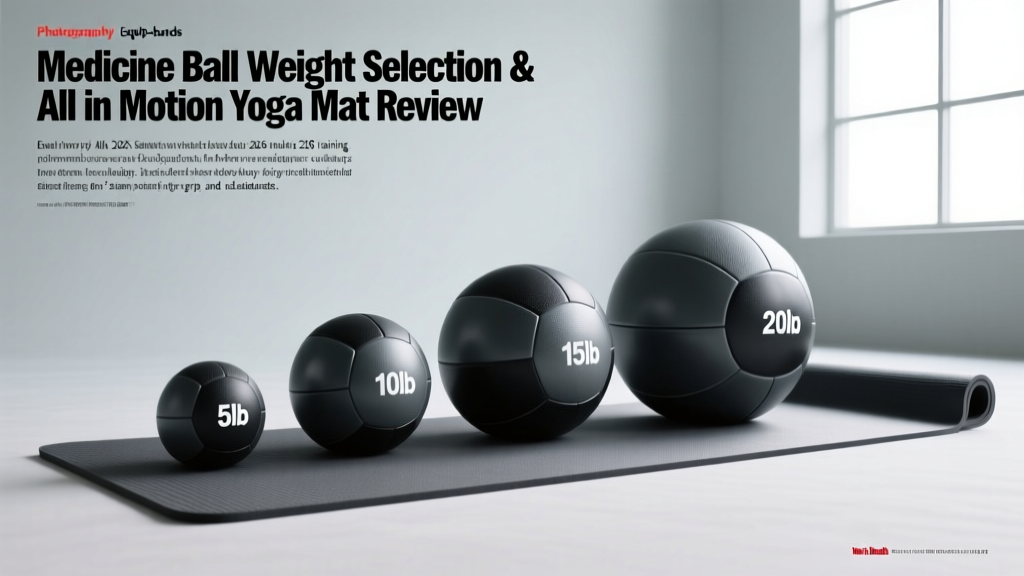
Medicine Ball Weight Selection & Infrared Yoga Mat Recovery
Avoid common medicine ball weight selection mistakes. Learn exact weight ranges, troubleshoot form failures, and pair workouts with an infrared yoga mat.

The Physics of Failure: Why Your Medicine Ball Weight is Wrong
Medicine ball training remains a cornerstone for developing rotational power, core stability, and explosive hip extension. Yet, walk into any commercial or garage gym in 2026, and you will consistently see athletes making critical errors in weight selection. The fundamental misunderstanding lies in the force-velocity curve. Power is the product of force (mass) and velocity. If you select a medicine ball that is too heavy, your movement velocity drops to near zero. You are no longer training explosive power; you are simply performing a slow, grinding strength movement that places undue shear force on your lumbar spine.
This comprehensive troubleshooting guide will diagnose your medicine ball mistakes, provide an exact weight selection matrix, and explain how to integrate an infrared yoga mat into your post-workout recovery protocol to mitigate the severe eccentric loading these exercises cause.
The 3 Most Common Medicine Ball Selection Mistakes
Mistake 1: Confusing Mass with Velocity (The Power Leak)
When performing rotational throws against a wall or overhead slams, the goal is maximal acceleration. Many lifters grab a 20lb (9kg) or 30lb (14kg) ball for Russian twists or lateral wall throws because they equate 'heavier' with 'better.' This is a catastrophic error for the transverse plane. According to biomechanical data published by the ExRx Medicine Ball Throw guidelines, optimal power output for rotational throws typically peaks between 4kg and 6kg (9-13 lbs) for advanced athletes. Exceeding this forces the lumbar spine to compensate for the lack of hip rotation speed, leading to L4-L5 disc compression.
Mistake 2: The 'Bounce-Back' Hazard (Material vs. Weight)
Weight selection is useless if you choose the wrong material. Medicine balls generally fall into three categories: rubber bounce balls (e.g., Rogue Fitness Echo Medicine Balls, $125), soft-shell wall balls (e.g., Dynamax, $135), and sand-filled dead-bounce slam balls (e.g., TRX HexGrip Slam Balls, $80). A common and dangerous mistake is using a high-bounce rubber ball for overhead slams. The kinetic energy transfer upon hitting the concrete floor will cause the ball to rebound violently, resulting in facial fractures or broken wrists.
⚠️ SAFETY WARNING: Never use a pressurized rubber medicine ball for floor slams. If your workout includes overhead slams, you MUST select a 'dead-bounce' slam ball filled with iron sand. The weight should be 10-20% lighter than your standard wall ball to account for the lack of rebound assistance.Mistake 3: Ignoring Grip Ergonomics at Higher Weights
Once you cross the 20lb threshold, the diameter of the ball becomes a limiting factor. A standard 35cm diameter medicine ball becomes difficult to secure during chest passes. If your fingers are slipping, your forearms fatigue before your core or chest. Troubleshooting this requires switching to hex-grip or textured PVC-coated medicine balls when moving above 15kg (33 lbs).
Troubleshooting Your Medicine Ball Mechanics
If you are experiencing pain or poor performance, use this diagnostic checklist to troubleshoot your form and equipment pairing:
- Symptom: Wrist pain during chest passes.
Troubleshooting: You are catching the ball with your wrists in extension (bent backward). Keep wrists neutral and absorb the ball's momentum by letting your elbows bend and retract toward your ribs. - Symptom: Lower back arching during overhead slams.
Troubleshooting: Your lats and core lack the mobility to reach full overhead extension. You are compensating by hyperextending the lumbar spine. Reduce the weight by 50% and focus on rib-cage depression. - Symptom: Loss of balance on rotational throws.
Troubleshooting: Your stance is too narrow. Widen your base to 1.5x shoulder width and ensure you are pivoting the lead foot (squashing the bug) to transfer force from the ground up.
The 2026 Weight Selection Matrix by Exercise Type
Use this data-driven matrix to select the correct weight and ball type for your specific training adaptation. Weights listed are for intermediate-to-advanced lifters; beginners should reduce these numbers by 30-40%.
| Exercise | Optimal Weight Range | Required Ball Type | Primary Adaptation |
|---|---|---|---|
| Lateral Wall Throws | 4kg - 8kg (9-18 lbs) | Soft Shell / Bounce | Rotational Power |
| Overhead Floor Slams | 6kg - 15kg (15-33 lbs) | Dead-Bounce Sand | Hip Extension / Core |
| Chest Pass (Partner) | 6kg - 12kg (15-26 lbs) | Rubber Bounce | Upper Body Explosiveness |
| Russian Twists (Floor) | 4kg - 10kg (9-22 lbs) | Soft Shell / Hex-Grip | Core Endurance |
| V-Ups / Sit-Up Throws | 3kg - 6kg (6-13 lbs) | Soft Shell | Flexion Power |
Active Recovery: Integrating the Infrared Yoga Mat
High-volume medicine ball slams and rotational throws place immense eccentric and isometric loads on the spinal erectors, latissimus dorsi, and obliques. In 2026, the gold standard for mitigating the resulting delayed onset muscle soreness (DOMS) isn't just static stretching or foam rolling; it's targeted thermal therapy. This is where an infrared yoga mat becomes a non-negotiable tool in the modern athlete's recovery arsenal.
Unlike traditional heating pads or hot baths that only warm the epidermis, a high-quality infrared yoga mat—such as the HigherDOSE Infrared Mat ($199) or the Pluviostyle Heated Mat—leverages far-infrared (FIR) light in the 880nm wavelength range. This specific wavelength penetrates up to 1.5 inches deep into the muscle belly and fascia. According to research highlighted by Harvard Health Publishing, deep tissue heat promotes localized vasodilation, increasing blood flow to damaged tissues and accelerating the clearance of metabolic waste products like lactate and hydrogen ions.
"Transitioning immediately from a heavy medicine ball power block to 20 minutes of supine rest on an infrared yoga mat set to 135°F drastically reduces next-day spinal stiffness. The FIR heat relaxes the hypertonic erector spinae muscles that were forced to stabilize the spine during rapid deceleration phases of the slam."
Recovery Protocol: After your final medicine ball set, spend 5 minutes cooling down your heart rate. Then, lay supine on your infrared yoga mat for 15-20 minutes. Focus on diaphragmatic breathing to engage the parasympathetic nervous system. The combination of deep-penetrating heat and core stabilization recovery ensures your central nervous system is primed for your next training session.
FAQ: Troubleshooting Edge Cases
Can I use a basketball or soccer ball for medicine ball drills?
No. Standard sports balls lack the necessary mass to provide a strength or power stimulus, and their high-pressure air bladders make them dangerously unpredictable when thrown against hard surfaces at high velocities. Furthermore, the slick surface will cause grip failures, leading to finger hyperextension injuries. Always use properly weighted, textured fitness balls.
How do I clean my infrared yoga mat after a sweaty recovery session?
Because infrared yoga mats contain internal heating elements and wiring, they cannot be submerged in water or put in a washing machine. After your post-slam recovery session, wipe the mat down with a damp microfiber cloth and a mild, non-toxic cleaner (like a 50/50 mix of water and white vinegar). Avoid harsh chemical degreasers or abrasive scrubbers, which can degrade the waterproof outer layer and expose the internal carbon heating panels to moisture.
Why does my medicine ball smell like chemicals?
If you recently purchased a heavy-duty rubber slam ball (like those from Rogue or Rep Fitness), the strong odor is due to 'off-gassing' of the vulcanized rubber and manufacturing adhesives. Troubleshooting this is simple: wipe the ball with a damp cloth, then leave it outdoors in a shaded, well-ventilated area for 48 to 72 hours. Do not leave it in direct sunlight, as UV exposure will dry out the rubber and cause micro-cracking, eventually leading to the ball splitting open during a heavy slam.
More gear to consider
All reviews
Pull Up Assist Band Sizing & DIY Yoga Mat Holder Pattern

Stability Ball vs BOSU Ball: Value Beyond a Whole Foods Yoga Mat

Jump Rope Types Guide: Speed, Beaded, Weighted & Yoga Mats Cleaning
Pull-Up Assist Band Sizing: Pairing with Ideal Yoga Mat Thickness

Jump Rope Troubleshooting: Why a Free Yoga Mat Ruins Speed Ropes