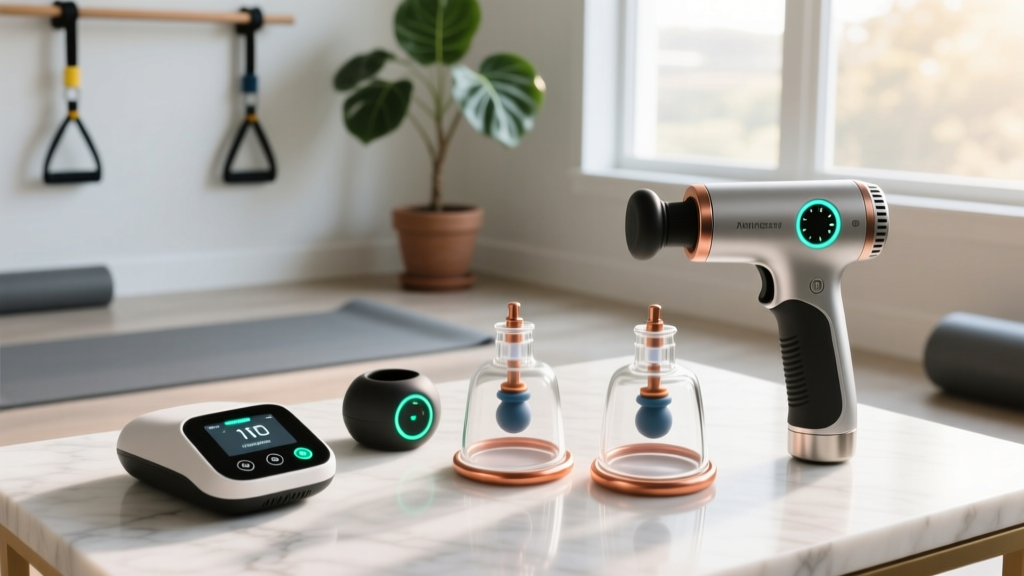
Massage Gun During Pregnancy: Percussion vs Vibration Value
Analyze the budget and value of using a massage gun during pregnancy. Compare percussion vs vibration therapy for safe, cost-effective prenatal relief.

The Biomechanics of Prenatal Relief: Percussion vs. Vibration
Evaluating the value of a massage gun during pregnancy requires a fundamental understanding of how your body's biomechanics shift over three trimesters. As the hormone relaxin increases to prepare the pelvis for childbirth, it causes systemic ligament laxity. This leads to joint instability, shifted center of gravity, and compensatory lumbar lordosis (lower back arching), resulting in severe muscular tension in the thoracolumbar fascia and upper trapezius.
When seeking recovery technology, expecting mothers are often caught between two distinct modalities: percussion therapy and vibration therapy. While marketing materials often use the terms interchangeably, their mechanical outputs and prenatal safety profiles are vastly different.
⚠️ CRITICAL SAFETY WARNING: The American College of Obstetricians and Gynecologists (ACOG) notes that pregnancy induces a hypercoagulable state, significantly increasing the risk of Deep Vein Thrombosis (DVT). Never use high-amplitude percussion therapy on the calves or deep thigh muscles during pregnancy, as aggressive mechanical force can dislodge an undiagnosed blood clot. Always consult your OB-GYN before introducing percussive devices to your lower extremities.Percussion Therapy: High Amplitude, Deep Force
True percussion therapy involves rapid, concentrated strikes with an amplitude ranging from 12mm to 16mm, delivering up to 40 pounds of stall force. Devices like the Theragun PRO operate at speeds up to 2400 RPM (40 Hz). While exceptional for breaking down post-workout fascial adhesions, this aggressive mechanical input can trigger the myotatic stretch reflex. In joints already destabilized by relaxin, deep percussive strikes can cause micro-trauma or exacerbate pelvic girdle pain.
Vibration Therapy: Low Amplitude, Neurological Soothing
Vibration therapy utilizes surface-level oscillation (typically 0mm to 3mm amplitude) at higher frequencies (up to 90 Hz). Rather than mechanically forcing muscle fibers apart, vibration stimulates the Golgi tendon organs and Pacinian corpuscles, effectively overriding pain signals to the brain (the Gate Control Theory of pain). For prenatal tension headaches, upper back spasms, and gentle lymphatic drainage, vibration is vastly superior and significantly safer.
Budget Breakdown: Calculating the Prenatal ROI
From a purely financial perspective, spending $600 on a top-tier percussive device for a 9-month window where its primary feature (deep percussion) is largely contraindicated represents poor capital allocation. The highest ROI comes from devices that offer versatile low-speed settings, soft attachments, or dedicated vibration modes.
| Device Model (2026 Pricing) | Retail Cost | Amplitude | Lowest RPM / Hz | Prenatal Value Rating |
|---|---|---|---|---|
| Theragun PRO (Gen 5) | $599 | 16mm | 1750 RPM (29Hz) | Low (Overkill for prenatal) |
| Hyperice Hypervolt 2 | $299 | 14mm | 1750 RPM (29Hz) | Medium (Quiet, but firm) |
| Bob and Brad Q2 Mini | $119 | 7mm | 1800 RPM (30Hz) | High (Excellent budget pick) |
| Renpho R3 Active | $89 | 10mm | 1800 RPM (30Hz) | Medium-High (Great entry) |
| Hyperice Vyper 3 (Roller) | $199 | 0mm (Vibration) | 45Hz - 90Hz | High (Safest for lymphatic) |
The "Dampener Hack": Converting Percussion to Vibration on a Budget
Most consumers do not realize that you do not need to buy a specialized, expensive vibration tool to achieve safe prenatal relief. You can manipulate the mechanical output of a budget-friendly percussion gun using attachment swapping.
According to guidelines on prenatal massage safety, gentle, broad pressure is preferred over deep, localized trigger point work. Here is how to maximize the value of a $119 device like the Bob and Brad Q2:
- Step 1: Attach the Pneumatic Dampener. Never use the standard EVA foam ball or the hard bullet/cone attachment during pregnancy. The dampener (often included with mid-tier and premium guns) absorbs up to 60% of the stall force, effectively muting the 16mm "strike" into a soft oscillation.
- Step 2: Set Speed to Level 1. Cap the device at its lowest RPM (usually around 1750-1800 RPM). This keeps the frequency below 30Hz, which is soothing rather than stimulating.
- Step 3: Use the "Floating" Technique. Do not press the device into the tissue. Let the weight of the gun rest on the upper trapezius or rhomboids. The resulting sensation mimics a high-frequency vibration massage rather than a deep percussive strike.
Strategic Value: The Prenatal-to-Postpartum Pivot
The true value analysis of a recovery tool must extend beyond the 40 weeks of gestation. Postpartum recovery introduces entirely different biomechanical demands: nursing-induced cervical flexion ("nursing neck"), repetitive lifting of an increasingly heavy infant, and core rehabilitation.
"A budget-friendly, low-amplitude massage gun purchased in the first trimester for gentle upper-back vibration becomes an indispensable, high-amplitude percussive tool for postpartum postural fatigue. The cost-per-use plummets when viewed through a 24-month lens."
Where to Allocate Your Remaining Budget
If you have a total recovery budget of $300 for your pregnancy, do not spend it all on a premium massage gun. A smarter allocation strategy for 2026 looks like this:
- $89 - Renpho R3 or Bob and Brad Q2: For upper back, neck, and shoulder vibration therapy (using the dampener hack).
- $45 - Premium Compression Socks (e.g., Figs or 2XU): Graduated compression (20-30 mmHg) is vastly more effective and safer for managing lower-leg edema and DVT prevention than any percussive device.
- $60 - Supportive Pregnancy Pillow (e.g., PharMeDoc): Essential for maintaining neutral spinal alignment during side-sleeping, reducing the morning need for percussive therapy on the lumbar spine.
Real-World Troubleshooting: Edge Cases and Failure Modes
When using percussive or vibrating tools while expecting, users frequently encounter specific failure modes that diminish the tool's value or introduce risk:
1. The Sciatica Misconception
The Error: Applying high-speed percussion directly to the gluteal region to relieve sciatic nerve pain. The Reality: The sciatic nerve runs deep beneath the piriformis. Aggressive percussion can cause localized inflammation that actually increases nerve compression. The Fix: Use a low-speed vibration setting on the surrounding musculature (hamstring origin, lower lumbar erectors) to promote blood flow without directly agitating the nerve pathway.
2. Abdominal Proximity and Acoustic Startle
The Error: Using the device on the lower rib cage or obliques while lying supine or semi-reclined. The Reality: While the mechanical force won't penetrate the amniotic sac, the acoustic noise of a budget motor (which can exceed 75 decibels on cheaper models) placed near the abdomen can trigger an acoustic startle reflex in a third-trimester fetus. The Fix: Invest in a device with a brushless motor rated below 60 decibels (like the Hypervolt or Theragun lines), or restrict use to the upper thoracic spine and cervical regions while seated.
Frequently Asked Questions
Can I use a massage gun on my lower back while pregnant?
You should avoid direct percussion on the lumbar spine and the sacroiliac (SI) joints. The ligaments supporting the SI joint are highly lax during pregnancy. Direct mechanical force can cause joint subluxation. Stick to the muscular bellies of the upper back (rhomboids, mid-trapezius) using gentle vibration.
Is vibration therapy safe for swelling in my feet and ankles?
While gentle, sweeping manual massage is safe for edema, localized mechanical vibration or percussion on the lower legs carries the aforementioned DVT risk. For lower extremity swelling, pneumatic compression boots (like the Normatec Go) set to the lowest pressure gradient (30-40 mmHg) offer a safer, more effective value proposition for lymphatic drainage than a massage gun.
What is the most cost-effective attachment for prenatal use?
The pneumatic dampener or the "soft ball" attachment. Avoid the fork (spine attachment), bullet (trigger point), and flat head (dense muscle) attachments entirely until you are fully recovered postpartum.
More gear to consider
All reviews
How to Use Massage Gun on Legs & Trigger Point Balls for Longevity
Aura Massage Gun Setup Walkthrough & Buyer's Comparison Guide

Optimize Your Massage Gun Routine With Stretching Equipment

Reebok Massage Gun Review: 5 Buyer Mistakes to Avoid

Infrared Sauna Blanket Guide & Cotsoco Massage Gun Mistakes