
How to Use Massage Gun on Legs & Trigger Point Balls for Longevity
Learn how to use massage gun on legs alongside trigger point balls for deep tissue maintenance, injury prevention, and long-term muscle longevity.

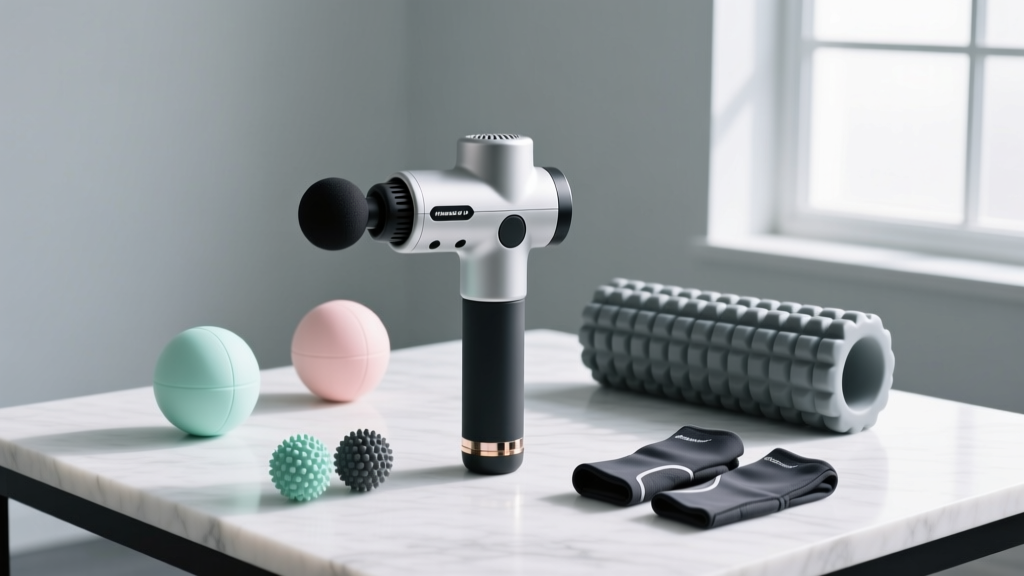
When building a sustainable recovery routine, understanding the synergy between different modalities is critical. Many athletes know how to use massage gun on legs to flush out metabolic waste, but rely solely on percussion at the expense of localized fascial release. To achieve true long-term muscle longevity and joint health, percussion must be paired with trigger point therapy tools and balls. This comprehensive guide breaks down the biomechanics, tool selection, and exact protocols for maintaining your lower body kinetic chain.
The Biomechanics of Leg Maintenance: Percussion vs. Ischemic Compression
To maintain leg health over decades of training, you must address both fluid dynamics and structural adhesions. Percussive devices and trigger point tools achieve these goals through entirely different physiological mechanisms.
Percussive Therapy (Fluid Dynamics)
Massage guns utilize rapid bursts of pressure (measured in RPMs and stall force) to stimulate blood flow, activate the Golgi tendon organ, and down-regulate the sympathetic nervous system. According to the Cleveland Clinic, percussive therapy is highly effective for increasing localized circulation and temporarily improving range of motion by reducing neural tone in overactive muscles.
Trigger Point Therapy (Ischemic Compression)
Trigger point balls apply sustained, localized pressure to myofascial trigger points (hyperirritable nodules within a taut band of skeletal muscle). This creates a temporary ischemic state; when the pressure is released, a reactive hyperemia (rush of oxygenated blood) occurs, flushing out inflammatory cytokines and mechanically breaking up cross-linked collagen adhesions. As noted in clinical Physio-pedia guidelines on Self-Myofascial Release, sustained pressure is mandatory for altering the viscoelastic properties of the fascia.
How to Use Massage Gun on Legs for Preventative Maintenance
Knowing how to use massage gun on legs correctly prevents nerve irritation and maximizes tissue health. In 2026, top-tier devices like the Theragun PRO Plus ($599) and Hyperice Hypervolt 2 Pro ($549) offer adjustable stall forces (up to 60 lbs) and variable speeds. Here is the anatomical mapping for leg maintenance:
- Quadriceps (Rectus Femoris & Vasti): Use the Standard Ball attachment. Set speed to 2200-2400 RPM. Glide slowly (1 inch per second) from the hip flexor down to the patellar tendon. Stop 2 inches above the knee cap.
- Hamstrings: Use the Dampener attachment to soften the impact. Set speed to 1750 RPM. Focus on the muscle bellies, avoiding the direct back of the knee (popliteal fossa) where major nerves and arteries reside.
- Calves (Gastrocnemius & Soleus): Use the Fork attachment to straddle the Achilles tendon, or the Dampener for the muscle bellies. Keep speed at 1750 RPM. Never apply direct percussion to the Achilles tendon itself, as repetitive micro-trauma can induce tendinopathy.
- IT Band & TFL: The Iliotibial band is a thick fascial tract, not a muscle. Do not aggressively hammer it. Use the Dampener on a low setting (1200 RPM) over the Tensor Fasciae Latae (TFL) near the hip, and lightly glide down the lateral thigh.
Integrating Trigger Point Therapy Tools and Balls
While massage guns flush the tissue, trigger point tools and balls are required to 'un-glue' stubborn fascial adhesions that restrict joint mechanics. Selecting the right tool depends on the required durometer (hardness) and surface area.
Tool Selection Matrix
| Tool Type | Best Model/Example | Avg Cost | Best For (Legs) | Pressure Profile |
|---|---|---|---|---|
| Standard Lacrosse Ball | Champion Sports / Kieba | $8 - $15 | Glutes, Piriformis, Calves | High (Hard rubber, ~70A Shore) |
| Dual-Sphere Roller | Rad Roller / 5 BILLION | $30 - $45 | Paraspinals, Hamstring origins | Medium (Silicone, ~50A Shore) |
| Vibrating Wave Roller | Theragun Wave Roller | $149 | Quads, IT Band, Calves | Variable (Vibration + Grid texture) |
| Knobbed Massage Ball | Hyperice Vyper 3 | $199 | Deep Soleus, Plantar Fascia | High (Targeted nodules + vibration) |
For deep leg maintenance, the Rad Roller ($40) is exceptional for targeting the hamstring insertions near the ischial tuberosity (sit bones) without compressing the sciatic nerve. For the lower leg chain, a standard lacrosse ball is unmatched for releasing the plantar fascia, which directly impacts calf and Achilles tension.
The 15-Minute Leg Longevity Protocol
To integrate both modalities for maximum tissue health, follow this sequential routine post-training or on active recovery days. The sequence matters: always use the massage gun first to increase tissue temperature and blood flow, then use the trigger point balls to address specific restrictions.
- Global Flush (5 Minutes): Use the Theragun/Hypervolt with the Dampener on all major leg muscle groups (quads, hamstrings, calves) at 1750 RPM. Spend 45 seconds per muscle group.
- Plantar Fascia Release (2 Minutes): Stand and roll a firm lacrosse ball under the arch of each foot. Apply 50% of your body weight. When you find a tender nodule, hold static pressure for 30 seconds.
- Glute/Piriformis Trigger Point (4 Minutes): Sit on the floor, place a lacrosse ball under the gluteus medius (side of the hip). Cross your ankle over the opposite knee (figure-4 position) to expose the deep rotators. Hold on tender points for up to 60 seconds until the pain threshold drops by 50%.
- Calf/Soleus Pinpoint (4 Minutes): Sit with legs extended. Place a dual-sphere roller or vibrating ball under the thickest part of the calf. Slowly dorsiflex and plantarflex your ankle (point and flex toes) while resting on the ball to create 'flossing' of the fascial layers.
Maintenance Care for Your Recovery Tools
Longevity applies to your equipment as much as your body. High-end recovery tools require specific maintenance to ensure they last beyond their standard 1-to-2-year warranties.
- Lithium-Ion Battery Care: The batteries in devices like the Theragun PRO Plus degrade if stored at 0% or 100% charge for long periods. If you are traveling or not using the device for a month, store it at a 50% charge in a cool, dry environment (ideally 60-70°F).
- Sanitizing Attachments and Balls: Sweat and dead skin cells harbor bacteria that can cause folliculitis on your legs. Wipe down massage gun attachments with a 70% isopropyl alcohol wipe after every use. For porous rubber lacrosse balls, wash them weekly in warm water with a mild antibacterial soap; avoid harsh bleach which degrades the rubber matrix.
- Motor Housing Dust: Percussive devices pull in ambient air to cool the internal brushless motors. Every 6 months, use compressed air to blow out the ventilation grilles on the back of the device to prevent thermal throttling and motor burnout.
Summary: The Synergistic Approach to Leg Health
Mastering how to use massage gun on legs is only half the equation for lifelong mobility. By combining the vascular flushing of percussive therapy with the structural remodeling of trigger point therapy tools and balls, you create a comprehensive maintenance ecosystem. Investing the 15 minutes a day into this synergistic protocol will drastically reduce your risk of compensatory movement patterns, chronic tendonitis, and fascial restrictions, keeping your legs resilient for years to come. For more on foundational movement prep, consult resources from the Hyperice educational blog or certified physical therapy guidelines.
More gear to consider
All reviews
Infrared Sauna Blanket & Panel Setup: No Flash Disk Recovery Tool

Avoiding Massage Gun Dangers: Best Trigger Point Tools & Balls

Beginner Guide: Infrared Sauna Panels & Sciatic Massage Gun

Normatec vs Hyperice Recovery Boots & the Best 16 Head Massage Gun
8 Head Massage Gun vs Trigger Point Balls: 2026 Value Breakdown
