
Elliptical vs Treadmill: 2026 Trends & LSRZ Sport Treadmill Data
Analyzing 2026 elliptical vs treadmill trends, joint impact data, and the market rise of compact budget models like the LSRZ Sport treadmill for home use.

The 2026 Home Cardio Paradigm Shift
The home fitness equipment market has undergone a radical transformation by 2026. While the 2020-2023 era was defined by massive, $3,000 commercial-grade clones dominating suburban garages, today's consumer prioritizes spatial efficiency, acoustic dampening, and multi-functional micro-cardio. This shift has reignited the classic debate: elliptical vs treadmill for home cardio. However, the context of this debate has changed. We are no longer just comparing the NordicTrack Commercial 1750 to the Bowflex Max Trainer. Instead, market analysts are tracking a massive surge in ultra-compact, budget-friendly alternatives, with the LSRZ Sport treadmill line emerging as a primary case study in how entry-level engineering is disrupting traditional floor plans.
2026 Market Data Highlight
According to recent consumer hardware tracking, searches for 'foldable under-desk treadmills' and 'compact ellipticals' have increased by 41% year-over-year. The sub-$300 cardio segment now accounts for nearly 28% of all home cardio units shipped in North America, heavily driven by apartment-dwelling remote workers.
Biomechanics and Caloric Expenditure: The Core Debate
Before analyzing the hardware, we must establish the physiological baseline. The choice between an elliptical and a treadmill fundamentally comes down to Ground Reaction Forces (GRF) and Metabolic Equivalent of Task (MET) values. When evaluating traditional stride mechanics, the treadmill remains the undisputed king of raw caloric expenditure, while the elliptical dominates in joint preservation.
| Metric | Treadmill (Running 6 mph) | Elliptical (Moderate Resistance) | Compact Treadmill (Walking 3 mph) |
|---|---|---|---|
| Peak GRF (Joint Impact) | 2.0x - 2.5x Body Weight | 0.5x - 1.2x Body Weight | 1.1x - 1.3x Body Weight |
| MET Value | 9.8 METs | 5.0 - 7.5 METs | 3.5 METs |
| Primary Muscle Activation | Calves, Quads, Glutes | Glutes, Hamstrings, Biceps (if arms used) | Tibialis Anterior, Calves |
| Acoustic Output (dB) | 75 - 85 dB | 55 - 65 dB | 60 - 68 dB |
As documented in kinematic studies published by the Journal of Sports Science & Medicine, the elliptical's closed-kinetic-chain movement significantly reduces sheer force on the tibiofemoral joint. However, for users strictly targeting VO2 max improvements and fast-twitch muscle fiber recruitment, the treadmill's ballistic loading phase is irreplaceable.
Market Disruption: The LSRZ Sport Treadmill Case Study
While high-end ellipticals like the Bowflex Max Trainer M9 (retailing near $1,999) offer incredible HIIT capabilities, they require a minimum ceiling clearance of 8 feet and a 15-square-foot footprint. This is where the LSRZ Sport treadmill alters the 2026 market calculus. Brands like LSRZ Sport have capitalized on the 'micro-cardio' trend, offering 2-in-1 folding units that bridge the gap between sedentary work and active recovery.
Specification Breakdown and Market Positioning
The flagship LSRZ Sport 2-in-1 folding model typically retails between $179 and $239. Let us break down the engineering realities of this price point compared to traditional cardio machines:
- Motor Architecture: Equipped with a 2.25 HP peak (often 1.0 to 1.25 HP continuous) DC motor. Unlike the 3.5 HP continuous motors found in $1,500 treadmills, this motor is designed strictly for walking and light jogging (max speeds usually capped at 7.6 mph).
- Deck Dimensions: The running surface measures approximately 41 x 15 inches. This is 25% shorter than a standard commercial deck, requiring users to maintain a tighter stride and actively monitor their positioning.
- Shock Absorption: Instead of adjustable elastomer cushions, LSRZ utilizes a 5-layer PVC belt with basic MDF (medium-density fiberboard) deck flexion to dampen impact.
'The rise of the LSRZ Sport treadmill and similar micro-treadmills proves that the modern consumer values frequency over intensity. A 150-calorie walk during a Zoom meeting is proving more sustainable for the general population than a grueling 45-minute elliptical session that requires dedicated workout gear and time.' - 2026 Home Fitness Hardware Report
Engineering Realities: Failure Modes in Budget Cardio
When analyzing the elliptical vs treadmill debate through the lens of long-term hardware reliability, especially in the budget sector, distinct failure modes emerge. According to durability testing frameworks referenced by the Consumer Reports Fitness Lab, sub-$500 cardio machines require strict maintenance protocols to avoid catastrophic failure.
Treadmill Edge Cases and Failure Points
- Motor Controller Board Frying: In budget treadmills like the LSRZ Sport, the most common failure is the motor controller board. If the user exceeds the 265 lb weight limit, or fails to lubricate the silicone belt every 30 miles, friction increases. The DC motor draws excess amperage to compensate, ultimately melting the solder joints on the controller board.
- MDF Deck Warping: Unlike phenolic resin decks on premium models, MDF decks absorb ambient humidity. In non-climate-controlled environments, the deck can warp, causing the belt to track aggressively to one side and shred the plastic side rails.
Elliptical Edge Cases and Failure Points
- Crank Arm Bearing Degradation: Budget ellipticals rely on sealed ball bearings at the pedal crank. Lateral torque from users with wider stances (Q-factor issues) wears out the inner bearing race, resulting in a rhythmic 'clicking' sound that eventually seizes the pedal arm.
- Magnetic Resistance Sensor Misalignment: Cheaper magnetic resistance systems rely on a physical cable pulling a magnet closer to the flywheel. Over time, the cable stretches, meaning a digital display reading 'Level 10' might physically only be applying 'Level 6' resistance.
The 2026 Buyer's Decision Framework
To synthesize this market analysis, the American Council on Exercise (ACE) guidelines on cardiovascular progression suggest matching the equipment to the user's primary physiological barrier. Use the following framework to make your 2026 purchasing decision:
Choose the Elliptical If:
- You have a history of patellofemoral pain syndrome or plantar fasciitis.
- You require upper-body integration (push/pull handles) for active recovery days.
- Your home environment requires ultra-low decibel output (e.g., sleeping roommates).
Choose the LSRZ Sport Treadmill If:
- You live in a sub-800 sq ft apartment and need to slide the unit under a sofa or bed (folded height is often under 6 inches).
- Your goal is NEAT (Non-Exercise Activity Thermogenesis) enhancement via walking pads during desk work.
- You are on a strict sub-$250 budget but still require a motorized belt for variable pacing.
Final Market Verdict
The elliptical vs treadmill debate in 2026 is no longer a simple binary of 'which is better.' It is a nuanced evaluation of spatial economics, acoustic limits, and joint biomechanics. While the elliptical retains its crown for high-resistance, low-impact joint rehabilitation, the market has overwhelmingly validated the utility of micro-treadmills. The LSRZ Sport treadmill represents a highly pragmatic, data-backed solution for the modern remote worker looking to inject consistent, low-intensity steady-state (LISS) cardio into a sedentary lifestyle without sacrificing valuable square footage or taking on massive financing plans.
More gear to consider
All reviews
SpaceWalker Treadmill vs. Stair Climber: Home Use Guide

Under Desk Treadmill Value: How Much Incline on Treadmill for Glutes

Complete Setup: Finding a Treadmill That Fits Under Bed
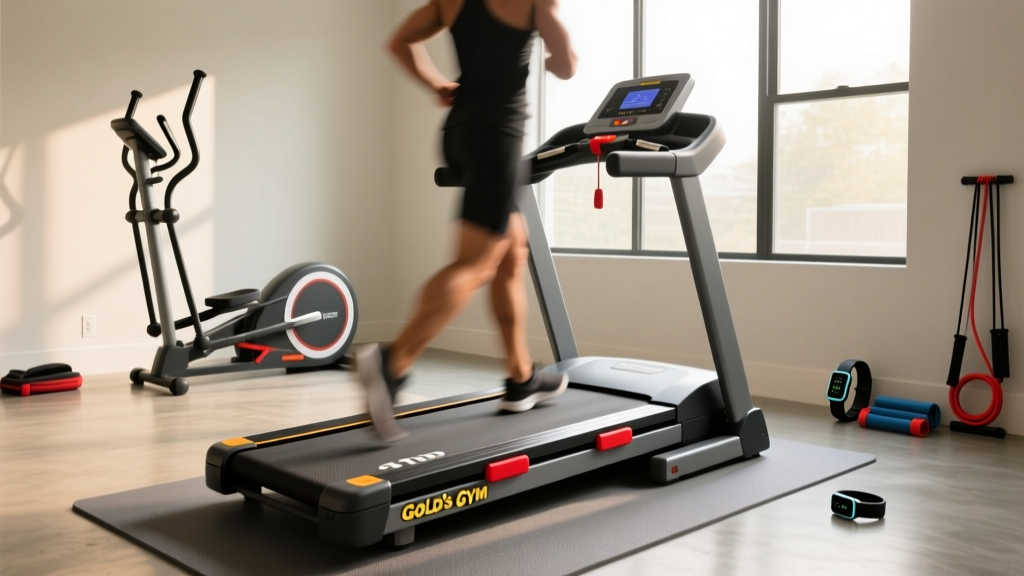
Gold's Gym Treadmill 410 Maintenance & Compact Cardio Care

Is It Better to Run on a Treadmill or Outside? Portable Cardio Costs
