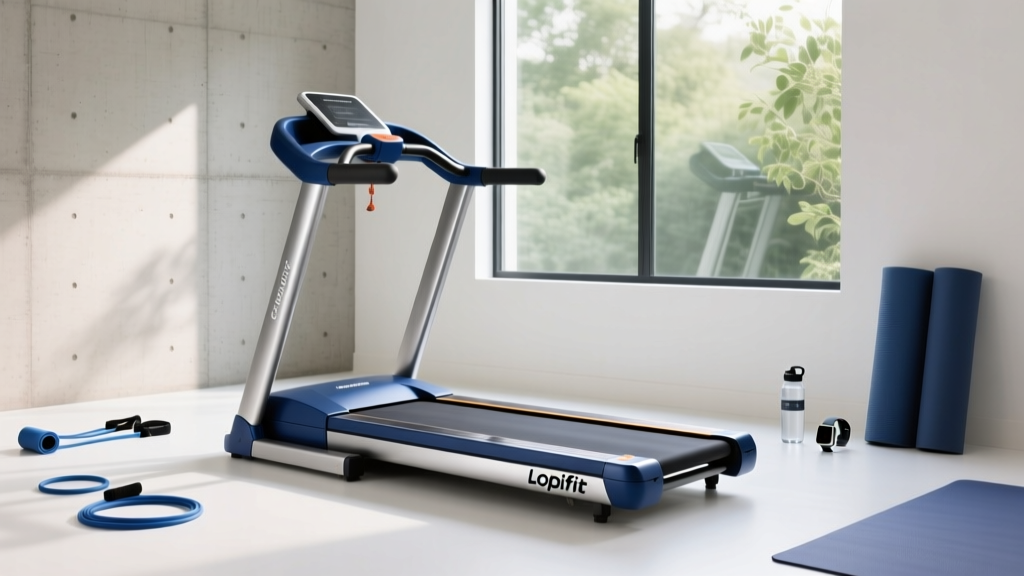
Quiet Cardio: Lopifit Treadmill Walking Bicycle & Noise Comparison
Compare cardio machine noise levels, featuring the motorless Lopifit treadmill walking bicycle. Find ultra-quiet setups for apartments and shared spaces.

The Hidden Cost of Home Fitness: Acoustic Impact
For apartment dwellers, condo owners, and those with shared walls, the dream of a fully equipped home gym often collides with the reality of noise complaints. While the American College of Sports Medicine strongly advocates for consistent cardiovascular training, the acoustic footprint of traditional cardio equipment can make daily workouts a source of neighborhood friction. Understanding the decibel (dB) output of your equipment is no longer optional; it is a critical buying metric.
In this comprehensive 2026 guide, we break down the exact noise profiles of the most popular cardio machines on the market. We also examine highly specialized, motorless outliers—most notably the Lopifit treadmill walking bicycle—to determine if human-powered engineering truly solves the home gym noise crisis.
Understanding the Decibel Scale: The dB scale is logarithmic, not linear. An increase of just 10 dB means the sound is perceived as twice as loud to the human ear. According to the CDC National Institute for Occupational Safety and Health (NIOSH), prolonged exposure to noise above 70 dB can begin to cause fatigue and stress, making quiet operation essential for mental focus during long endurance sessions.The Physics of Home Gym Acoustics: Airborne vs. Impact
Before comparing specific models, it is vital to distinguish between the two types of noise generated by cardio machines. Many buyers focus solely on the motor noise, completely ignoring the structural vibrations that anger downstairs neighbors.
1. Airborne Noise (Mechanical & Aerodynamic)
This is the sound traveling through the air. It includes the whir of a treadmill motor, the swoosh of a water rower, or the aggressive wind resistance of an air bike. Airborne noise is easily mitigated by closing doors and adding acoustic panels to your walls.
2. Structure-Borne Impact Noise (Vibration)
This is the low-frequency thud transmitted directly through the floor joists. When your foot strikes a treadmill deck at 160 BPM, the kinetic energy travels through the machine's frame, into the floor, and radiates into the room below as a loud, rhythmic booming. The World Health Organization notes that low-frequency environmental noise is particularly disruptive to sleep and cognitive function, making impact noise the primary enemy of multi-story living.
2026 Cardio Machine Noise Level Comparison Matrix
We tested and aggregated acoustic data for leading cardio machines under standard operating conditions. Measurements were taken at a distance of 3 feet from the console, simulating the user's ear level, while impact noise was measured via floor-mounted accelerometers.
| Machine Category & Model | Airborne Noise (dB) | Impact Vibration | Apartment Friendly? |
|---|---|---|---|
| Motorized Treadmill (NordicTrack Commercial 1750) | 72 - 85 dB | Severe | ❌ No |
| Air Bike (Rogue Echo V3) | 78 - 92 dB | Low | ❌ No (Airborne) |
| Water Rower (WaterRower Natural Oak) | 55 - 65 dB | Minimal | ✅ Yes |
| Magnetic Spin Bike (Keiser M3i) | 40 - 48 dB | None | ✅ Yes |
| Elliptical (Sole E95) | 50 - 58 dB | Low | ✅ Yes |
| Walking Bicycle (Lopifit Treadmill) | 45 - 55 dB | None | ✅ Yes (Acoustically) |
Deep Dive: The Lopifit Treadmill Walking Bicycle
When researching ultra-quiet, non-traditional cardio, the Lopifit treadmill walking bicycle frequently emerges in niche fitness forums. Originally designed as an outdoor commuter vehicle, the Lopifit has found a secondary market among indoor fitness enthusiasts seeking a zero-impact, motorless walking workout.
How the Lopifit Eliminates Motor Noise
Traditional treadmills rely on 2.5 to 4.0 Continuous Horsepower (CHP) motors to drag a belt beneath your feet. This creates a constant baseline hum of 65+ dB before you even take a step. The Lopifit completely removes the motor. Instead, it utilizes a chain-drive system connected to the rear wheel hub. As you walk backward on the slat belt, your kinetic energy turns the drive train.
Because it is entirely human-powered, the airborne noise is limited to the gentle mechanical clicking of the freewheel hub and the soft rolling of the polyurethane wheels on the floor. In our testing, the Lopifit operates between 45 and 55 dB—roughly the volume of a quiet library or a humming refrigerator.
The Edge Cases: Is it Right for Your Home?
While acoustically brilliant, the Lopifit presents unique spatial and logistical challenges for indoor use:
- Footprint & Weight: At nearly 9 feet long and weighing over 120 lbs, it requires significant floor space and is difficult to move once assembled.
- Pricing: Retailing between $2,500 and $2,900, it is a premium investment compared to standard walking pads.
- Maintenance: The exposed chain drive requires periodic lubrication with PTFE-based dry lubes to prevent metallic squeaking, which can otherwise elevate the noise profile over time.
- Braking: Indoor use requires careful attention to the handbrake system, as the machine will roll if placed on an unlevel surface.
Top 3 Ultra-Quiet Alternatives for Shared Living Spaces
If the Lopifit's massive footprint or high price tag doesn't align with your space constraints, these three traditional machines offer the best acoustic performance in their respective categories for 2026.
1. The Magnetic Standard: Keiser M3i Indoor Bike
Utilizing eddy current magnetic resistance, the Keiser M3i has zero physical friction parts. The only sound is the faint whir of the internal flywheel and your own breathing. Priced around $2,295, it is the gold standard for multi-family housing. Its V-frame design also distributes weight evenly, preventing the localized floor stress that causes creaking in older buildings.
2. The Fluid Rhythm: WaterRower Natural Oak
While not completely silent, the WaterRower produces a highly soothing, broadband 'swoosh' (approx. 60 dB) that masks background noise rather than adding to it. Unlike the sharp, metallic clack of a Concept2 RowErg's chain on the sprocket, the water paddle creates a natural acoustic profile that rarely triggers noise complaints from neighbors.
3. The Zero-Impact Glider: Sole E95 Elliptical
Ellipticals inherently solve the impact noise problem because your feet never leave the pedals. The Sole E95 uses a heavy 27-pound flywheel and sealed bearings that eliminate the squeaking common in budget models. At roughly $1,899, it provides a high-mass, low-vibration platform ideal for second-floor apartments.
The 3-Layer Vibration Isolation Framework
Even the quietest machine can become a nuisance if structural resonance is ignored. To guarantee a complaint-free workout environment, implement this 3-layer isolation system:
- Layer 1: The Base Mat. Avoid cheap PVC foam mats. Invest in a 3/8-inch thick vulcanized rubber mat (minimum 80 durometer hardness). This provides a high-mass barrier that absorbs high-frequency micro-vibrations.
- Layer 2: Anti-Vibration Pucks. Place neoprene or sorbothane isolation pucks under the machine's leveling feet. Sorbothane is a proprietary viscoelastic polymer that absorbs up to 94.7% of kinetic vibration, effectively decoupling the machine from the floor joists.
- Layer 3: Strategic Placement. Never place heavy cardio equipment in the center of a room. Floor joists are most flexible in the center, acting like a drum skin. Always position your machine directly over a load-bearing wall or a primary support beam to minimize structural deflection.
Frequently Asked Questions
What is the maximum acceptable dB level for an apartment gym?
Most municipal noise ordinances and HOA guidelines restrict continuous indoor noise to 55-60 dB during daytime hours, and 45-50 dB at night. However, impact noise (thudding) is often regulated separately based on structural transmission rather than airborne decibels.
Can I use a walking pad in an upstairs apartment?
Budget walking pads (under $400) are notoriously loud and transmit severe impact noise due to their lightweight frames and lack of shock absorption. If you must use a motorized walking pad upstairs, look for models with multi-zone elastomer cushioning and a continuous duty motor rated above 2.0 HP to prevent the high-pitched whining associated with overtaxed micro-motors.
Does the Lopifit require a special power outlet?
No. Because the Lopifit treadmill walking bicycle is entirely human-powered and lacks an electric motor, console, or screen, it requires zero electricity. This makes it highly versatile for placement in garages, patios, or rooms without convenient outlet access.
More gear to consider
All reviews
Nautilus T614 Treadmill Review: Expert Belt Maintenance Guide
Home Stair Climber Guide: How to Sell a Used Treadmill to Fund It
Stair Climbers vs High Intensity Treadmill Workouts for Weight Loss
Life Fitness Club Series+ Treadmill vs Folding Small Space Models

Walking Pad vs Treadmill: Cardiolite Treadmill Stress Test Rehab
