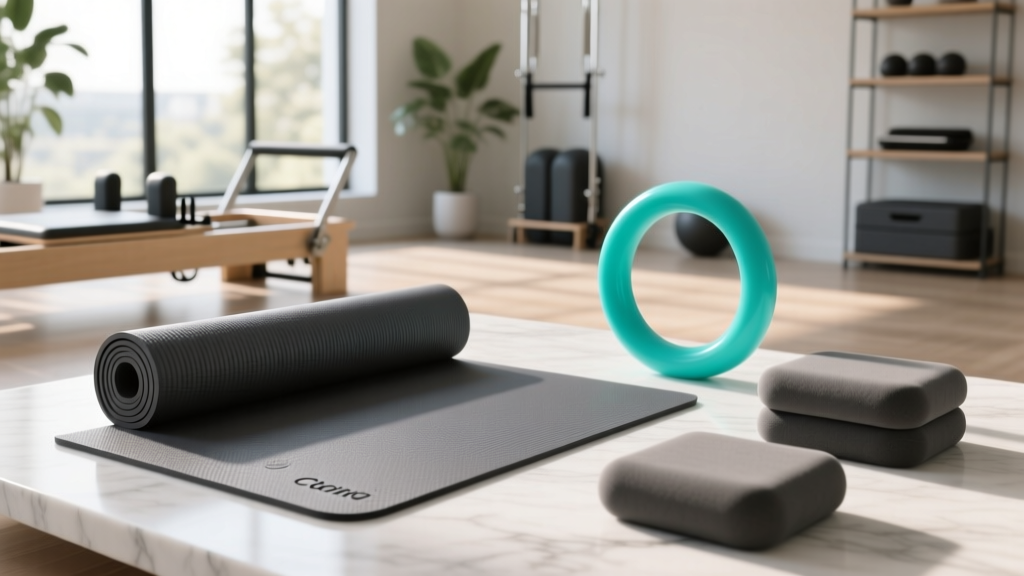
Loop vs Tube Bands: Space Layouts for an Instructional Yoga Mat
Optimize your small home gym layout. We compare loop vs tube bands based on spatial footprint, anchoring, and integration with an instructional yoga mat.

The Anchor: Why Your Instructional Yoga Mat Dictates Band Choice
Designing a functional home gym in a compact space requires ruthless spatial optimization. In apartments, small bedrooms, or multipurpose living areas, the undisputed anchor of your workout zone is an instructional yoga mat. Premium mats like the Liforme Original or the Gaiam Align (typically measuring 24 inches by 68 inches) feature printed alignment grids that guide biomechanical positioning. But when you introduce elastic resistance into this defined footprint, a critical layout dilemma emerges: should you utilize flat loop bands or handled tube bands?
The choice between loop and tube bands is rarely just about exercise variety; it is fundamentally a question of spatial clearance, anchor point logistics, and clutter management. According to the Cleveland Clinic, elastic resistance is highly effective for joint-safe muscle building, but improper anchoring in confined spaces leads to snapped bands and property damage. This guide breaks down the exact spatial footprints, tension geometries, and layout blueprints for integrating both band types into a small-room setup anchored by an instructional yoga mat.
Space Optimization Rule #1: Never measure your room by its total square footage. Measure the 'safe swing zone' radiating outward from the edges of your 24x68 instructional yoga mat.Loop Bands: The Zero-Clearance Advantage
Flat loop bands (such as the Rogue Fitness Monster Bands or TheraBand CLX loops) are continuous circles of extruded latex or TPE. Their standard resting length is 41 inches, and they can safely stretch to roughly 150% to 200% of their resting length (approx. 80 to 100 inches total) before risking structural failure.
Footprint and Anchoring Dynamics
The primary spatial advantage of loop bands is their reliance on the user's body weight as the primary anchor. By stepping on the bottom arc of the band with one or both feet, you instantly create a closed kinetic chain. Because your feet remain planted on your instructional yoga mat, the spatial footprint of the exercise is exactly the footprint of the mat itself. You require zero additional clearance beyond the mat's edges for exercises like bicep curls, front squats, or overhead presses.
Furthermore, the alignment lines on an instructional yoga mat become a vital measuring tool. When performing lateral band walks with a mini-loop band around your ankles, the grid lines allow you to maintain a precise 24-inch stance width, ensuring symmetrical tension and preventing the band from rolling up your calves—a common failure mode in unguided spaces.
Edge Cases and Wall Proximity
If you need to anchor a heavy loop band (e.g., a 1-inch thick purple or green band offering 50-125 lbs of resistance) for pull-up assistance or lat pulldowns, you must loop it over a high bar or a heavy piece of furniture. In a small room, wrapping a loop band around a structural pillar or the base of a solid oak dresser requires only 2 inches of clearance between the furniture and the wall, making it highly adaptable to tight nooks.
Tube Bands: The Door-Anchor Dilemma
Tube bands (like the Black Mountain Products Tube Set or Bowflex SelectTech tubes) consist of cylindrical latex tubes fitted with nylon straps, carabiners, and rigid plastic or foam handles. A standard tube measures 48 inches, but with handles attached, the functional length extends to 55+ inches.
The Clearance Tax
While tube bands excel at mimicking cable machine mechanics for chest presses and tricep pushdowns, they impose a massive 'clearance tax' on small spaces. To perform horizontal or vertical pulling motions, you must use a door anchor. A standard interior door is 32 inches wide and requires a swing radius. If your instructional yoga mat is placed in a 5x5 foot bedroom alcove, placing the mat perpendicular to the door might leave you with only 18 inches of space between your head and the wall when lying down for chest presses.
According to safety guidelines highlighted by the American Council on Exercise (ACE), tube bands must be anchored to a hinge-side door frame to prevent the door from swinging open mid-rep. This severely limits your layout options, forcing you to align your instructional yoga mat parallel to the door hinge, which may conflict with your room's natural traffic flow or window placements.
Handle Clutter and Tangling
Tube bands introduce rigid geometry into your space. The hard plastic handles cannot be folded or tightly rolled. When not in use, a 5-tube set with a door anchor and ankle straps occupies roughly 1.5 cubic feet of storage space and is notorious for tangling, which adds visual clutter—a major psychological detractor in multipurpose living spaces.
Comparative Spatial Matrix
Below is a direct comparison of how loop and tube bands interact with a standard 24x68 instructional yoga mat layout.
| Feature | Flat Loop Bands (41-inch) | Tube Bands with Handles |
|---|---|---|
| Resting Length | 41 inches | 48 inches (55+ with handles) |
| Primary Anchor | User's feet / Furniture wrap | Door frame anchor / Pole |
| Mat Integration | High (Grid lines guide stance width) | Low (Handles extend past mat edges) |
| Required Clearance | 0 inches beyond mat perimeter | 36+ inches for door swing/anchor |
| Storage Volume | ~15 cubic inches (rolled tight) | ~2,500 cubic inches (tangled set) |
| Average Cost | $15 - $60 per set | $25 - $45 per set |
Small-Room Layout Blueprints
To maximize your square footage, select your band type based on the specific architectural constraints of your room.
Blueprint A: The 4x6 Bedroom Nook (Loop Band Exclusive)
If your workout space is a 4x6 foot area carved out between a bed and a closet, tube bands are functionally obsolete. The door anchor will likely hit the bedframe, and the handles will strike the walls during lateral raises. The Solution: Use a set of 41-inch flat loop bands. Stand lengthwise on your instructional yoga mat. The mat's top and bottom borders act as your spatial boundaries. For overhead presses, step on the band and press upward; the ceiling is your only limit. For rows, loop the band around the sturdy base of your bedframe, utilizing the mat's alignment grid to ensure your knees are perfectly stacked over your ankles during the pull.
Blueprint B: The Hallway or Doorway Corridor (Tube Band Optimized)
If your space is a long, narrow hallway or a dedicated doorway transition, tube bands shine. You can anchor the door anchor at chest height, lay your instructional yoga mat parallel to the hallway wall, and perform cable-style rotational chops and chest presses. The hallway's natural length provides the necessary 6 to 8 feet of clearance required to fully elongate the tube band without snapping it back toward the anchor point.
Storage and Clutter Eradication
In space-optimized design, equipment must 'disappear' when not in use. Loop bands can be rolled into tight cylinders and stored inside the hollow core of a foam roller, or tucked into a small drawer alongside your instructional yoga mat's cleaning spray. Tube bands, conversely, require dedicated wall hooks or a specialized duffel bag. If you are committed to tube bands in a small space, install heavy-duty adhesive hooks (rated for 15 lbs) on the back of your bedroom door or the side of a bookshelf to hang the tubes vertically, keeping the floor entirely clear for your mat.
'In micro-apartment fitness design, the visual weight of your equipment matters as much as its physical weight. Tangled tubes with rigid handles create subconscious spatial anxiety, whereas flat bands roll away into nothingness, preserving the zen of your workout zone.'
— Interior Fitness Layout Principles, 2025
Final Verdict for Compact Spaces
When the primary constraint is spatial optimization around an instructional yoga mat, flat loop bands are the undisputed winner. They respect the boundaries of your mat, utilize your body weight as a zero-clearance anchor, and leverage the mat's instructional grid for precise foot placement. Tube bands should be reserved exclusively for layouts where a dedicated, unobstructed door anchor is available, and where the user has the storage infrastructure to manage the rigid handles. By matching your elastic resistance type to your room's architectural realities, you can build a highly effective, joint-safe home gym without sacrificing your living space.
More gear to consider
All reviews
Jade Yoga Harmony Yoga Mat & Foam Roller Density: Head-to-Head Guide
Yoga Mat Grip & Material: Can I Use Dawn to Clean My Yoga Mat?
Medicine Ball Weight Selection & Yoga Mat Hanger Storage Guide

Beyond the Lululemon Yoga Mat Outlet: Resistance Band Guide

Maintenance on a Budget: Practical, Proven Strategies That Save Money Without Sacrificing Reliability