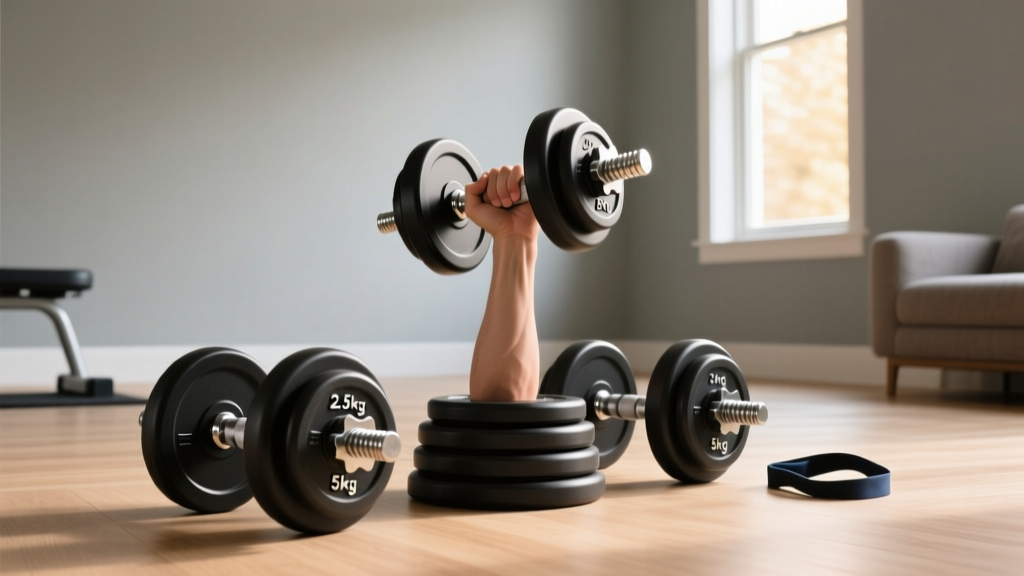
Loadable Plates for Side Lateral Raises With Dumbbells: Space Guide
Discover how to optimize your home gym layout using loadable dumbbells with interchangeable plates for perfect side lateral raises with dumbbells.

The Spatial Dilemma of Isolation Training
When designing a compact home gym, space optimization is the ultimate constraint. Compound movements like squats and deadlifts require minimal equipment variations, but isolation work tells a different story. To properly progress on side lateral raises with dumbbells, lifters face a brutal mathematical reality: the medial deltoid is a small muscle group that demands micro-loading. Jumping from 15-pound to 20-pound fixed dumbbells represents a massive 33% load increase, almost guaranteeing form breakdown, trap dominance, and shoulder impingement.
Historically, solving this meant purchasing a full rack of fixed hex dumbbells in 2.5-pound increments from 5 to 40 pounds. In 2026, a high-quality urethane fixed dumbbell set of this magnitude costs upwards of $1,400 and requires a 3-tier rack consuming roughly 18 square feet of valuable floor space. For apartment dwellers or garage gym owners maximizing every inch, this footprint is unacceptable. The solution? Loadable dumbbells with interchangeable plates. However, simply buying a cheap spinlock handle set introduces severe biomechanical clearance issues that can ruin your lateral raise mechanics. This guide breaks down exactly how to select, configure, and layout loadable dumbbell systems specifically optimized for isolation movements.
⚠️ The Clearance Failure Mode
Standard 14-inch spinlock handles are notorious for ruining lateral raises. When your arms are resting at your sides at the bottom of the movement, the outer collar and plates on a 14-inch handle extend up to 7 inches past your grip center. This forces the plates to collide with the greater trochanter of your femur (your outer thigh). To compensate, lifters subconsciously widen their stance or prematurely abduct the shoulder, entirely altering the kinetic chain and reducing tension on the target medial deltoid fibers.
Loadable Dumbbell Configurations for Lateral Raises
To execute side lateral raises with dumbbells flawlessly in a space-constrained environment, you must prioritize handle geometry and plate density. Below is a structural comparison of the three most viable loadable systems on the 2026 market, evaluated specifically for isolation clearance and spatial footprint.
| System Type | Handle Length | Thigh Clearance | Plate Compatibility | Storage Footprint | Est. Cost (Pair) |
|---|---|---|---|---|---|
| Standard Spinlock | 14 inches | Poor (Hits thigh) | Standard 1" Cast Iron | 1.5 sq ft | $45 - $60 |
| Compact Spinlock | 10 inches | Excellent | Standard 1" / Fractional | 1.0 sq ft | $28 - $40 |
| Block-Style (e.g., Ironmaster) | 8.5 inches (Square) | Superior | Proprietary Interchangeable Blocks | 1.2 sq ft | $359 - $399 |
For pure space optimization and budget efficiency, the 10-inch compact spinlock handle (such as the Yes4All 10" model or CAP Barbell 10" solid steel handle) paired with fractional plates is the undisputed champion for lateral raises. By shaving 4 inches off the total handle length, the weight sits tight against the grip, allowing your arms to rest naturally at your sides without the plates grazing your legs. If budget allows and you want a premium, rattle-free experience, block-style loadable dumbbells like the Ironmaster Quick-Lock V2 offer a fixed-dumbbell feel with an interchangeable plate mechanism, though they require a larger upfront investment.
Designing the 9-Square-Foot "Isolation Zone"
Space optimization isn't just about the equipment; it's about the layout. You do not need a massive 10x10 foot dedicated zone for isolation work. By designing a targeted 3x3 foot "Isolation Zone," you can perform side lateral raises with dumbbells with perfect form while keeping your gym footprint minimal.
Step 1: Strategic Mirror Placement
According to ACE Fitness exercise guidelines, maintaining a slight forward lean and keeping the movement within the scapular plane (about 30 degrees forward of the coronal plane) is critical to preventing shoulder impingement. In a compact layout, mount a 24x36 inch shatterproof acrylic mirror directly in front of your 3x3 foot rubber mat. This allows you to visually verify that your elbows are leading the movement and that your upper traps aren't hijacking the lift, without requiring the spatial depth needed to step back and observe yourself in a traditional full-length gym mirror.
Step 2: Micro-Plate Magnetic Storage
The primary advantage of a loadable dumbbell with interchangeable plates is the ability to micro-load. However, loose 1.25 lb and 2.5 lb fractional plates scattered on the floor destroy the aesthetic and safety of a small room. Install a magnetic wall-mounted plate tree or a heavy-duty pegboard strip exactly 36 inches off the ground on the adjacent wall. This specific height allows you to swap plates while maintaining a neutral spine, keeping the floor entirely clear for your stance and footwork adjustments.
Biomechanics and Progression: Why Interchangeable Plates Rule
The kinesiology of the shoulder dictates that the lever arm during a lateral raise is exceptionally long. As noted in ExRx.net's kinesiology breakdown of the lateral raise, the resistance torque peaks when the arm is parallel to the floor. Because the medial deltoid is relatively small compared to the pectorals or lats, standard 5-pound commercial weight jumps are biomechanically inappropriate for intermediate and advanced lifters.
"Progressive overload on isolation movements requires fractional increments. A 2.5-pound total increase (1.25 lbs per hand) on a 15-pound lateral raise represents a manageable 16.6% load increase, preserving strict joint mechanics and continuous tension, whereas a 5-pound jump often forces the lifter to utilize momentum via hip extension."
By utilizing a loadable dumbbell setup with a pair of 1.25 lb fractional plates (which cost roughly $18 per pair and measure a mere 3 inches in diameter), you unlock months of linear progression. You can seamlessly transition from 15 lbs to 17.5 lbs to 20 lbs over a 12-week mesocycle without ever needing to purchase a new pair of fixed dumbbells or sacrifice precious floor space.
Managing Rotational Inertia and Knurling
One edge case often overlooked in space-saving gym designs is the rotational inertia of interchangeable plates. When performing side lateral raises with dumbbells, the wrist naturally pronates and supinates slightly at the top of the movement (often referred to as "pouring the pitcher"). If you use standard smooth-bore spinlock handles with loose cast-iron plates, the plates will shift and grind against the collar, creating micro-rotations that destabilize the wrist joint.
The Fix: Always use machined steel fractional plates or plates with integrated rubber O-rings on your loadable handles. Furthermore, ensure your 10-inch compact handles feature deep, aggressive knurling on the grip and a smooth, unknurled section on the sleeve. This prevents the interchangeable plates from binding against the knurling when you tighten the spinlock collar, ensuring the weight distribution remains perfectly balanced during the eccentric lowering phase of the raise.
Final Layout Blueprint Summary
- Equipment: Pair of 10-inch solid steel spinlock handles + 100 lb set of machined fractional plates (1.25, 2.5, 5, 10 lb increments).
- Footprint: 3x3 foot interlocking rubber mat (9 sq ft total).
- Storage: Wall-mounted magnetic plate rack positioned at 36-inch height.
- Visual Feedback: 24x36 inch wall mirror mounted directly in the scapular plane line of sight.
- Total Spatial Savings: Reclaims approximately 15 square feet of floor space compared to a traditional 3-tier fixed dumbbell rack, while reducing equipment costs by over 80%.
By shifting to a loadable dumbbell with interchangeable plates, you aren't just saving money and space; you are actively engineering a home gym environment that respects the biomechanical realities of isolation training. Proper clearance, micro-loading capabilities, and an optimized visual layout ensure that every rep of your side lateral raises with dumbbells is safe, strict, and highly effective.
More gear to consider
All reviews
Top Dumbbell Racks for Heavy Lifts & Seated Dumbbell Good Mornings

Heavy Dumbbell Training Spaces: Cast Iron vs Competition Kettlebells
EZ Curl Bar vs Straight Bar: Pairing with the Dumbbell Incline Flye

Loadable Dumbbells for Dumbbell Squats for Quads: Budget Breakdown
Is a 50 lb Dumbbell Shoulder Press Good? Olympic Barbell Guide
