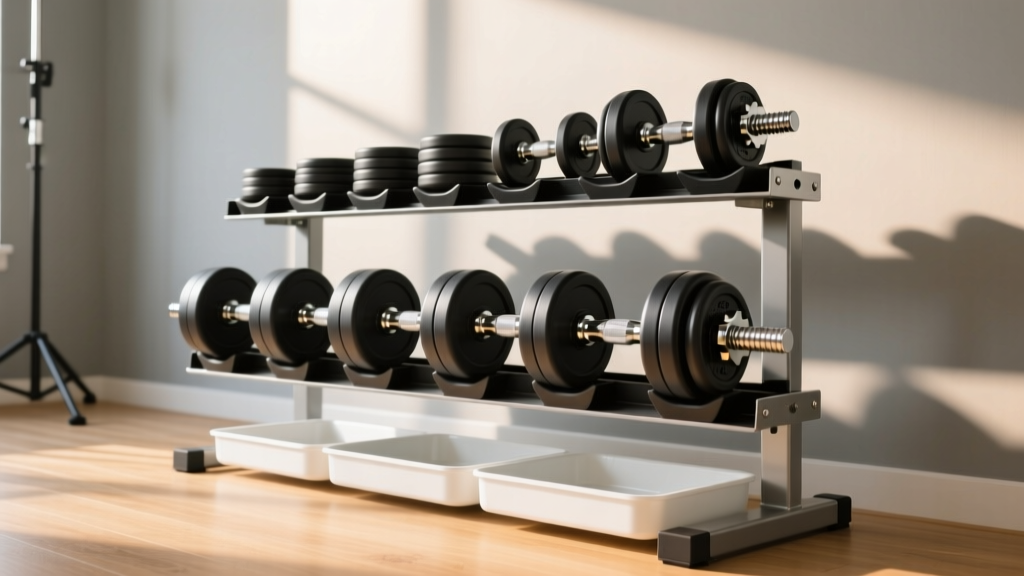
Space-Saving Dumbbell Set Up: Loadable Handles & Plates
Maximize your home gym footprint with a space-saving loadable dumbbell set up. Compare handles, plate storage, and layout dimensions for compact spaces.

The Spatial Math: Fixed Racks vs. Loadable Dumbbell Set Ups
When designing a compact home gym, every square foot of floor space is a premium commodity. Traditional fixed-weight dumbbell racks are notorious space hogs. A standard 3-tier commercial rack holding a full set of 5 to 50-pound rubber hex dumbbells (10 pairs) requires roughly 14 to 16 square feet of dedicated floor space, not including the 36-inch clearance zone needed for safe access.
In stark contrast, a loadable dumbbell set up utilizing interchangeable plates and Olympic handles compresses this footprint dramatically. By pairing two high-quality loadable handles with a vertical plate tree holding 200 pounds of urethane plates, you can achieve the exact same weight range while consuming less than 4 square feet of total floor space. This 70% reduction in spatial footprint makes plate-loaded systems the undisputed champion of space optimization for garage gyms, spare bedrooms, and apartment workout nooks.
Space Optimization Rule of Thumb
For every 100 lbs of interchangeable plate weight you add to a vertical tree, you only increase your gym's footprint by approximately 1.2 square feet. Fixed dumbbells, however, require an additional 2.5 square feet of rack space for every 100 lbs added.
Choosing the Right Loadable Handle for Compact Gyms
Not all loadable dumbbell handles are created equal, and selecting the wrong model can ruin your space-saving layout. The market is split between standard 1-inch peg handles and 2-inch Olympic sleeves. For a serious, long-term space-optimized gym, 2-inch Olympic loadable handles are the mandatory choice.
The Rogue Loadable Dumbbell Handles represent the gold standard in this category. Machined from solid steel, they feature a 20.5-inch overall length and a 6.5-inch loadable sleeve. This specific sleeve length is critical: it allows you to load enough bumper or urethane plates to reach 100+ lbs per hand without the plates sliding off during heavy Romanian deadlifts or walking lunges.
The 1-Inch vs. 2-Inch Dilemma
- 1-Inch Standard Handles: Cheaper upfront (often $20-$30 a pair), but the sleeves are typically only 4 to 5 inches long. This severely caps your maximum weight, especially if you use thicker rubber-coated plates. They also bend under heavy loads, ruining the barbell-like spin mechanics.
- 2-Inch Olympic Handles: Pricier ($80-$120 a pair), but they feature bronze bushings or bearings for smooth rotation during dynamic movements like snatches or cleans. The thicker sleeves accommodate high-density urethane plates, maximizing your weight capacity per inch of sleeve length.
The Plate Storage Bottleneck: Vertical vs. Horizontal
The handle is only half of your dumbbell set up; the interchangeable plates dictate your actual storage layout. In a space-constrained environment, horizontal plate storage (stacking plates on the floor or on a low peg) is a tripping hazard and wastes valuable square footage.
'A vertical plate tree is non-negotiable for compact loadable dumbbell stations. It elevates the plates, keeps the center of gravity low to prevent tipping, and allows you to store fractional change plates (1.25 lb and 2.5 lb) on the top pegs for seamless micro-loading during isolation exercises.' — Home Gym Layout Specialists, Garage Gym Reviews
According to comprehensive equipment testing by Garage Gym Reviews, pairing your loadable handles with a 6-peg vertical tree positioned exactly 18 inches from your workout bench creates an ergonomic 'pivot zone.' This allows you to strip and load plates without taking more than a single step, maintaining your heart rate and workout flow.
Real-World Dimensions and Clearance Requirements
To design your layout accurately, you must account for the physical dimensions of the loaded dumbbells. A common failure mode in compact gyms is failing to account for the 'swing radius' during chest flyes or lateral raises, resulting in drywall damage or smashed mirrors.
| Equipment Component | Standard Dimensions | Required Clearance Zone |
|---|---|---|
| Olympic Loadable Handle (Unloaded) | 20.5' Length / 2' Sleeve Dia. | N/A (Stored vertically) |
| 45 lb Urethane Plate | 17.5' Diameter / 1.3' Thick | 1.5' per plate on sleeve |
| Loaded Dumbbell (100 lbs) | ~24' Total End-to-End Length | 36' lateral swing radius |
| Vertical 6-Peg Plate Tree | 22' W x 22' D x 34' H | 12' access radius |
Note: Always measure your specific plates. Cast iron plates are thinner than rubber hex plates, which drastically changes how many you can fit on a 6.5-inch sleeve.
Plate Thickness: The Hidden Variable in Loadable Set Ups
This is where most home gym owners miscalculate. If you buy a pair of loadable handles with 6.5-inch sleeves, you might assume you can load three 45-lb plates per side. However, plate material dictates thickness:
- Cast Iron Plates: A 45-lb iron plate is roughly 1.1 inches thick. You can fit four on a 6.5-inch sleeve, leaving room for a spring collar.
- Rubber Hex Plates: A 45-lb rubber plate is often 1.5 to 1.7 inches thick. You will max out at two plates per side before running out of sleeve space for the collar.
- Virgin Urethane Plates: The optimal choice for loadable dumbbells. A 45-lb urethane plate (like the Rogue Urethane Plates) is precisely 1.3 inches thick, offering a premium balance of high density, zero odor, and sleeve efficiency.
Warning: Collar Clearance Failure
Never load plates so tightly that you cannot fully seat a heavy-duty spring collar or clamp. If a collar is hanging off the edge of the sleeve by even 0.25 inches, the lateral force of a dumbbell bench press can dislodge it, causing plates to slide off mid-rep. Always leave at least 0.75 inches of bare sleeve for secure collar placement.
Designing the Layout: The 'Triangle of Efficiency'
For the ultimate space-optimized layout, arrange your equipment in an equilateral triangle with 3-foot sides:
- Point A (The Anchor): Your adjustable FID (Flat/Incline/Decline) bench.
- Point B (The Armory): The vertical plate tree and loadable handles.
- Point C (The Zone): The open floor space for standing movements like lunges, goblet squats, and farmer's carries.
This triangular layout ensures that you never have to walk more than three feet to change weights or transition from seated to standing exercises, effectively making a 50-square-foot room feel like a dedicated 150-square-foot free weight zone.
Expert Verdict: Is a Loadable Dumbbell Set Up Right for You?
If your primary constraint is square footage, but you refuse to compromise on the tactile feel of true free weights, a loadable dumbbell set up with interchangeable plates is unmatched. While dial-adjustable dumbbells (like the PowerBlock or Bowflex) save even more space, they suffer from bulky end-profiles that interfere with movements like dumbbell pullovers or close-grip presses. Loadable Olympic handles provide the exact biomechanics of commercial fixed dumbbells, allow for infinite micro-loading via fractional plates, and keep your floor plan wide open for functional training.
More gear to consider
All reviews
American Barbell Dumbbells & Kettlebell Budget Guide
Olympic vs Standard Plates: Upgrading Your Side Bend Dumbbell Setup
Optimizing Reverse Dumbbell Flies: Olympic vs Standard Plates

Sumo Deadlifts With Dumbbells: Top Neoprene Picks Compared
Standard vs Olympic Plates: Planning a Delt Workout with Dumbbells
