Loadable Dumbbells for Single Arm Dumbbell Overhead & Small Gyms
Optimize your home gym layout with loadable dumbbells. Discover space-saving designs and clearance tips for the single arm dumbbell overhead press.

The Spatial Economics: Fixed Racks vs. Loadable Systems
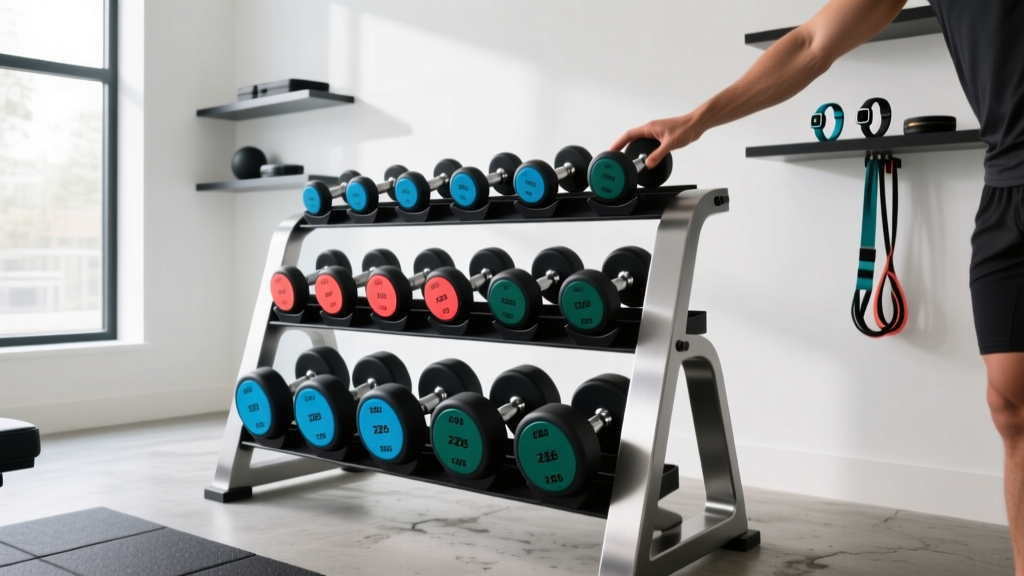
When designing a compact home gym or apartment training space, the traditional fixed dumbbell rack is the ultimate spatial bottleneck. A standard 5 to 50-pound rubber hex dumbbell set requires a 4-foot wide, 2-tier rack. Factoring in the rack's depth (usually 18 inches) and the mandatory 3-foot user clearance zone required to safely maneuver the weights, you are surrendering roughly 18 square feet of prime floor space. In a 200-square-foot garage gym or a spare bedroom, that footprint is devastating.
Enter the loadable dumbbell with interchangeable plates. By utilizing a pair of loadable handles and a single vertical plate tree or wall-mounted storage bracket, you can replicate a 100-pound dumbbell set in less than 3 square feet of total floor space. This spatial efficiency is not just about storing the gear; it is about reclaiming the central floor area required for complex, asymmetrical movements. As of 2026, with urban living spaces shrinking and home gym real estate at a premium, transitioning to loadable handles is the single most effective layout optimization strategy for serious lifters.
Designing Clearance for the Single Arm Dumbbell Overhead
Reclaiming floor space is only half the battle; the reclaimed space must be functionally mapped to your exercise biomechanics. The single arm dumbbell overhead movement is a prime example of an exercise that demands specific spatial allowances that fixed racks often disrupt.
Vertical and Lateral Clearance Requirements
According to the EXRX Biomechanics Directory, unilateral overhead pressing requires significant lateral elbow flare and vertical extension to properly engage the anterior deltoid and stabilize the scapula. If your workout bench is pushed flush against a wall or jammed inside a narrow power rack, the single arm dumbbell overhead becomes mechanically compromised. Your elbow will strike the wall or rack upright during the eccentric lowering phase, artificially limiting your range of motion and increasing the risk of shoulder impingement.
Layout Rule of Thumb: To safely perform the single arm dumbbell overhead press, your bench must be positioned at least 3.5 feet away from any lateral wall or rack upright. Furthermore, standard 8-foot ceilings leave roughly 7 feet 4 inches of usable vertical clearance once you account for the lifter's seated height and arm length. If you are taller than 6 feet 2 inches, you must perform this movement seated rather than standing to avoid striking the ceiling drywall at lockout.The Triangle Layout Method
To maximize space for the single arm dumbbell overhead, implement the 'Triangle Layout' in your gym. Place your adjustable bench in the center of the room. Position your loadable dumbbell handles and plate storage tree at a 45-degree angle to the head of the bench, and your primary rack at a 45-degree angle to the foot. This creates a tight, efficient triangle that minimizes walking distance while leaving the lateral spaces completely open for unilateral elbow tracking.
Comparative Analysis: Top Loadable Dumbbell Handles
Not all loadable dumbbells are created equal. The market is split between 1-inch standard sleeves and 2-inch Olympic sleeves. This distinction drastically affects your spatial footprint, plate compatibility, and maximum loadable weight. Below is a breakdown of the top contenders for space-optimized gyms.
| Brand & Model | Sleeve Diameter | Overall Length | Sleeve Length | Approx. Price (Pair) | Best For |
|---|---|---|---|---|---|
| Rogue Loadable Handle | 2" (Olympic) | 13.5" | 6.5" | $300 | Heavy lifters using bumper plates |
| Ironmaster Quick-Lock V2 | 1" (Standard) | 14.5" | Block Design | $239 (Handles only) | Compact spaces, drop-safety |
| Titan Fitness Loadable | 2" (Olympic) | 14.0" | 6.0" | $180 | Budget Olympic plate users |
The 1-Inch vs. 2-Inch Spatial Dilemma
When optimizing for space, the 2-inch Olympic loadable dumbbell (like the Rogue or Titan) presents a hidden spatial trap: plate thickness. A standard 45-pound Olympic bumper plate is roughly 3.3 inches thick. On a 6.5-inch sleeve, you can only fit one 45-pound plate and a 10-pound plate per side before running out of sleeve space, capping your dumbbell at around 125 pounds. If you need heavier weights, you must buy expensive, ultra-thin steel competition plates, which defeats the budget-friendly nature of loadable systems.
Conversely, 1-inch standard cast iron plates are incredibly thin. A 10-pound standard plate is less than an inch thick. This allows you to stack significantly more weight onto a compact handle, keeping your overall plate storage footprint dense and manageable. However, standard spin-lock collars can loosen during dynamic movements, which leads us to real-world failure modes.
Real-World Failure Modes and Edge Cases
Designing a layout around loadable dumbbells requires anticipating how the equipment behaves when it leaves the storage tree. Here are the most common failure modes encountered in compact gyms:
- Collar Loosening During Unilateral Work: The single arm dumbbell overhead press generates immense rotational torque at the wrist and handle. Traditional star-lock spin collars frequently vibrate loose during the eccentric phase of overhead presses. Solution: Invest in premium spring collars or ratcheting clamps (like the Rogue HG 2.0 Collars) specifically designed for dumbbell sleeves, and always orient the collar threads away from your face.
- Knurling and Floor Damage: Loadable dumbbells lack the thick rubber or urethane coating of fixed hex dumbbells. If you fail a rep and drop a steel loadable dumbbell onto a standard rubber mat, the exposed steel plates will easily crack the mat and damage the concrete subfloor. Solution: Your layout must include a dedicated 3x5 foot, 3/4-inch thick horse stall mat drop zone directly beneath your bench.
- Plate Rattle and Balance: Interchangeable plates shift during movement. If you use mismatched plate sizes (e.g., a 25lb plate paired with a 10lb plate on the same sleeve), the center of mass shifts slightly, making the single arm dumbbell overhead lockout feel unstable. Solution: Always load plates symmetrically and use a felt washer between steel plates to eliminate the metallic clanking that can distract you during heavy overhead stabilizations.
Plate Storage: Vertical Trees vs. Wall Mounts
Where you put the interchangeable plates when they aren't on the handles dictates your gym's traffic flow.
- The Vertical Plate Tree: A standard 10-peg vertical tree takes up a 2x2 foot footprint. It is ideal for garages where wall space is consumed by mirrors or whiteboards. However, it creates a tripping hazard if placed in the primary walking lane.
- Wall-Mounted Saddle Brackets: For true space optimization, wall-mounted plate saddles are superior. By mounting 2-inch plate holders directly to the wall studs at waist height, you eliminate the floor footprint entirely. This keeps the floor clear for sprawling movements and ensures your lateral clearance for the single arm dumbbell overhead is never obstructed by a misplaced plate tree.
Pro-Tip for Wall Mounts: When mounting plate saddles, ensure they are anchored directly into wooden studs or masonry using 3/8-inch lag screws. Drywall anchors will inevitably fail under the dynamic load of sliding 45-pound plates on and off the pegs, leading to catastrophic wall damage.
Summary Checklist for Your Layout
To finalize your space-optimized free weight zone, verify the following parameters before purchasing your gear:
- Measure your ceiling height and subtract 10 inches to determine your maximum safe standing overhead lockout height.
- Ensure a minimum of 42 inches of lateral clearance on both sides of your bench for the single arm dumbbell overhead elbow path.
- Choose 1-inch handles for high-weight, low-space environments, or 2-inch handles if you already own a full set of Olympic bumper plates.
- Install a dedicated, heavy-duty drop zone mat to protect your flooring from bare steel interchangeable plates.
By abandoning the archaic fixed dumbbell rack and embracing a strategically laid-out loadable dumbbell system, you transform a cramped spare room into a fully functional, professional-grade strength facility. The spatial freedom you gain directly translates to better biomechanics, safer lifting environments, and a more versatile training arsenal.
More gear to consider
All reviews
Home Gym Setup: Neoprene Gear & Bicep Exercises Using Dumbbells

Dumbbell Rack Storage & Value: Does Setup Impact Skull Crusher Form?

EZ vs Straight Bar Value & Glute-Focused Split Squat Dumbbell Holds

Rubber Hex vs Urethane: Value Analysis for the Best Workout with Dumbbells for Arms

Chest Fly Dumbbell Alternative: Adjustable Dumbbell Mistakes & Fixes