
How Much Is a Dumbbell? 2026 Loadable Plate Market Trends
Discover how much a dumbbell costs in 2026. We analyze loadable plate market trends, pricing tiers, and ROI for home gyms vs fixed weights.

The Shift to Loadable Dumbbells in 2026
The home fitness equipment market has undergone a massive maturation phase over the last few years. As we navigate 2026, the initial rush for cheap, space-saving dial-adjustable dumbbells has cooled, replaced by a demand for commercial-grade durability and heavy-load capacity. This shift has brought the loadable dumbbell with interchangeable plates back into the spotlight. But for consumers and commercial gym owners alike, the fundamental question remains: how much is a dumbbell when you factor in handles, plates, collars, and long-term maintenance?
According to recent fitness equipment market analyses, the global free weights segment continues to grow, driven by a surge in powerlifting and functional bodybuilding routines that require loads exceeding the standard 50-100 lb limits of consumer adjustable dumbbells Grand View Research. Loadable dumbbells bridge the gap between the space-efficiency of a single handle and the infinite scalability of a barbell plate collection.
Breaking Down the Costs: How Much Is a Dumbbell Really?
To answer 'how much is a dumbbell' accurately, we must separate the handle ecosystem from the weight media (the plates). In 2026, pricing is heavily stratified by sleeve diameter (1-inch Standard vs. 2-inch Olympic) and locking mechanisms.
| System Type | Handle Cost (Pair) | Plate Cost (Per Lb) | Max Load Capacity | Best For |
|---|---|---|---|---|
| 1' Standard Spinlock | $35 - $60 | $1.20 - $1.80 | 45 - 60 lbs | Beginners, Light Isolation |
| 2' Olympic Loadable | $90 - $160 | $2.00 - $4.50 | 100 - 200+ lbs | Heavy Pressing, Garage Gyms |
| Proprietary Loadable (e.g., Ironmaster) | $259 - $399 | $2.60 - $3.50 (Kits) | 120 - 165 lbs | Space-Constrained Heavy Lifters |
When evaluating how much a dumbbell costs, a fixed 50 lb urethane hex dumbbell will run you roughly $130 to $180 per pair in 2026. Conversely, a pair of premium 2-inch Olympic loadable handles costs about $140, and you can load them with plates you likely already own from your barbell setup, drastically lowering the marginal cost per pound.
Top Loadable Systems Dominating the 2026 Market
The market is currently segmented into three distinct tiers. We have analyzed the top performers based on sleeve length, knurling depth, and locking mechanism reliability.
1. The Premium Proprietary Tier: Ironmaster Quick-Lock V2
While not a traditional 'plate' system, the Ironmaster Quick-Lock V2 utilizes proprietary interchangeable weight blocks that screw in via a single heavy-duty bolt. Priced at $259 for the base pair (up to 45 lbs each), the 120 lb add-on kit costs an additional $319. According to extensive durability testing by Garage Gym Reviews, the V2's square-head design and zero-rattle locking mechanism make it the closest loadable option to a true fixed dumbbell, surviving thousands of drops without the mechanical failure common in dial-adjustables.
2. The Olympic Workhorse: Titan Fitness 2' Loadable Handles
For lifters who already own a rack full of 2-inch Olympic bumper or cast-iron plates, the Titan Fitness Olympic Dumbbell Handles ($89.99 per pair) are the undisputed value champions of 2026. Featuring a 10.5-inch loadable sleeve and a solid steel shaft with medium-depth volcano knurling, these handles support well over 150 lbs per hand. The primary edge case? Sleeve diameter tolerances. Cheaper imported Olympic plates sometimes have slightly narrow 2-inch center holes, requiring manual filing to fit smoothly onto Titan's chrome sleeves.
3. The Elite Commercial Standard: Rogue DB-15
Rogue's DB-15 Loadable Dumbbell ($115 per pair) features a shorter 7.5-inch sleeve but compensates with an incredibly robust internal bushing system and a rigid weld. It is designed specifically for Olympic lifting variations and heavy farmer's carries where overall dumbbell length must be minimized to prevent the plates from striking the user's legs.
⚠️ Critical Failure Mode Warning: Avoid 1-inch standard handles with threaded 'star-lock' collars for heavy pressing. The threading on budget handles routinely strips after 50-100 tightening cycles, leading to plates sliding off mid-rep. If you must use standard plates, upgrade to handles with smooth sleeves and use external spring-clip collars.Material Economics: Cast Iron vs. Urethane vs. Rubber
The cost of interchangeable plates is just as vital as the handle. In 2026, global supply chain stabilizations have slightly reduced the freight surcharges on raw cast iron, but urethane premiums remain high.
- Cast Iron ($1.20 - $2.00/lb): The most economical choice. However, iron plates are thicker, meaning you will run out of sleeve space on a loadable dumbbell much faster. A 10-inch sleeve might only hold 80 lbs of thick cast iron plates before you run out of room for the collar.
- Virgin Rubber ($2.00 - $3.00/lb): Offers floor protection and noise dampening. Beware of cheap rubber plates that off-gas heavily or degrade when exposed to UV light in garage gyms.
- Urethane ($3.50 - $5.50/lb): The commercial standard. Urethane is virtually odorless, highly resistant to tearing, and features a thinner profile than rubber, allowing you to pack more weight onto a loadable dumbbell sleeve.
ROI Framework: Loadable vs. Fixed Hex vs. Adjustable
When determining how much a dumbbell setup will cost your home or commercial gym over a 5-year period, consider this decision matrix:
The 150-lb Threshold Rule: If your working weight for dumbbell presses or rows exceeds 100 lbs per hand, fixed hex dumbbells become prohibitively expensive and space-consuming. A full rack of fixed dumbbells from 50 to 120 lbs (in 5 lb increments) costs upwards of $3,500 and requires a 10-foot tiered rack. A pair of Olympic loadable handles and a 300 lb plate tree costs under $600 and occupies 4 square feet.
Step-by-Step Buying Strategy for 2026
- Audit Your Existing Plates: If you own 2-inch Olympic plates, buy 2-inch loadable handles (Titan, Rogue, or Rep Fitness). Do not buy 1-inch standard handles.
- Measure Sleeve Length: Ensure the handle has at least a 9-inch loadable sleeve if you plan to use thick bumper plates. If using thin steel plates, 7 inches is sufficient.
- Budget for Collars: Loadable dumbbells do not come with collars. Budget $30-$50 for a pair of high-quality aluminum clamp collars (like Rogue HG 2.0 or Lock-Jaw). Spring clips are dangerous for heavy dumbbell floor presses.
Future Market Projections (2026–2028)
Industry experts tracking fitness hardware trends note a growing preference for modular systems. As noted in BarBend's comprehensive loadable dumbbell analysis, manufacturers are beginning to introduce hybrid loadable systems that allow users to swap between traditional Olympic plates and proprietary compact weight blocks. Expect to see more brands releasing 'short-sleeve' loadable handles specifically optimized for kettlebell-style ballistic movements, where a long barbell-style sleeve creates an unwieldy center of gravity.
Frequently Asked Questions
Can I use my barbell bumper plates on loadable dumbbells?
Yes, provided you buy 2-inch Olympic loadable handles. However, bumper plates are exceptionally thick (a 45 lb bumper is roughly 3.2 inches wide). You will likely only fit one or two bumper plates per side before maxing out the sleeve length, making them better suited for lighter, high-rep functional work rather than max-effort heavy pressing.
Why do loadable dumbbells feel different than fixed dumbbells?
The center of gravity shifts. A fixed hex dumbbell has its mass distributed compactly around the handle. A loadable dumbbell with plates spreads the mass further outward along the sleeve. This requires more stabilizer muscle recruitment during presses and flies, which can actually be beneficial for hypertrophy but may initially lower your working weight by 5-10%.
How much is a dumbbell set for a full commercial gym?
For commercial applications, loadable dumbbells are rarely used for the general membership floor due to the time it takes to change weights. Commercial gyms spend between $8,000 and $15,000 on fixed urethane dumbbell sets. Loadable systems are reserved for commercial powerlifting facilities, strongman gyms, and personal training studios where space is at a premium and heavy, bespoke loading is required.
More gear to consider
All reviews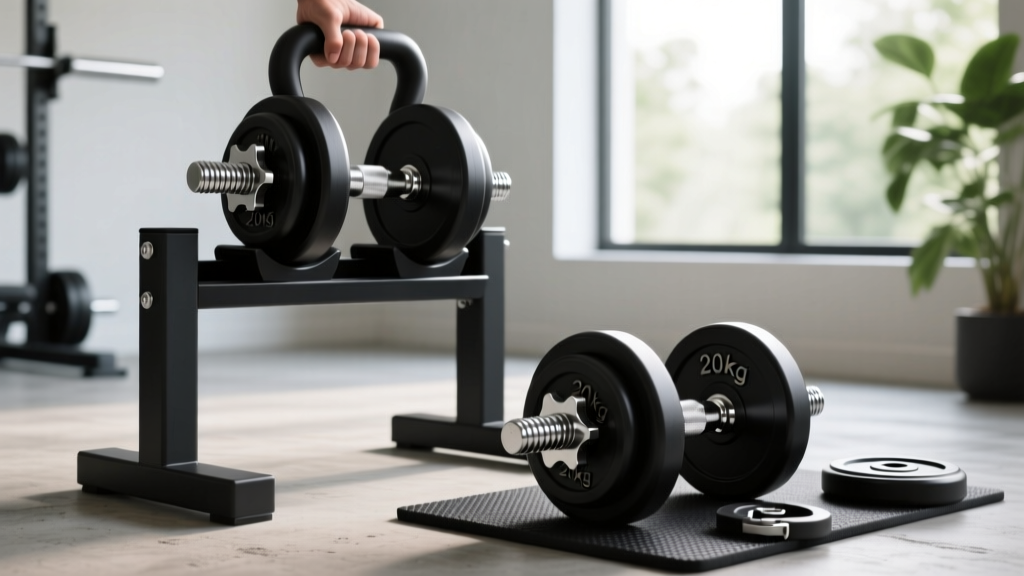
Collar & Clamp Guide: Upgrading a Shoulder Workout Using Dumbbells

Cast Iron vs Competition KB Care: 30 Min Glute Workout with Dumbbells

Best Beyond Hyperice: Top 7 Alternatives That Outperform in Recovery, Precision, and Value (2024)

Beyond the 30 Pound Dumbbell Workout: Bumper vs Iron Plate Care

The Conor McGregor Dumbbell Setup: Neoprene Weights for Home MMA
