Kotia Treadmill Review: Best Budget Folding Pick for Small Spaces?
Is the Kotia treadmill worth the $250 price tag for small apartments? We break down the budget, footprint, and long-term value of this folding machine.

The True Cost of the Kotia Treadmill: A 2026 Budget Breakdown
When outfitting a small apartment or a compact home office, the allure of a sub-$300 folding treadmill is undeniable. As of early 2026, the Kotia treadmill has dominated budget-friendly marketplaces, frequently retailing between $239 and $269. But in the world of home fitness equipment, the sticker price is rarely the final cost of ownership. To truly evaluate this machine from a value analysis perspective, we must look beyond the initial checkout total and examine the hidden costs required to make this budget cardio machine safe, functional, and durable.
Hidden Cost Breakdown
- Base Price: $249.00 (Average 2026 Amazon/Walmart pricing)
- High-Density PVC Equipment Mat (Required): $35.00. Budget treadmills lack sealed motor housings. Without a mat, floor dust is sucked into the motor compartment, causing premature overheating and voiding the warranty.
- 100% Silicone Lubricant (Required): $12.00. The factory belt coating degrades within 40 miles of use.
- Surge Protector: $25.00. Cheap PWM motor controllers are highly susceptible to voltage spikes.
- Total True Entry Cost: ~$321.00
At roughly $321 out the door, the Kotia still undercuts entry-level models from brands like Horizon or ProForm by over 60%. However, this financial saving introduces specific spatial and biomechanical compromises that small-space dwellers must carefully weigh.
Spatial Efficiency: Measuring the "Small Space" Claim
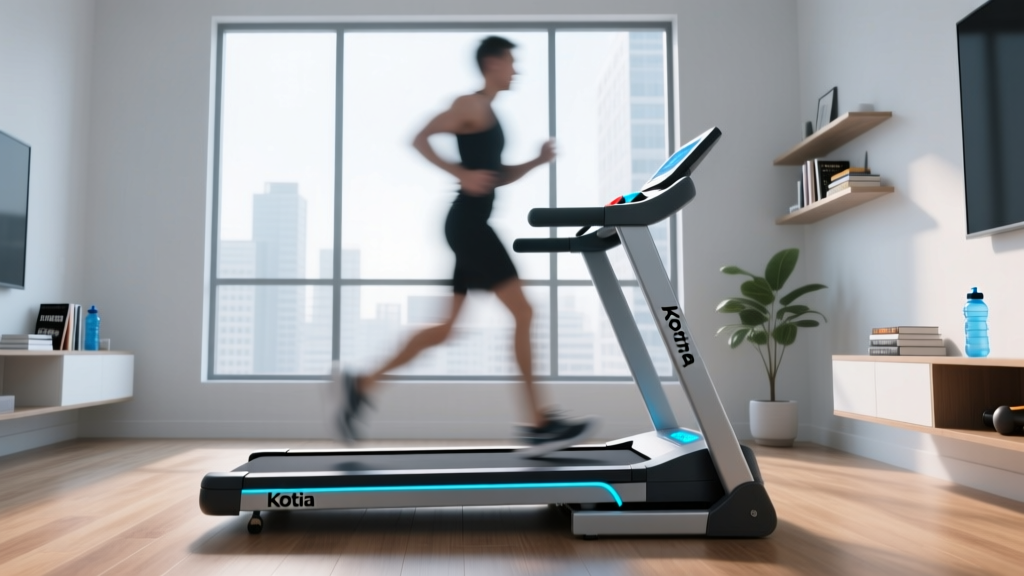
The primary selling point of any folding treadmill for small spaces is its footprint. The Kotia folding treadmill utilizes a manual pin-lock folding mechanism rather than a premium hydraulic soft-drop system. When deployed, the unit measures approximately 45 inches long by 20 inches wide, occupying roughly 6.25 square feet of floor space.
When folded upright, the dimensions shrink to a 21" x 20" base with a height of 44". Weighing in at just 65 lbs, it is light enough for a single person to tilt and roll into a closet or tuck behind a sofa. However, the lack of transport wheels on some of the base Kotia models means you are manually deadlifting 65 lbs of awkward, shifting mass every time you want to transition your living room from "office mode" to "gym mode."
Biomechanical Compromises in Compact Designs
The most critical spatial compromise is the running deck. The Kotia features a 40" x 15" belt. To put this in perspective, a standard commercial treadmill belt is 60" x 20". A 15-inch width requires a highly constrained, narrow gait. According to biomechanical standards, normal walking gait width is 2 to 4 inches, but running or brisk walking requires lateral stability. Furthermore, the 40-inch length forces any user over 5'8" to shorten their natural stride by 12% to 15%. Over long sessions, this altered hip flexor engagement can lead to anterior knee strain. If you are strictly walking at 3.0 mph, the deck is adequate; if you intend to jog, the spatial footprint becomes a safety hazard.
Performance vs. Price: Where the Value Proposition Fractures
To understand the value of the Kotia treadmill, we must compare its internal components against the broader market. Budget brands frequently advertise "2.0 HP Peak" motors. It is vital to understand that Peak Horsepower is the maximum draw the motor can hit for a fraction of a second before tripping the breaker. The Continuous Horsepower (CHP)—the metric that actually matters for sustained cardio—is typically around 1.0 to 1.25 CHP on these models.
| Feature | Kotia Compact | Sunny Health SF-T7515 | Horizon T101 |
|---|---|---|---|
| Price (2026) | $249 | $389 | $699 |
| Motor (CHP) | ~1.0 CHP (2.0 Peak) | 2.5 Peak | 2.75 CHP |
| Belt Size | 40" x 15" | 49" x 18" | 55" x 20" |
| Weight Capacity | 220 lbs | 270 lbs | 300 lbs |
| Incline | Fixed / Manual | 3-Level Manual | 0-10% Motorized |
As the American Heart Association recommends a minimum of 150 minutes of moderate-intensity aerobic activity per week, consistency is key. If the Kotia's motor overheats and triggers its thermal cutoff switch at the 35-minute mark because a 190 lb user is walking at a brisk 4.0 mph, it fails to support the very health guidelines it is meant to facilitate.
Durability and Edge Cases: What Breaks First?
In our value analysis, we must account for the depreciation and failure rates of budget fitness gear. The Kotia treadmill utilizes a basic PWM (Pulse Width Modulation) motor controller. When your foot strikes the deck, it creates a momentary amperage spike. On a premium machine, the controller absorbs this. On the Kotia, a heavier user walking at high speeds can spike the draw to 12-15 amps, which gradually degrades the MOSFETs on the controller board over 6 to 8 months of daily use.
"Consumers must understand the difference between Peak and Continuous Horsepower. A 2.0 Peak HP motor is essentially a 1.0 CHP motor. It is engineered for walking, not the sustained friction and impact load of running. Using a budget walking treadmill for jogging is the fastest way to destroy the deck and fry the motor controller."
Another common edge case involves the folding hinge. The friction-based pin mechanism relies on plastic casing alignment. If the treadmill is folded and unfolded aggressively without lifting the deck slightly to relieve pressure on the pin, the plastic housing can develop micro-fractures within the first year. Regular maintenance, specifically vacuuming under the motor hood every 60 days and lubricating the belt every 30 miles, is non-negotiable if you want this machine to survive past its 90-day limited warranty.
The "Upgrade Threshold" Decision Framework
How do you know if the Kotia is a smart financial move or a false economy? Use this decision framework to determine if you should stick to the $250 budget or cross the "upgrade threshold" into the $500+ category.
- The User Weight Rule: If the primary user weighs over 185 lbs, the Kotia's 1.0 CHP motor will operate at 80%+ capacity just to maintain a 3.5 mph walking pace. Upgrade to a minimum 2.5 CHP machine (like the Sunny Health or Horizon) to prevent motor burnout.
- The Height and Stride Rule: If you are taller than 5'9", the 40-inch belt will force an unnatural gait. According to physical therapy guidelines referenced by the Mayo Clinic, altered walking mechanics can lead to joint stress. Upgrade to a 50-inch+ belt.
- The Frequency Multiplier: If you plan to use the treadmill more than 5 days a week, the cost-per-use of a $700 treadmill over 3 years is vastly superior to replacing a $250 treadmill every 11 months. If you only walk 3 times a week while watching TV, the Kotia's value proposition holds strong.
Final Verdict: Maximizing Your ROI
The Kotia treadmill is not a commercial-grade machine disguised as a bargain; it is exactly what it claims to be—a highly compact, entry-level walking pad designed for small spaces and light use. From a strict budget breakdown perspective, it offers an unbeatable spatial-to-price ratio for urban apartment dwellers, remote workers utilizing standing desks, and seniors looking for low-impact, low-speed indoor walking.
However, value is intrinsically tied to use-case alignment. If your goal is Couch-to-5K training, high-intensity interval jogging, or if you have a larger physical frame, the Kotia is a poor investment that will cost you more in frustration and replacement parts. But if you need a simple, stowable solution to hit your daily step count without sacrificing half your living room, the Kotia remains one of the most pragmatic budget folding treadmills on the market in 2026. Just remember to buy the equipment mat.
More gear to consider
All reviews
Motor Comparison & How to Fix Motor in Treadmill That's Belt is Stuck

Elliptical vs Treadmill: Walking on Treadmill for 30 Minutes Daily

Equinox Treadmills vs Ellipticals: Home Cardio Maintenance Guide

Treadmill Motor Guide for 10000 Steps on Treadmill Calculator Targets
Curved Manual vs Motorized Treadmill: Sole Treadmill Lube & Care