
Jump Rope Types: Speed, Weighted, Beaded & Normal Yoga Mat Thickness
Compare speed, weighted, and beaded jump ropes. Learn how normal yoga mat thickness impacts your rope choice, footwork, and joint health.

The 2026 Home Gym Dilemma: Rope Selection and Floor Dynamics
Jump rope training has evolved far beyond the schoolyard. In 2026, it stands as a cornerstone of hybrid home fitness, prized for its unparalleled cardiovascular efficiency and neuromuscular coordination benefits. However, as enthusiasts transition from concrete driveways to indoor home gyms, a critical variable is often overlooked: the interaction between your jump rope type and your flooring. Specifically, understanding how normal yoga mat thickness alters the physics of your jump is the difference between a fluid, joint-friendly workout and a frustrating session plagued by tripped cables and ankle fatigue.
Whether you are practicing double-unders or weighted power slams, the surface beneath you dictates energy return, acoustic feedback, and rope durability. According to the American College of Sports Medicine (ACSM), plyometric exercises like jumping rope require optimal ground reaction force management to protect the Achilles tendon and plantar fascia. When you introduce a dampened surface like a yoga mat into the equation, your equipment choices must adapt.
Decoding the Big Three: Speed, Weighted, and Beaded Ropes
Before analyzing floor interaction, we must establish the mechanical differences between the three primary jump rope categories. Each design serves a distinct physiological purpose and reacts uniquely to soft flooring.
1. Speed Ropes
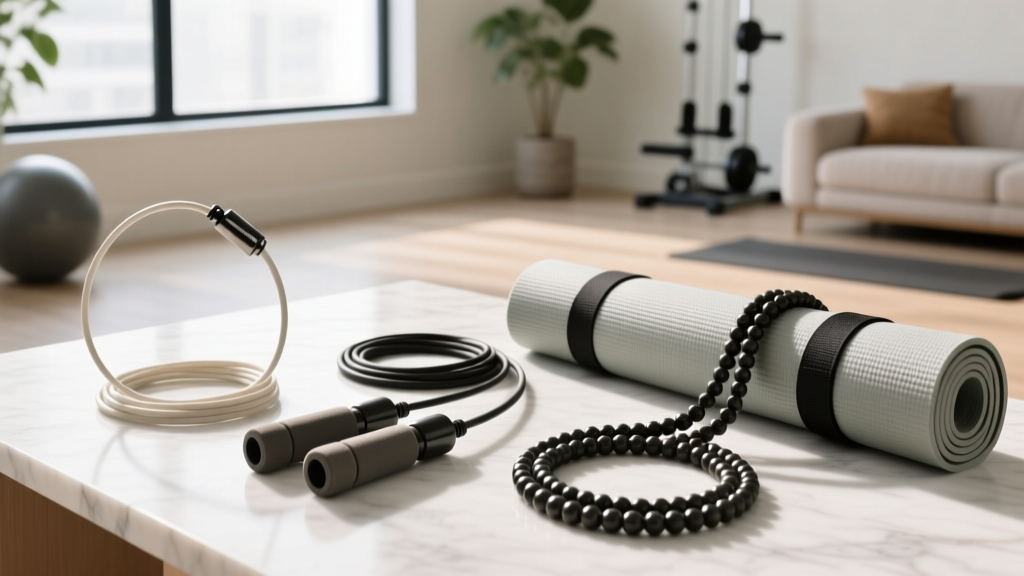
Designed for velocity and advanced maneuvers like double-unders and triple-unders. These feature ultra-thin cables (typically 1.5mm to 2.5mm) made of bare steel wire coated in PVC, or pure polymer. They rely on 90-degree ball-bearing swivels in the handles to minimize drag. Because they possess virtually no mass, the user must generate all the momentum through precise wrist flicks.
2. Weighted Ropes
These ropes integrate mass into the handles or the cable itself, ranging from 1/4 lb to over 2 lbs. The added weight provides tactile feedback, making it easier for beginners to track the rope's arc. Furthermore, the American Council on Exercise (ACE) notes that weighted ropes significantly increase upper body muscle activation, turning a cardio session into a full-body endurance workout.
3. Beaded Ropes
Constructed from a nylon core strung with 1-inch cylindrical polyurethane beads. They are highly durable, do not tangle easily, and provide a distinct 'click' sound upon ground contact. This acoustic feedback is invaluable for timing and rhythm, especially for beginners learning the basic bounce.
| Rope Type | Avg. Weight | Cable Material | Best For | 2026 Avg. Price |
|---|---|---|---|---|
| Speed | 2 - 4 oz | Steel Wire / PVC | Double-unders, HIIT, Agility | $12 - $25 |
| Weighted | 1/4 lb - 2 lbs | Heavy Polymer / Steel Core | Muscle endurance, Beginners | $45 - $110 |
| Beaded | 6 - 9 oz | Nylon Core + PU Beads | Rhythm, Trick training, Outdoors | $25 - $45 |
Why Normal Yoga Mat Thickness Dictates Your Rope Choice
When fitness professionals refer to normal yoga mat thickness, they are generally describing the industry-standard 4mm to 5mm (approx. 1/8 to 3/16 inch) range. Premium examples include the Manduka PROlite (4.7mm) or the Lululemon The Mat (5mm). This thickness is engineered to provide a balance of joint cushioning and standing stability for yoga asanas. However, for the high-impact, repetitive loading of jump rope training, this specific thickness creates unique biomechanical challenges.
The 5mm Threshold Rule
Any mat thickness exceeding 5mm begins to absorb the kinetic energy required for a rapid rebound. When you jump on a standard 5mm PVC or TPE mat, the foam compresses under your metatarsals. This 'sinking effect' increases your ground contact time by milliseconds—just enough to disrupt the timing required for a speed rope to clear your feet, leading to frustrating toe-catches.
The Friction and Durability Factor
Speed ropes featuring bare or thinly coated steel cables act like whips. When a 2mm steel cable strikes a 5mm PVC yoga mat at high velocity, it does not bounce; it slices. Over a few weeks of indoor training, a speed rope will carve permanent micro-grooves into a standard yoga mat, compromising its structural integrity and leaving black scuff marks. Conversely, the thick polyurethane beads of a beaded rope distribute the impact force over a wider surface area, bouncing cleanly off the mat without causing abrasion.
Step-by-Step: Matching Your Rope to Your Mat and Goals
To build a sustainable indoor jump rope routine, follow this decision framework to align your equipment with your flooring.
- Step 1: Audit Your Flooring Density. Press your thumb firmly into your mat. If you can easily bottom out and feel the floor beneath, your mat is likely a low-density 4mm travel or budget mat. If it offers firm resistance, you have a high-density 5mm mat. High-density mats offer better energy return for speed work.
- Step 2: Define Your Primary Objective. If your goal is pure cardiovascular conditioning and mastering double-unders, you need a speed rope. If you want to build shoulder endurance and grip strength, opt for a weighted system like the CrossRope Get Lean (1/4 lb).
- Step 3: Select the Compatible Rope.
- For Speed Work on a 5mm Mat: Use a 2.5mm PVC-coated cable (never bare steel) to protect the mat surface. Expect to jump slightly higher to compensate for the mat's energy absorption.
- For Weighted Ropes on a 5mm Mat: Limit your rope weight to 1/2 lb or less. Heavier ropes (1 lb+) require aggressive downward force; when paired with a soft 5mm mat, this creates ankle instability as the foam compresses unevenly under heavy loads.
- For Beginners on Any Standard Mat: Choose a beaded rope (e.g., Rx Smart Gear). The acoustic 'click' on the mat provides the timing cue your brain needs, and the beads will not damage the PVC surface.
Real-World Failure Modes: When the Mat and Rope Clash
Even experienced athletes make equipment mismatches. Here are the most common failure modes observed in home gyms, and how to troubleshoot them.
- The 'Mud' Effect (Weighted Rope + Thick Mat): Using a 1 lb heavy rope on a 6mm+ thick mat causes severe calf fatigue. The mat absorbs the downward strike, forcing the user to pull the heavy cable out of the 'mud' on every rotation. Fix: Move to a hard surface or drop the rope weight to 1/4 lb.
- The Scuff-and-Slice (Speed Rope + TPE Mat): TPE (Thermoplastic Elastomer) mats are highly eco-friendly but notoriously soft. A speed cable will shred a TPE mat in under ten sessions. Fix: Place a thin, high-density EVA foam puzzle tile under your mat, or switch to a beaded rope.
- The Static Cling Trip (PVC Mat + PVC Cable): In dry winter climates, the friction between a PVC-coated speed cable and a PVC yoga mat generates static electricity, causing the rope to cling to the mat for a microsecond upon impact, altering the bounce arc. Fix: Wipe the mat with a damp microfiber cloth before your session to dissipate static.
Expert Sizing Framework for Dampened Surfaces
Proper rope sizing is non-negotiable for injury prevention. Standard sizing charts assume you are jumping on a hard, non-compressible surface like wood or concrete. When you introduce normal yoga mat thickness (4mm-5mm) into the equation, your effective standing height is slightly reduced, and your jump arc is dampened.
To size your rope correctly for indoor mat training:
- Stand on the center of the rope with one foot, wearing your actual training shoes.
- Pull the handles upward along your body.
- For Speed Ropes on a yoga mat, the base of the handles should reach exactly to your armpit. The slight compression of the mat requires a marginally longer cable than outdoor sizing to prevent toe-catches.
- For Weighted and Beaded Ropes, the handles should reach the bottom of your rib cage. The heavier mass requires a shorter arc to maintain control and prevent the rope from bottoming out too far in front of your feet, which can cause shoulder impingement over time.
By respecting the physics of your flooring and selecting the appropriate jump rope type, you transform a standard yoga mat from a potential tripping hazard into a highly effective, joint-preserving launchpad for your 2026 fitness goals.
More gear to consider
All reviews
Gaiam Yoga Mat Folding Travel Fitness & Band Set Guide

How To Choose Safety: A Practical, Evidence-Based Guide for Industrial and Construction Professionals

Yoga Block & Strap Guide: Space Layouts & Yoga Mat Holder Wall Mount
Jump Rope Types Troubleshooting & How to Strap a Yoga Mat
Beginner Pull-Up Band Sizing & Yoga Mat Size Guide
