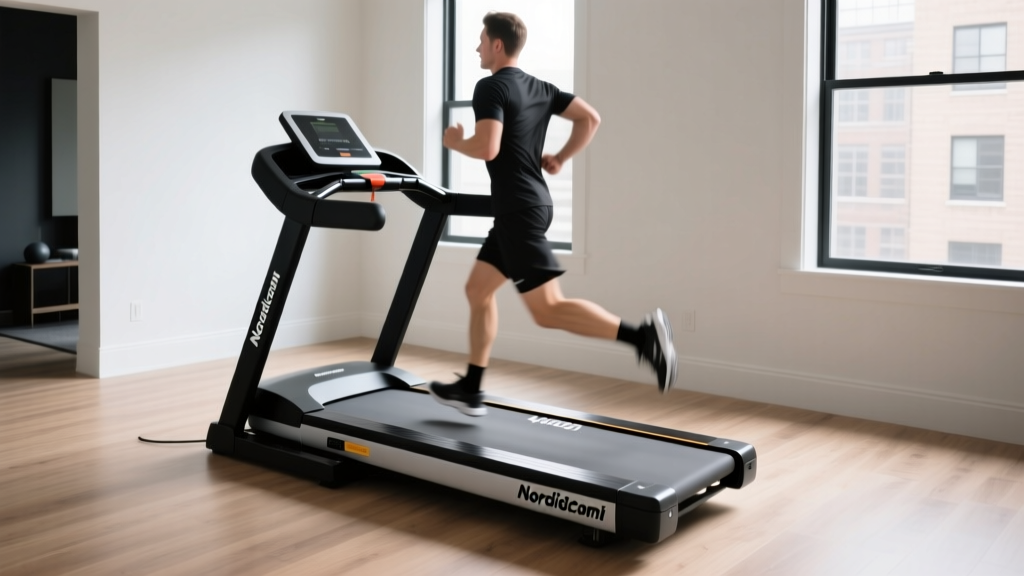
Best Treadmills for a 15-Minute Workout: Buying Guide
Discover the best treadmills for a 15-minute workout. Our beginner-friendly buying guide compares key features, motor specs, and top models for quick cardio.

Why Your Treadmill Must Be Optimized for 15-Minute Sessions
For beginners and busy professionals alike, the 15-minute treadmill workout has become the gold standard for daily cardiovascular health. According to the Mayo Clinic, high-intensity interval training (HIIT) can deliver the same aerobic and metabolic benefits in 15 minutes as a 45-minute steady-state jog. However, most treadmill buying guides focus on marathon runners or hour-long steady walkers, completely ignoring the mechanical demands of short, intense sessions.
When you only have 15 minutes, you cannot afford to spend three minutes waiting for a sluggish incline motor to reach 12%, or fumbling through a touchscreen menu to change your speed. A machine built for quick cardio must feature rapid acceleration curves, physical quick-keys, and high-torque incline mechanics. This step-by-step beginner's guide breaks down the exact features you need to compare when buying a treadmill specifically for a 15-minute workout in 2026.
Beginner Insight: The American Heart Association notes that even short bouts of vigorous activity count toward your weekly 75-minute minimum requirement. A 15-minute daily routine is clinically sufficient, provided the intensity is high enough.Step 1: Match the Motor CHP to Your 15-Minute Style
Not all 15-minute workouts are created equal. Your choice of Continuous Duty Horsepower (CHP) depends entirely on the type of short session you plan to run.
For 15-Minute HIIT (Sprints and Intervals)
HIIT requires rapid transitions between walking (3 mph) and sprinting (8 to 10 mph). Budget treadmills with 2.0 to 2.5 CHP motors often suffer from 'acceleration lag,' taking 5 to 8 seconds to reach top speed. In a 15-minute workout with eight 30-second sprint intervals, that lag eats up over a minute of your actual work time. You need a minimum of 3.0 CHP (ideally 3.5 CHP) to ensure the belt responds in under 2 seconds. The Sole F80 (3.5 CHP, typically priced around $999) is a benchmark here, offering immediate torque without straining the motor.
For 15-Minute Incline Power Walks
If your routine involves walking at a steep 10% to 15% incline at 3 mph, speed acceleration matters less than high-torque incline motors. Pushing a user's body weight up a steep grade generates immense heat and friction. Look for motors rated for continuous incline use, and avoid peak-HP marketing traps.
Step 2: Incline Ramp Rates and Deck Friction
In a 45-minute workout, a slow incline ramp rate is a minor annoyance. In a 15-minute workout, it is a dealbreaker. Many entry-level treadmills elevate at a rate of 0.5% per second. To reach a 12% incline, you would wait 24 seconds—nearly 3% of your total workout time spent just waiting for the deck to rise.
- Standard Ramp Rate: 0.5% per second (Avoid for short HIIT incline intervals).
- Rapid Ramp Rate: 1% to 1.5% per second. The Horizon 7.0 AT (approx. $999) features a rapid-response incline system specifically designed to keep up with interval apps and quick manual adjustments.
Friction Failure Mode: During steep 15-minute incline walks, the belt presses harder against the deck, generating excess heat. If the treadmill uses a cheap 1-ply belt, it will stretch and slip within a few months. Always verify that the machine uses a 2-ply, 1.4mm+ thick belt with pre-applied silicone lubrication to handle the localized heat of steep, short-duration walking.
Step 3: Console Ergonomics (Why Touchscreens Fail Quick Workouts)
When executing a 15-minute treadmill workout, your heart rate is often elevated, and your hands may be sweaty. Large, tablet-style touchscreens look impressive in a showroom, but they require you to navigate menus, swipe, and tap small digital buttons to change your speed from 4 mph to 7 mph.
For short, intense sessions, physical tactile quick-keys are mandatory. You need dedicated, raised buttons for specific speeds (e.g., 3, 6, 9 mph) and inclines (e.g., 5%, 10%, 15%) that you can hit without looking down. Machines that prioritize massive HD screens over physical buttons will actively hinder the flow of a rapid interval session.
2026 Feature Comparison Matrix: Top Picks for Quick Cardio
Below is a structured comparison of three distinct treadmill categories optimized for the 15-minute timeframe, based on current market pricing and mechanical specifications.
| Model / Category | Best 15-Min Routine | Motor & Incline Specs | Console Type | Est. Price (2026) |
|---|---|---|---|---|
| Horizon 7.0 AT | App-guided HIIT & Intervals | 3.0 CHP, Rapid 1% / sec incline ramp | Physical quick-keys, basic LCD | $999 |
| Sole F80 | Heavy-duty Sprint Intervals | 3.5 CHP, 15% max incline, 22x60 belt | Hybrid (Dial + physical speed keys) | $999 |
| UREVO Strol 2E (Walking Pad) | Low-Impact LISS Recovery Walks | 2.0 Peak HP, 5% fixed manual incline | Minimalist remote + LED display | $349 |
Step 4: Real-World Failure Modes to Avoid
When buying a treadmill for short, intense bursts, be aware of these specific mechanical failure modes that plague poorly engineered machines:
- DC Motor Thermal Shutoff: Direct Current (DC) motors in sub-$500 treadmills are not designed for the rapid start-stop-start cycles of a 15-minute HIIT workout. The sudden current draw causes the internal windings to overheat, triggering a safety shutoff halfway through your session. Always verify the motor has a heavy-duty flywheel (at least 4 lbs) to assist with momentum and reduce electrical strain.
- Deck Delamination: Short, high-speed intervals generate concentrated kinetic impact. If the deck lacks elastomer cushioning (like the 8-zone variable cushioning found on higher-end models), the friction will eventually cause the deck laminate to peel, creating dead spots that ruin your stride and burn out the motor.
- Handrail Wobble on Steep Incline: During a 15-minute steep incline walk, beginners often rely heavily on the handrails. If the uprights are made of thin, low-gauge steel, the entire console will shake violently at a 12% grade, making it impossible to read the display or safely dismount.
Expert Warning: Never use a motorized treadmill's safety clip as an excuse to skip a proper warm-up. In a 15-minute session, spend the first 3 minutes at 2.5 mph on a flat incline to allow the belt lubrication to distribute evenly before initiating high-speed or high-incline intervals.
Final Verdict: Choosing Your 15-Minute Machine
To successfully execute a 15-minute treadmill workout, your equipment must eliminate all friction between you and the exercise. If your goal is high-intensity interval training, prioritize the Horizon 7.0 AT for its rapid incline response and physical buttons. If you are a heavier user or plan on aggressive sprinting, the Sole F80's 3.5 CHP motor and expansive 22-inch belt provide the necessary safety margin and durability.
Conversely, if your 15-minute routine consists of a brisk, low-impact walk while catching up on emails or a morning podcast, a high-quality walking pad like the UREVO Strol 2E is a highly efficient, space-saving alternative that costs a fraction of the price. By matching the machine's mechanical strengths to your specific 15-minute routine, you guarantee that every single second of your workout is optimized for cardiovascular health.
More gear to consider
All reviews
How Old Was the Inventor of the Treadmill? Plus Top Under-Desk Picks

Elliptical vs Treadmill: The 2026 Arch Treadmill Market Shift
Centr Runr Treadmill vs Walking Pads: 2026 Compact Desk Review

Does a Treadmill Use a Lot of Electricity? Belt Maintenance Impact

Nordic Track Treadmill Review: 2026 Folding Models for Small Spaces