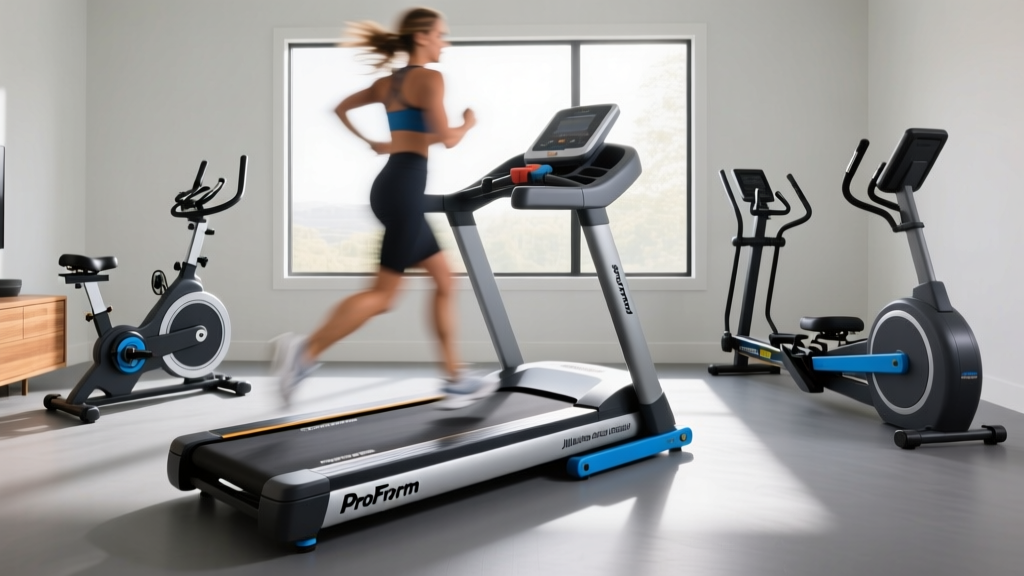
Jillian Michaels ProForm Treadmill Noise Fixes & Cardio Comparisons
Troubleshoot Jillian Michaels ProForm treadmill noise and compare decibel levels across top cardio machines. Fix squeaks, thumps, and motor hums today.

Building a home gym in 2026 often means working with limited square footage, shared walls, and downstairs neighbors. While cardio equipment offers unparalleled convenience, the acoustic footprint of these machines can quickly become a household nuisance. The Jillian Michaels ProForm treadmill line—encompassing the highly popular legacy and modern ProForm models she endorsed, such as the 7.0S, 8.0S, and specific JM-branded series—remains a staple in many home gyms due to its robust Mach Z commercial motors and structured workout programming. However, treadmills are inherently percussive machines.
If your daily run has devolved into a symphony of squeaks, thumps, and high-pitched whines, you are likely dealing with a mix of user error, deferred maintenance, and structural resonance. This guide serves as your comprehensive troubleshooting manual for the Jillian Michaels ProForm treadmill, while also providing a broader cardio machine noise level comparison to help you understand the acoustic realities of your entire home gym setup.
The Decibel Breakdown: Cardio Machine Noise Level Comparison
Before diving into the wrench-and-lube troubleshooting phase, it is critical to establish a baseline. Not all cardio machines are created equal when it comes to acoustic output. According to standard acoustic measurements referenced by the National Institute for Occupational Safety and Health (NIOSH) and acoustic standards, a normal conversation sits around 60 dB, while a vacuum cleaner operates at roughly 70-75 dB.
| Machine Type | Popular Example | Primary Noise Source | Avg. Decibel Range | Vibration Transfer |
|---|---|---|---|---|
| Treadmill | Jillian Michaels ProForm 8.0S | Footstrike impact, motor hum, belt friction | 65 - 78 dB | High (Structure-borne) |
| Air Bike | Rogue Echo / Assault Bike | Wind resistance fan blades | 70 - 85 dB (Scales with RPM) | Low |
| Elliptical | NordicTrack FS14i | Pivot joints, magnetic resistance flywheel | 45 - 55 dB | Very Low |
| Magnetic Rower | Hydrow / Concept2 RowErg | Rail rollers, chain/belt tension, damper | 50 - 65 dB | Moderate (Horizontal) |
| Spin Bike | Peloton Bike+ / Keiser M3i | Drivetrain (belt/chain), pedal bearings | 40 - 50 dB | Very Low |
As the data illustrates, treadmills and air bikes are the loudest offenders, but for entirely different reasons. Air bikes generate airborne noise (the sound of moving air and fan blades), while treadmills generate a combination of airborne motor noise and structure-borne noise (vibrations traveling through the floor joists).
Troubleshooting the Jillian Michaels ProForm Treadmill
The Jillian Michaels ProForm treadmill series typically features a 2.5 to 3.0 Continuous Horsepower (CHP) motor and a 1-ply or 2-ply commercial walking belt. When these machines become excessively loud, users often make a few critical maintenance mistakes.
Mistake 1: Ignoring the Silicone Lubrication Schedule
The Symptom: A high-pitched whining or squealing sound that worsens as the machine heats up, often accompanied by the motor hood feeling unusually warm.
The Fix: ProForm decks are pre-lubricated at the factory, but the silicone degrades over time. When friction increases between the walking belt and the wooden deck, the motor has to work harder, drawing more amps and generating a mechanical whine. You must apply 100% silicone treadmill lubricant (never use WD-40 or petroleum-based oils, which will destroy the belt). Lift the center of the belt and apply a zigzag pattern of silicone directly onto the deck. Run the treadmill at 2.0 MPH for three minutes without stepping on it to distribute the lube evenly.
Mistake 2: Over-Tightening the Walking Belt
The Symptom: A rhythmic 'thumping' or a strained, low-frequency hum from the rear roller.
The Fix: Many users mistakenly tighten the belt to fix a slipping issue, but over-tensioning puts massive lateral stress on the roller bearings and the motor drive belt. Using a 3/16-inch or 5mm hex key (depending on your exact ProForm model year), locate the rear roller adjustment bolts. To properly tension the belt, you should be able to lift the center of the belt roughly 2 to 3 inches off the deck. Adjust the left and right bolts in exact quarter-turn increments to maintain perfect alignment.
⚠️ Critical Warning: Never use petroleum-based solvents or standard household oils on your ProForm treadmill. According to ProForm's official support and maintenance guidelines, using non-silicone lubricants will void your warranty and cause the walking belt to delaminate and stretch irreparably within weeks.Diagnostic Flowchart: Identifying Your Treadmill's Noise Profile
If the basic maintenance steps above do not resolve the issue, use this diagnostic checklist to isolate the failure point:
- Is the noise a rhythmic 'slap' or 'thump'?
- Cause: The walking belt seam is passing over the deck, or a roller bearing is failing.
- Action: Inspect the belt seam for lifting. If the belt is smooth, spin the front and rear rollers by hand (with the machine unplugged). If you feel grinding or hear a clicking, the sealed bearings are shot and the roller must be replaced.
- Is there a rattling or buzzing vibration?
- Cause: Loose motor hood screws, side rail caps, or the incline motor actuator.
- Action: Remove the motor hood (usually 4 to 6 Phillips-head screws). Check the flywheel and drive belt for dust buildup. Tighten all mounting brackets. Ensure the incline lift tube is properly greased with white lithium grease.
- Does the noise only happen when your foot strikes the deck?
- Cause: Impact resonance transferring to the floor.
- Action: See the 'Structure-Borne Noise' section below.
Structure-Borne vs. Airborne Noise: The Apartment Dilemma
When evaluating cardio machine noise levels, apartment dwellers must understand the physics of sound transmission. The Environmental Protection Agency (EPA) notes that low-frequency, structure-borne vibrations are the primary culprit in residential noise complaints, as they bypass standard wall insulation and travel directly through building frameworks.
When you run on a Jillian Michaels ProForm treadmill, the impact force of your footstrike can exceed 2.5 times your body weight. This kinetic energy travels down the treadmill's uprights, into the floor, and across the ceiling of your downstairs neighbor.
Pro Tip for Multi-Level Homes: Standard PVC or thin yoga mats do nothing to stop low-frequency impact noise. To properly decouple a treadmill from your floor joists, you need a high-density, 3/8-inch to 1/2-inch thick vulcanized rubber anti-vibration mat. In 2026, a premium 3/8-inch rubber horse-stall mat or specialized treadmill isolation pad costs between $45 and $85 and will reduce structure-borne noise transfer by up to 60%.
Cross-Machine Comparison: Fixing Squeaks on Ellipticals and Bikes
While the Jillian Michaels ProForm treadmill requires belt and deck maintenance, other cardio machines in your gym might be contributing to the overall noise pollution. Here is how to troubleshoot the unique noise profiles of alternative cardio equipment:
- Ellipticals (e.g., ProForm Hybrid Trainer): The most common mistake is using WD-40 on the pivot arms. Elliptical joints require white lithium grease or PTFE (Teflon) dry lubricant. If you hear a 'clunk' at the apex of your stride, check the crank arm bolts connecting the pedals to the flywheel; these loosen over time and require a socket wrench to re-torque.
- Indoor Cycling Bikes (Belt Drive): Belt-drive bikes are virtually silent, but if you hear a 'chirping' sound, the poly-V drive belt is likely misaligned or lacking tension. Unlike chain-drive bikes, you should never lubricate a rubber drive belt. Simply adjust the bottom bracket tensioner.
- Magnetic Rowers: A grinding noise on the rail usually means dust and pet hair have mixed with the factory grease on the seat rollers. Wipe the aluminum rail with isopropyl alcohol and a microfiber cloth. Do not apply oil to the rail, as it will attract more debris and create a sticky, noisy sludge.
When to Call ProForm Support (Warranty & Edge Cases)
Most treadmill noise issues are resolved with a hex key, a bottle of silicone, and a rubber mat. However, certain failure modes require professional intervention. If your Jillian Michaels ProForm treadmill exhibits a loud, metallic 'grinding' from deep within the motor housing, or if the Motor Control Board (MCB) is emitting a high-pitched electronic squeal before tripping your circuit breaker, do not attempt to open the motor casing.
Internal motor brush wear or a failing MCB capacitor requires specialized diagnostic tools. Always have your serial number (located on the front frame near the power cord) ready, and reach out directly to ProForm Customer Service to verify your warranty status. Attempting to rewind a motor or solder an MCB yourself will immediately void your coverage and poses a severe electrical hazard.
By understanding the acoustic differences between cardio machines and committing to a strict, silicone-based maintenance schedule, you can keep your Jillian Michaels ProForm treadmill running smoothly and quietly for years to come, ensuring your home gym remains a sanctuary rather than a source of household friction.
More gear to consider
All reviews
Echelon Stride Sport Treadmill: 2026 Compact Cardio Market Trends

Treadmill for Walking Exercise vs Bikes: 2026 Budget

Stair Climber Setup Guide: Pairing With a Dumbbell Rowing Machine
Treadmill vs Cycling: Step-by-Step Buying Guide & Feature Comparison
Setup Guide: Motor Size for an 8:30 Pace on Treadmill
