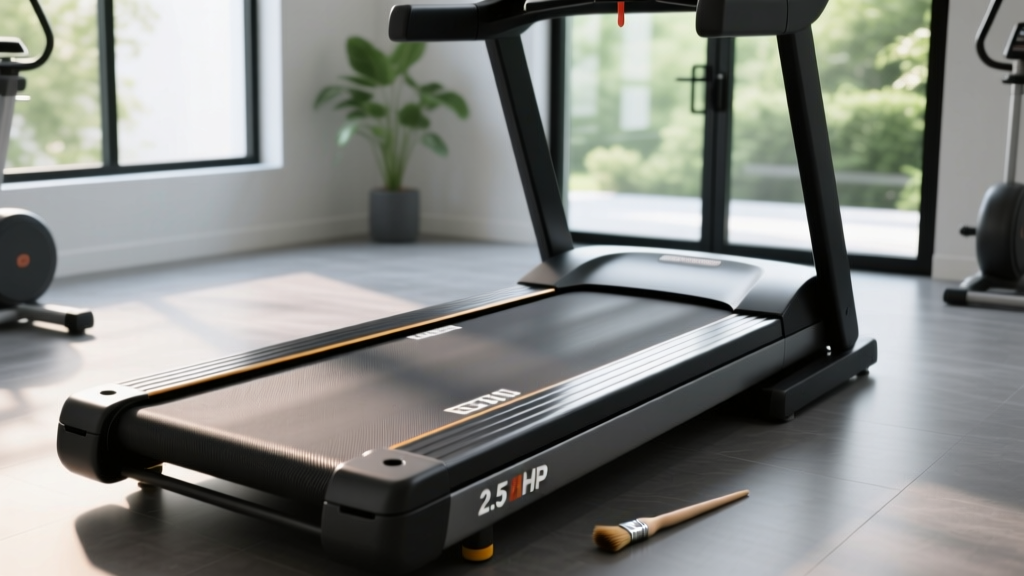
2.5 HP Treadmill Belt Maintenance: Lubrication & Longevity Guide
Learn how to properly lubricate and maintain your 2.5 HP treadmill belt. Prevent motor burnout, reduce friction, and extend your machine's lifespan.

The Hidden Vulnerability of 2.5 HP Treadmill Motors
Owning a 2.5 hp treadmill means you have a highly efficient, light-duty machine perfect for walking, jogging, and small-space home gyms. Popular models in this category, such as the Sunny Health SF-T7515, XTERRA Fitness TR150, and various ProForm light-duty series, rely on these compact motors to deliver consistent performance. However, because a 2.5 HP motor operates closer to its maximum threshold during running compared to a 3.5 HP or 4.0 HP commercial motor, it is uniquely vulnerable to one specific killer: belt friction.
When the walking belt dries out, the coefficient of friction between the belt and the deck spikes. This forces the motor to work exponentially harder, generating excessive heat and ultimately leading to catastrophic failure of the Motor Control Board (MCB) or the drive motor itself. According to repair data analyzed by the Treadmill Doctor, over 60% of premature home treadmill motor failures are directly traced back to neglected belt lubrication and improper tensioning.
The Science of Friction: Amp Draw and MCB Failure
To understand why lubrication is non-negotiable, you must understand amp draw. A healthy, well-lubricated 2.5 hp treadmill motor will pull between 4 to 6 amps during a standard 3.5 mph walk, and 6 to 9 amps during a 6.0 mph run.
When the belt lacks 100% silicone lubrication, friction increases. The motor must draw more electrical current to maintain the same belt speed. A dry belt can push the amp draw to 12 to 15+ amps. This massive surge in current overheats the MCB. While modern MCBs have thermal breakers that will trip and shut the machine down to prevent a fire, repeated thermal tripping degrades the internal capacitors and MOSFETs. Replacing an MCB typically costs between $120 and $220, not including labor—a completely avoidable expense if you maintain the belt.
⚠️ Critical Warning: The '100% Silicone' Rule
Never use WD-40, standard household oils, or petroleum-based lubricants on your treadmill belt. Petroleum products will chemically degrade the urethane and polyester weave of the walking belt, causing it to stretch, warp, and delaminate. Furthermore, solvents will strip the factory-applied paraffin wax coating off the wooden deck. Only use 100% pure silicone treadmill lubricant (typically sold in 4oz bottles for $10 to $15 from brands like Impresa or Godora).
Step-by-Step Belt Lubrication Protocol
For a standard 2.5 hp treadmill used 3 to 4 times a week, lubrication should be performed every 130 miles or every 3 months, whichever comes first. Follow this precise procedure to ensure even distribution without over-saturating the deck.
- Power Down and Secure: Unplug the treadmill from the wall outlet. Remove the safety key to ensure the machine cannot accidentally start while your hands are near the rollers.
- Loosen the Belt Tension: Locate the two rear roller adjustment bolts at the back end caps. Using the provided Allen wrench (usually 6mm), turn both bolts exactly two full turns counter-clockwise. This creates enough slack to lift the belt without stripping the bolt threads.
- Apply the Silicone: Lift the edge of the belt on one side. Insert the applicator tube of your 100% silicone lubricant and squeeze approximately 0.5 oz (half the bottle) in a zig-zag pattern down the center third of the deck. Repeat on the opposite side with the remaining 0.5 oz.
- Re-Tension the Belt: Turn both rear adjustment bolts exactly two full turns clockwise to return them to their original position.
- Distribute the Lubricant: Plug the machine back in. Stand on the side rails, start the treadmill at 2.0 mph, and let it run for 3 minutes. Then, walk on the belt at 3.0 mph for 5 minutes, intentionally shifting your weight from the left foot to the right foot to press the silicone evenly across the entire deck surface.
Diagnostic Table: Is Your Belt Too Dry?
If you do not have an amp meter to measure the exact electrical draw, you can diagnose belt friction using physical symptoms. Cross-reference your machine's behavior with the chart below to determine if immediate maintenance is required.
| Symptom | Normal / Healthy Metric | Danger Zone Metric | Likely Culprit |
|---|---|---|---|
| Belt Hesitation | Smooth, instant response to foot strikes | Belt stutters or slips when foot lands | Dry belt OR loose drive belt |
| Deck Temperature | Cool to slightly warm after 30 mins | Hot to the touch (over 110°F) after 15 mins | Severe friction / lack of silicone |
| Motor Sound | Low, consistent hum | High-pitched whining or labored groaning | Motor strain from dry deck |
| Static Shock | Minimal to none | Frequent shocks when touching console | Dry belt generating static electricity |
Belt Tension and the 'Three-Finger' Rule
Lubrication is only half the battle; proper tension is equally critical. A belt that is too tight will cause the same amp draw spikes as a dry belt, as the motor must fight the physical crush-load of the belt against the deck. Conversely, a belt that is too loose will slip, causing the user to stumble and potentially leading to severe injuries—a risk frequently highlighted in home gym safety reports by Consumer Reports.
To test your tension, use the industry-standard Three-Finger Rule. Turn off and unplug the treadmill. Go to the exact middle of the treadmill deck on the side edge. Lift the walking belt upward. You should be able to fit exactly three fingers (approximately 2.5 inches of vertical clearance) between the bottom of the belt and the top of the deck. If you can fit your whole hand, the belt is too loose. If you can only fit one finger, it is over-tensioned and is actively damaging your 2.5 HP motor bearings.
When to Replace the Belt and Deck
No amount of silicone will save a worn-out deck. Most 2.5 hp treadmill decks are constructed from medium-density fiberboard (MDF) coated with a phenolic resin or paraffin wax. Over time, typically after 1,500 to 3,000 miles, the friction wears through this coating, exposing the raw, porous wood underneath. Once raw wood is exposed, it acts like sandpaper against the walking belt.
According to parts specialists at Fitness Repair Parts, if you lubricate your belt but it still feels gritty, or if you notice black rubber dust accumulating near the rear roller, your deck is likely scored. At this stage, you must replace both the walking belt ($40 to $65) and the deck ($50 to $90) simultaneously. Installing a new belt on a scored deck will destroy the new belt's underside within 30 days.
Expert Insight: When ordering a replacement belt for a light-duty 2.5 HP model, always measure the old belt's length and width while it is still on the machine. Do not rely solely on the manufacturer's manual, as factories occasionally source slightly different deck sizes for the same model number across different production years.
Frequently Asked Questions
Can I use a silicone spray aerosol instead of liquid?
It is highly discouraged. Aerosol silicone sprays often contain propellants and carrier solvents (like isoparaffin) that can degrade the belt glue. Furthermore, the overspray coats the treadmill's electronics, motor brushes, and drive belt, attracting dust and causing electrical shorts. Stick to liquid 100% silicone with an applicator tube.
Why does my 2.5 hp treadmill smell like burning rubber?
A burning rubber smell is an immediate red flag indicating extreme friction. Stop using the machine immediately. Unplug it, check the belt tension, inspect the deck for deep grooves, and apply 100% silicone lubricant. If the smell persists after lubrication, the drive motor's internal brushes or the MCB may have already suffered heat damage.
Do walking pads with 2.5 HP motors need lubrication?
Yes. In fact, low-profile walking pads often require more frequent lubrication (every 60 to 90 days) because their compact decks have less surface area for heat dissipation, and they are frequently stored under beds or desks where dust and pet hair easily become trapped under the belt, accelerating wear.
More gear to consider
All reviews
Stair Climber Machine Home Guide: How to Build a Treadmill for a Dog?

NordicTrack Commercial Series 1250 Treadmill & Bike Space Layout
Home Stair Climber Guide: What Is 15 Incline on Treadmill in Degrees?

Under-Desk Treadmill Review: Maximizing Every Mile on a Treadmill
Weighted Treadmill Trends: 2026 Under Desk Office Use Review