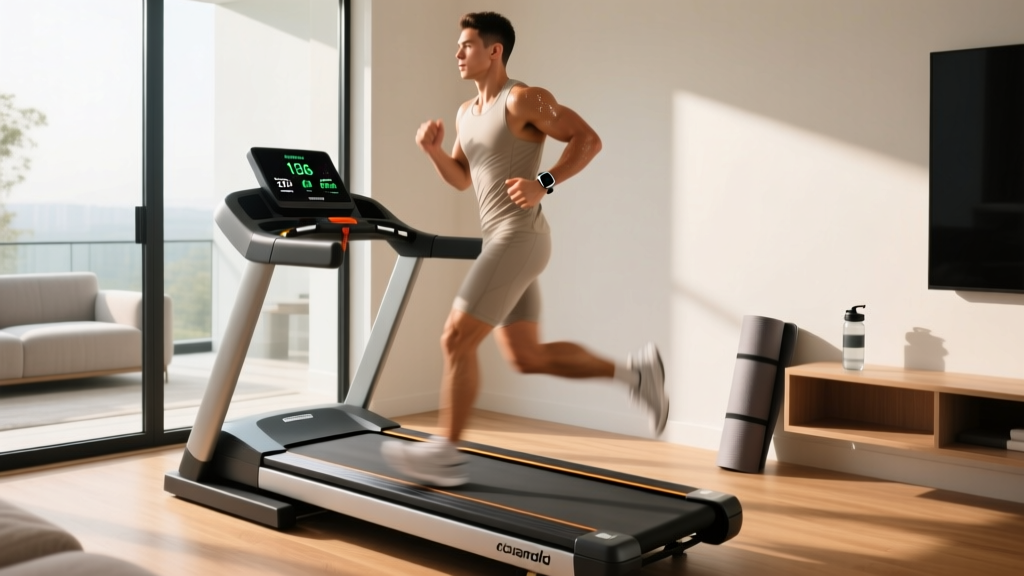
How to Use a Treadmill to Lose Weight: 2026 Feature Guide
Learn how to use a treadmill to lose weight with our 2026 beginner guide. Compare essential features, incline specs, and step-by-step fat-burn workouts.

The 2026 Weight Loss Paradigm: Beyond the Basic Walk
Many beginners purchase a home cardio machine, set it to a flat 2.0 mph, and wonder why the scale refuses to budge after a month. If you are trying to figure out how to use a treadmill to lose weight effectively, the secret lies in the intersection of machine capabilities and metabolic programming. In 2026, treadmill technology has evolved far beyond simple moving belts; modern machines are equipped with advanced incline motors, biometric sensors, and interactive resistance profiles designed specifically to maximize caloric expenditure.
This beginner-friendly, step-by-step guide will first help you identify the exact treadmill features you need to support a weight loss journey, and then show you exactly how to use those features to trigger fat loss without burning out or risking joint injury.
⚠️ Beginner Buying Trap: Peak vs. Continuous Horsepower (CHP)When shopping for a weight-loss treadmill, ignore 'Peak Horsepower' marketing claims. Peak HP only measures the motor's output at top speed for a few seconds. For daily incline walking and interval training, you must look for Continuous Horsepower (CHP). If a user weighing over 180 lbs uses a 2.0 CHP motor for daily 12% incline walks, the motor will overheat, degrade, and likely void the warranty within six months. Always target a minimum of 3.0 CHP for weight loss routines.
Step 1: Choosing the Right Features for Fat Loss
Not all treadmills are built for high-calorie-burn workouts. To support a progressive weight loss regimen, your machine must handle increased mechanical stress. Here is a comparison of the critical features you need to look for in 2026, categorized by budget and optimal weight-loss specifications.
| Feature | Budget Spec (<$800) | Weight Loss Optimal ($1k-$2k) | Why It Matters for Fat Loss |
|---|---|---|---|
| Motor Power | 2.5 CHP | 3.0 to 4.0 CHP (e.g., Sole F80) | Prevents stuttering during heavy-load incline intervals. |
| Max Incline | 10% to 12% | 15% to 40% (e.g., NordicTrack X7i) | Higher inclines engage the posterior chain, doubling calorie burn without high-impact running. |
| Belt Dimensions | 20' x 55' | 22' x 60' | Provides safe lateral and forward space as your stride lengthens during HIIT sprints. |
| Deck Cushioning | Standard Rubber | Variable Elastomers | Absorbs up to 30% more shock, protecting knees and shins for heavier beginners. |
Top 2026 Model Recommendations for Weight Loss
- The Value Workhorse: Horizon 7.4 (~$999). Features a 3.0 CHP motor and 15% incline. Excellent for beginners starting with steady-state incline walking.
- The Mid-Range Champion: Sole F80 (~$1,199). Boasts a 3.5 CHP motor, 22' x 60' belt, and heavy-duty cushioning. Ideal for users over 200 lbs transitioning into running.
- The Calorie Torcher: NordicTrack InclineTrainer X7i (~$2,999). Offers a massive 40% incline. This extreme gradient allows for low-speed, high-calorie-burn workouts that spare the joints entirely.
Step 2: How to Use Your Treadmill to Lose Weight (Workout Protocols)
Once you have a machine with adequate CHP and incline capabilities, it is time to program your workouts. According to Harvard Health Publishing, a 185-pound person burns roughly 336 calories running at a moderate 5 mph pace for 30 minutes. However, by manipulating incline and heart rate zones, you can exceed this burn rate while walking, drastically reducing joint impact.
Protocol A: The 12-3-30 Incline Fat-Burn Walk
This viral, highly effective protocol is perfect for beginners who want to avoid running but still trigger significant fat oxidation.
- Set the Incline: Adjust your treadmill to a 12% gradient. (If you are a complete beginner, start at 8% and work up over three weeks).
- Set the Speed: Set the belt speed to 3.0 mph. This is a brisk, purposeful walking pace.
- Set the Time: Walk for exactly 30 minutes.
- The Rule: Do not hold the handrails. Leaning back and holding the rails alters your biomechanics and reduces your actual caloric expenditure by up to 20%. Pump your arms naturally.
Protocol B: Heart Rate Zone 2 Training
Zone 2 cardio is the gold standard for building aerobic base and burning fat as a primary fuel source. The American Heart Association recommends keeping your heart rate between 60% and 70% of your Maximum Heart Rate (MHR) for optimal fat oxidation.
Calculating Your Zone 2 Target:
Use the Tanaka Formula for better accuracy than the standard '220 minus age' method.
MHR = 208 - (0.7 x your age)
Example for a 40-year-old: 208 - 28 = 180 BPM (Max).
Zone 2 Target: 108 BPM to 126 BPM.
Adjust your treadmill speed and incline dynamically to keep your heart rate locked in this exact window using the machine's grip sensors or a Bluetooth chest strap like the Polar H10.
Protocol C: Beginner 1:2 HIIT (High-Intensity Interval Training)
Once you have built a base with 4 weeks of Zone 2 and Incline walking, introduce HIIT to trigger Excess Post-exercise Oxygen Consumption (EPOC), which keeps your metabolism elevated for hours after the workout.
- Warm-up: 5 minutes at 2.5 mph, 0% incline.
- Work Interval (1 min): Increase speed to a challenging jog or sprint (e.g., 6.0 mph) at 2% incline.
- Recovery Interval (2 mins): Drop speed to a slow walk (2.0 mph) at 0% incline to catch your breath.
- Repeat: Complete 6 to 8 cycles (18-24 minutes total).
- Cool-down: 5 minutes easy walk.
Step 3: Progressive Overload and App Integration
The biggest mistake beginners make is doing the exact same 3.0 mph walk for six months. The human body is an adaptation machine; as you become more efficient, you burn fewer calories doing the same work. To continue losing weight, you must apply progressive overload.
In 2026, almost all mid-tier and premium treadmills feature FTMS (Fitness Machine Service) Bluetooth. This protocol allows your treadmill to communicate directly with third-party apps. Instead of staring at a blank wall, connect your machine to apps like Zwift, Kinomap, or the Peloton App. These apps automatically adjust your treadmill's incline and speed based on virtual terrain, forcing your body to adapt to unpredictable micro-intervals that shatter weight-loss plateaus.
Frequently Asked Questions (FAQ)
How many days a week should I use the treadmill to lose weight?
For sustainable fat loss, aim for 4 to 5 days a week, totaling 150 to 300 minutes of moderate-intensity cardio, as recommended by major health organizations. Alternate between heavy incline days (Protocol A) and Zone 2 days (Protocol B) to allow your central nervous system and joints to recover.
Is it better to walk on an incline or run flat for weight loss?
For beginners, especially those carrying extra weight, walking on a steep incline is vastly superior. Running on a flat surface generates ground reaction forces equal to 2.5 times your body weight, which frequently leads to shin splints and knee pain in heavier individuals. A 15% incline walk elevates the heart rate into the fat-burning zone while keeping impact forces minimal.
Why am I not losing weight despite walking on the treadmill daily?
Weight loss is ultimately governed by a caloric deficit. If you are walking daily but not losing weight, you are likely 'eating back' your burned calories. A 45-minute moderate treadmill session burns roughly 300-400 calories, which is easily negated by a single post-workout smoothie or an extra portion at dinner. Track your nutrition alongside your treadmill metrics to ensure you remain in a 300-500 calorie daily deficit.
More gear to consider
All reviews
Curved vs Motorized: Picking Your HIIT Cardio Workout Treadmill

Treadmill Motor Guide: How to Lose Fat on Treadmill

Rowing Guide and Technique: Reebok FR20Z Floatride Treadmill Comparison
Beyond NordicTrack Treadmill Disassembly: Compact Cardio Swaps

Walking Pad Versus Treadmill: 2026 Stationary Bike Budget Breakdown
