
How Low Should the Bench Be for Incline Dumbbell Press? (Barbell Guide)
Troubleshoot your free weight setup. Learn how low the bench should be for incline dumbbell press and avoid common Olympic barbell knurling mistakes.

Building a functional home gym in 2026 requires more than just buying the heaviest iron you can find. It demands a precise understanding of biomechanics and equipment specifications. Two of the most frequent troubleshooting issues we see at FitGearPulse involve improper bench setups for hypertrophy and catastrophic mistakes when purchasing Olympic barbells. Whether you are trying to isolate the clavicular head of the pectoralis major or looking for a barbell that will not tear your hands apart during heavy deadlifts, this guide will troubleshoot the most common free weight and rack setup errors.
The Biomechanics of the Incline Press: How Low Should the Bench Be?
When lifters ask, "how low should the bench be for incline dumbbell press," they are usually conflating two distinct setup variables: the angle of the back pad and the physical seat height relative to the floor. Getting either of these wrong shifts the tension away from the upper chest and onto the anterior deltoids or triceps.
Troubleshooting the Back Pad Angle
The most common mistake in commercial and home gyms is setting the adjustable bench too high. Many lifters default to the 45-degree or even 60-degree notch, mistakenly believing a steeper incline equals better upper chest activation. According to kinesiology data from ExRx.net, an incline that is too steep turns the movement into a shoulder press, heavily recruiting the front deltoids.
The 15-to-30 Degree Rule: To optimally target the clavicular (upper) pecs, the bench back pad should be set as "low" as possible while still maintaining an incline. A 15-degree to 30-degree angle is the biomechanical sweet spot. If your bench (like the popular Rep Fitness AB-3100) has a 15-degree incline setting, use it. If it only has 30 and 45, use the 30-degree setting and slightly tuck your elbows to minimize shoulder involvement.Troubleshooting Seat Pad Height and Foot Drive
If your question regarding "how low" refers to the seat pad's distance from the floor, the standard ergonomic height for a weight bench is between 17 and 19 inches.
- Too High (19+ inches): Shorter lifters will experience a loss of leg drive, causing the hips to slide forward during heavy dumbbell presses.
- Too Low (Under 16 inches): Taller lifters will find their knees bent at an acute angle, restricting hip mobility and making it difficult to safely kick heavy dumbbells into position.
Fix: If your bench is too high, place 45lb bumper plates under your feet to artificially lower the floor and restore proper leg drive geometry.
Troubleshooting Your Olympic Barbell Purchase: Weight Tolerances
Transitioning from the bench to the rack, a proper free weight setup requires a reliable Olympic barbell. A massive mistake buyers make in 2026 is trusting the "Olympic" label on budget Amazon bars without verifying the weight tolerances and sleeve dimensions.
The 45 lb vs. 20 kg Confusion
A true men's Olympic weightlifting or powerlifting bar weighs exactly 20 kilograms, which translates to 44.09 pounds. However, many budget bars marketed as "45 lb Olympic Bars" are manufactured with loose tolerances, weighing anywhere from 42 to 47 pounds. While a 2-pound difference seems negligible, it ruins progressive overload tracking and creates uneven loading if you mix brands on a barbell.
| Barbell Category | Target Weight | Acceptable Tolerance | Common Mistake |
|---|---|---|---|
| IWF Olympic WL Bar | 20 kg (44.09 lbs) | +/- 5 grams | Buying a 28mm shaft bar (WL requires 28mm, but cheap bars bend easily under heavy squats). |
| IPF Powerlifting Bar | 20 kg (44.09 lbs) | +/- 10 grams | Using a 28mm WL bar for heavy benching (lack of stiffness causes dangerous oscillation). |
| Budget "Commercial" Bar | "45 lbs" | +/- 1 to 3 lbs | Assuming it is exactly 45 lbs for math-based percentage training programs. |
Knurling Mistakes: Choosing the Wrong Grip Pattern
Knurling is the cross-hatched pattern machined into the steel shaft of the barbell. Buying a barbell without understanding knurling profiles is a guaranteed way to ruin your training sessions. According to comprehensive equipment reviews by BarBend, knurling is categorized by its shape and depth, not just its "aggressiveness."
The Three Main Knurl Profiles
- Hill Knurling: The peaks of the knurl are rounded off. It feels smooth and passive. Troubleshooting: Do not buy a hill-knurled bar for heavy deadlifts or Olympic lifts; your grip will fail before your posterior chain does. These are only acceptable for high-rep hypertrophy or budget commercial gyms.
- Volcano Knurling: The peaks are flattened slightly, creating a rim that bites into the hand without tearing the skin. The Rogue Ohio Bar is the gold standard for this profile. Troubleshooting: This is the most versatile profile for 90% of lifters. If you are buying your first and only barbell, buy a volcano knurl.
- Mountain Knurling: The peaks are sharp and pointed, coming to a distinct apex. Brands like Eleiko use this for their competition powerlifting bars. Troubleshooting: Avoid mountain knurling if you do high-rep CrossFit WODs or high-volume bench pressing, as it will tear your calluses and cause micro-lacerations.
Equipment Failure Modes: Bushings vs. Bearings
Another critical troubleshooting point when buying an Olympic barbell is the sleeve rotation mechanism. The sleeves (where you load the plates) must spin independently of the shaft to prevent the rotational inertia of the plates from snapping your wrists during cleans and snatches.
Warning: The Bushing Misconception
Many budget bars use cheap brass or composite bushings that grind and seize after a year of heavy use. For Olympic weightlifting, you must look for needle bearings (usually 4 to 8 per sleeve). For powerlifting (Squat, Bench, Deadlift), high-quality bronze bushings are actually preferred because they provide a slower, more controlled sleeve spin, which is safer for slow-moving heavy lifts.
FAQ: Free Weight Setup Troubleshooting
Why do my dumbbells slide down my incline bench?
If your dumbbells are sliding down your thighs or the bench pad during the setup, the bench vinyl is likely too worn, or the incline angle is too steep. Lower the bench to a 15-degree incline. Additionally, ensure the seat pan is angled slightly upward (many premium benches like the Rogue Adjustable Bench 3.0 feature an anti-slide seat wedge).
Does center knurling matter for the bench press?
Center knurling is designed to grip the back of your shirt during heavy squats. For the bench press, a center knurl can scrape your chest or get caught on your sternum. If you are buying a dedicated bench press bar (like a Texas Power Bar), a passive or completely absent center knurl is preferred to avoid skin irritation.
How do I fix a squeaky adjustable bench?
Squeaking usually originates from the pop-pin mechanism or the hinge bolts. Do not use standard WD-40, as it attracts dust and degrades rubber pads. Instead, disassemble the hinge bolts, apply a dry PTFE (Teflon) lubricant or white lithium grease to the metal-on-metal contact points, and tighten the nylon lock nuts with a torque wrench to roughly 40 Nm.
What is the ideal shaft diameter for an Olympic barbell?
For Olympic weightlifting, the IWF mandates a 28mm shaft to allow for a hook grip and wrist flexion during the catch phase. For powerlifting and general strength, a 29mm shaft provides better stiffness and reduces bar whip during heavy squats and bench presses. A 28.5mm shaft (like the Rogue Ohio Bar) is the ultimate compromise for a multi-purpose home gym.
More gear to consider
All reviews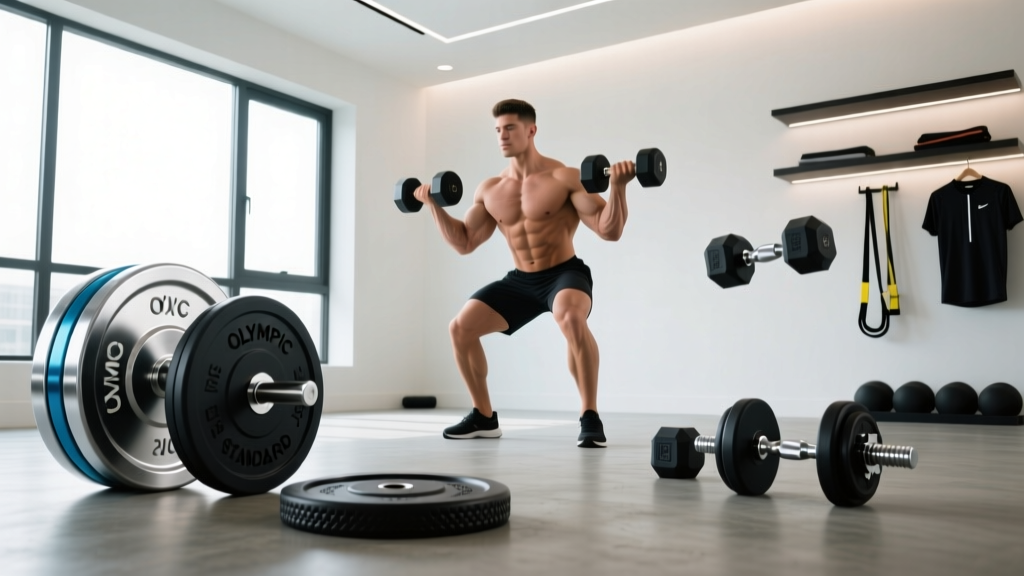
Olympic vs Standard Plates & How to Get Pecs with Dumbbells
Best Adjustable Dumbbells for Deltoid Muscle Exercises (2026)

Power Rack vs Squat Rack vs Stand for an 85 Pound Dumbbell

Power Rack vs Squat Rack vs Stand: Leg Extension Alternative Dumbbell

Ultimate Full Body Dumbbell Workout: Beginner Neoprene Guide
