
2026 Trends: Horizontal Chest Press Machine & Fly Gear Analysis
Analyze 2026 market trends for chest training, comparing the horizontal chest press machine with dumbbell vs. cable fly equipment for optimal ROI.

The 2026 Chest Training Equipment Landscape
As we navigate the 2026 commercial and high-end home gym equipment market, the architecture of the chest training zone has undergone a significant evolution. Facility owners and serious home gym builders are no longer just buying isolated pieces of iron; they are engineering comprehensive hypertrophy ecosystems. At the absolute center of this ecosystem remains the horizontal chest press machine, the undisputed anchor for compound mechanical tension. However, the secondary market for isolation equipment—specifically the ongoing debate and purchasing shift between dumbbell fly setups and cable fly systems—has become a major focal point for market analysts and biomechanics experts alike.
According to recent facility outfitting data tracked by Club Industry, commercial gyms are reallocating up to 40% of their isolation equipment budgets away from traditional free-weight benches and toward dual-pulley functional trainers. This trend report dives deep into the biomechanical ROI, spatial economics, and market pricing of pairing a premium horizontal chest press machine with the optimal fly equipment in 2026.
The Anchor: Horizontal Chest Press Machine Market Share
Before analyzing the isolation add-ons, we must establish the baseline compound movement. The modern horizontal chest press machine has evolved far beyond the linear, joint-stressing leverage designs of the early 2000s. Today's market leaders utilize converging arc technology and independent diverging arms to match the natural transverse adduction of the pectoralis major.
- Matrix Magnum Horizontal Chest Press: Retailing between $3,800 and $4,500 in 2026, this unit features a 15-degree converging motion path and specialized grip positions that reduce anterior deltoid shear.
- Life Fitness Signature Series: Priced around $3,200, this remains a staple in mid-tier commercial facilities due to its compact 14-square-foot footprint and low-maintenance aircraft-grade cable routing.
While these machines provide unparalleled overload for the sternal and clavicular heads, they fall short in delivering the deep, stretched-position hypertrophy stimulus that isolation fly movements provide. This necessitates the addition of fly equipment, bringing us to the core market comparison.
Isolation Add-Ons: Dumbbell Fly vs. Cable Fly Market Shift
The traditional method for achieving transverse adduction isolation has always been the dumbbell fly, performed on a flat or slight incline bench. However, the 2026 market shows a decisive pivot toward cable crossover and functional trainer systems. To understand this purchasing trend, we must look at the intersection of kinesiology and facility economics.
Biomechanical ROI: Tension Curves Explained
The primary driver of the shift from dumbbells to cables is the resistance profile. As detailed in kinesiology literature from ExRx, the pectoralis major functions to horizontally adduct the humerus. When performing a dumbbell fly, gravity only pulls straight down. This creates a highly inefficient tension curve: maximum mechanical tension occurs at the bottom of the movement (the stretched position, which is highly stimulus-generative but also carries the highest risk of pec tear), and tension drops to absolute zero at the top of the movement when the dumbbells are stacked directly over the shoulder joints.
Conversely, a cable fly system utilizing a 1:2 pulley ratio provides continuous, linear tension throughout the entire range of motion. By setting the pulleys slightly above shoulder height and pulling at a 15-degree downward angle, lifters can maintain peak mechanical tension at peak contraction (hands touching), a stimulus that the National Strength and Conditioning Association (NSCA) notes is critical for maximizing sarcomere overlap and metabolic stress.
Footprint, Liability, and Cost Analysis
From a facility management perspective, the dumbbell fly setup is becoming a liability and spatial nightmare. A proper dumbbell fly zone requires a commercial adjustable bench (taking up roughly 12 square feet) plus a minimum 20-square-foot clearance radius to account for users dropping heavy dumbbells or losing control at the bottom of the stretch. Furthermore, the cost of outfitting a full dumbbell rack to support progressive overload has skyrocketed. A commercial-grade urethane dumbbell set from 10 to 80 lbs now averages $2.20 per pound, meaning a full set costs upwards of $3,500.
In contrast, a high-end functional trainer like the Rep Fitness FT-5000 2.0 ($1,699.99) or the Rogue Monster RM-3F ($3,250) requires only a 12-square-foot footprint against a wall or in a rack footprint, eliminates the liability of dropped iron, and offers infinite micro-loading via 200 lb weight stacks with 10 lb increments.
2026 Buyer's Budget Framework: The Chest Zone
For facility owners or home gym builders allocating a $10,000 budget specifically for chest hypertrophy, the 2026 optimal allocation model is as follows:
- 50% ($5,000): Premium Horizontal Chest Press Machine (e.g., Hammer Strength MTS or Matrix Magnum) for heavy compound overload.
- 35% ($3,500): Dual-Pulley Functional Trainer / Cable Crossover for continuous-tension flys and crossovers.
- 10% ($1,000): High-quality adjustable FID bench (e.g., Rogue Adjustable Bench 3.0 at $595) for incline pressing and unilateral cable work.
- 5% ($500): A limited range of adjustable dumbbells (e.g., Nuobell 80s at $449) strictly for unilateral incline presses, completely eliminating dumbbell flys from the programming.
Equipment Comparison Matrix
To visualize the market positioning of these three distinct equipment categories, refer to the comparison matrix below. This data reflects average 2026 commercial and prosumer pricing, spatial requirements, and biomechanical outputs.
| Equipment Category | Average 2026 Cost | Footprint | Tension Curve | Primary Use Case |
|---|---|---|---|---|
| Horizontal Chest Press Machine | $3,200 - $5,200 | 14 - 18 sq ft | Converging Arc / High Overload | Compound mechanical tension, CNS adaptation |
| Cable Fly System (Functional Trainer) | $1,200 - $3,500 | 12 sq ft (Wall/Rack mount) | Constant Linear Tension | Metabolic stress, peak contraction isolation |
| Dumbbell Fly Setup (Bench + Iron) | $1,000 - $4,000+ | 32+ sq ft (incl. clearance) | Gravity-Dependent (Zero at peak) | Deep stretch (High injury risk at heavy loads) |
Final Verdict for Commercial and Home Gyms
The 2026 market data makes the trajectory undeniable: the dumbbell fly is being relegated to the history books in optimized training facilities. While adjustable dumbbells remain essential for unilateral incline pressing and general utility, utilizing them for transverse adduction (flys) is biomechanically inferior and spatially inefficient compared to modern cable systems.
For the ultimate chest training zone, the blueprint is clear. Invest heavily in a biomechanically sound horizontal chest press machine to handle the heavy, neurological compound loading. Then, pair it with a dual-pulley cable system to provide the constant-tension isolation work that dumbbells simply cannot replicate. This hybrid approach maximizes hypertrophic stimuli, minimizes joint shear and liability, and offers the highest return on investment for every square foot of gym space.
"The shift toward cable-based isolation in 2026 isn't just about saving floor space; it's about aligning equipment resistance profiles with actual muscle fiber orientation. You cannot build an elite chest training zone relying on gravity-dependent dumbbell flys when constant-tension cable alternatives exist." — FitGearPulse Biomechanics Analysis Team
More gear to consider
All reviews
Space Homegym Compare Essentials: Real-World Metrics, Brand Benchmarks, and Smart Layout Decisions
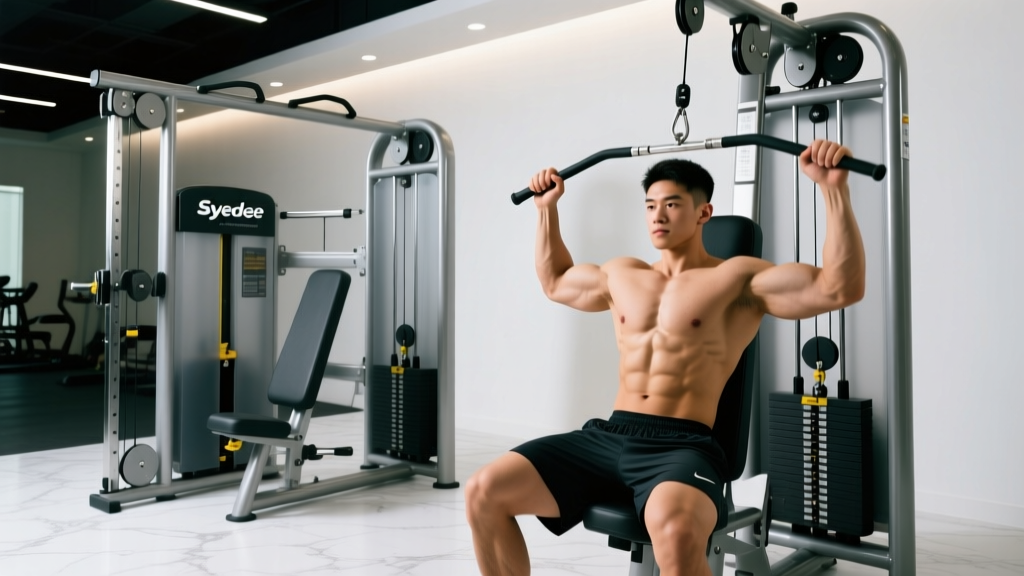
Syedee Chest Press Machine vs Cable Crossover: Chest Training Guide

Cable Crossover vs Chest Press Bench Machine: 2026 Guide

Cupping Buying Guide: How to Choose the Right Cups, Materials, and Systems for Clinical and Home Use

Fixing Common Chest Press Cable Machine Mistakes in Your Home Gym
