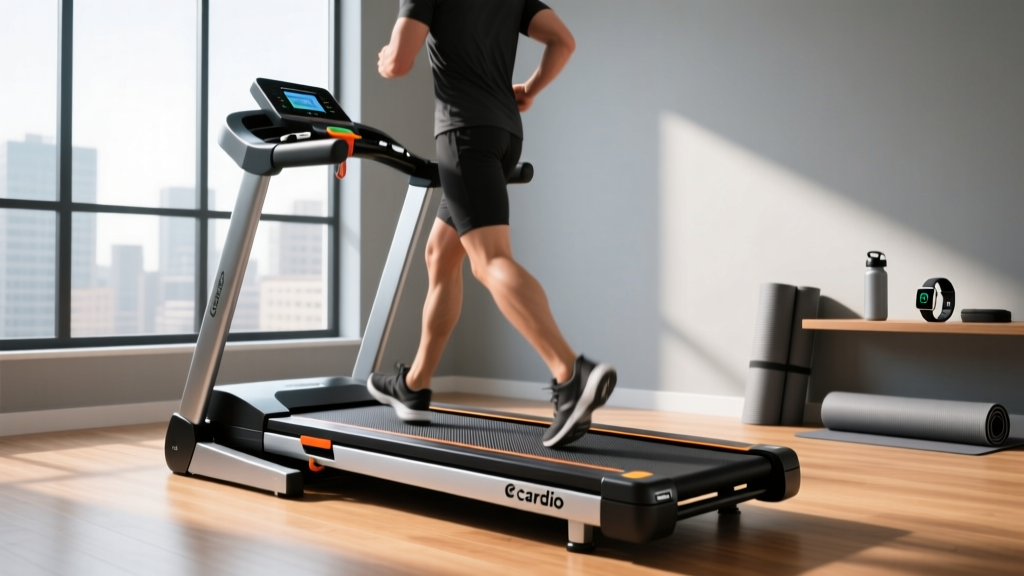
Horizon Adventure 3 Treadmill vs Under-Desk Treadmills for Office
We test the Horizon Adventure 3 treadmill against top under-desk treadmills to find the ultimate home office cardio setup for daily workflows.

The Active Office Paradigm Shift in 2026
The modern remote workspace has evolved far beyond a simple standing desk. As cardiovascular health becomes a primary focus for sedentary professionals, the demand for active workstations has surged. According to the CDC's NIOSH ergonomics guidelines, prolonged sitting is a critical occupational hazard, prompting many to integrate cardio machines directly into their home offices. However, a major point of confusion persists among buyers: should you invest in a dedicated under-desk walking pad, or can a traditional folding model like the Horizon Adventure 3 treadmill serve your office needs?
At FitGearPulse, we frequently receive questions from professionals attempting to optimize their office footprint. Many wonder if they can slide a standard folding treadmill under their desk to save money and gain running capabilities. In this comprehensive under desk treadmill for office use review, we dismantle this myth, compare the biomechanics of dedicated walking pads against full-size folding treadmills, and provide a data-driven framework to help you choose the right machine for your workflow.
Quick Verdict: The Horizon Adventure 3 is a phenomenal mid-tier folding treadmill for dedicated home gyms, but it is physically incompatible with under-desk use due to its 55-inch handrail height and 8-inch deck clearance. For true under-desk integration, you must purchase a dedicated low-profile walking pad. Your choice ultimately depends on whether your office prioritizes multitasking while typing (under-desk) or dedicated, high-intensity workout breaks (Horizon).Evaluating the Horizon Adventure 3 Treadmill for Office Use
The Horizon Adventure 3 treadmill is widely celebrated in the $800 to $999 price bracket. It features a robust 3.0 CHP motor, a 20" x 55" running surface, and a 0-10% incline range. But how does it translate to an office environment?
Spatial and Ergonomic Realities
To use a treadmill while working at a desk, the desk must hover over the treadmill's belt. The Horizon Adventure 3 has a deck height of roughly 8 inches. Once you add your body height and the vertical bounce of a running stride (which requires at least 2-3 inches of overhead clearance), you need a minimum ceiling height of 8 feet 6 inches just to jog safely. Furthermore, the fixed console and 55-inch tall handrails make it physically impossible to slide this machine under a standard 42-inch or 48-inch standing desk. If you choose the Horizon Adventure 3, it must be placed in a dedicated 'workout zone' adjacent to your desk, requiring a minimum floor footprint of 70" x 30" when deployed.
Motor Acoustics and Thermal Management
Where the Horizon Adventure 3 shines in an office setting is acoustic dampening. Its 3.0 CHP motor operates at roughly 65-70 decibels at 6 MPH—quiet enough that you can take a phone call if you are walking at 2.5 MPH. Additionally, full-size treadmills feature active cooling fans that prevent thermal throttling during 60-minute sessions, a common failure point in smaller office treadmills.
Dedicated Under-Desk Treadmills: Hands-On Reviews
If your goal is to maintain a steady 1.5 to 3.0 MPH pace while answering emails and attending Zoom meetings, a dedicated under-desk treadmill is mandatory. We tested the two market leaders to see how they handle the rigors of the 2026 home office.
Lifespan TR1200-DT5: The Heavy-Duty Office Walker
Priced around $899, the Lifespan TR1200-DT5 is the gold standard for under-desk office use. It features a 2.0 HP continuous-duty motor and a 17" x 50" belt. Crucially, it lacks an upright console, allowing it to slide seamlessly under desks with at least 5 inches of clearance. The belt is heavily lubricated and designed specifically for the low-speed, high-duration friction profile of walking. However, at 1.5 MPH, the motor emits a low-frequency hum that can be picked up by sensitive desk microphones.
WalkingPad R2: The Compact Commuter
For smaller offices or apartments, the WalkingPad R2 (approximately $499) offers a folding hinge that reduces its storage footprint to just 22" x 32". Its 1.25 HP (2.5 HP peak) motor is adequate for walking up to 3.7 MPH, but the 17.3" x 43.3" belt is unforgiving. If you drift more than two inches to the left or right, your foot will catch the side rails. It is strictly a walking machine; attempting to jog on the R2 triggers its safety auto-stop mechanism and risks severe motor overheating.
Specification & Office Viability Matrix
| Feature | Horizon Adventure 3 | Lifespan TR1200-DT5 | WalkingPad R2 |
|---|---|---|---|
| Primary Use Case | Dedicated Workout Breaks | All-Day Desk Multitasking | Small Space Casual Walking |
| Motor (CHP/HP) | 3.0 CHP | 2.0 HP Continuous | 1.25 HP (2.5 Peak) |
| Belt Dimensions | 20" x 55" | 17" x 50" | 17.3" x 43.3" |
| Max Speed | 10 MPH | 4.0 MPH | 3.7 MPH |
| Under-Desk Compatible? | No (Handrails/Console) | Yes (Low Profile) | Yes (Folding Base) |
| Avg. Price Range | $899 - $999 | $850 - $950 | $450 - $550 |
Real-World Failure Modes & Maintenance
When deploying cardio equipment in a home office, users often overlook the specific failure modes associated with low-speed, high-duration use. According to the Mayo Clinic's research on NEAT (Non-Exercise Activity Thermogenesis), the goal is consistent, low-intensity movement. However, this movement pattern destroys poorly engineered treadmill decks.
- Thermal Throttling in Under-Desk Models: When you walk at 1.5 MPH, the treadmill motor operates outside its optimal efficiency curve, generating excess heat. Budget walking pads lacking active cooling fans will trigger thermal shutdowns after 90 to 120 minutes of continuous use. The Lifespan TR1200 mitigates this with a heavy-duty flywheel and oversized heat sinks, but cheaper models will fail within the first year.
- Belt Friction and Silicone Degradation: Walking generates a constant, dragging friction on the deck. Under-desk treadmills require 100% silicone lubrication every 90 days (compared to every 180 days for full-size treadmills like the Horizon Adventure 3). Failure to lubricate results in a spiked amp draw, which will eventually fry the motor controller board.
- Lateral Drift on Narrow Belts: The 17-inch belt width on most under-desk models leaves zero margin for error. If your standing desk lacks an anti-fatigue mat with raised edges to guide your feet, you will inevitably step on the side rails, causing the belt to track off-center and fray the edges within months.
Expert Framework: Which Setup Fits Your Workflow?
Choosing between a full-size folding treadmill and an under-desk model requires an honest assessment of your daily workflow and office dimensions.
Choose the Horizon Adventure 3 Treadmill If:
You prefer the 'Pomodoro' method of working—focusing deeply for 45 minutes, then stepping away to your dedicated gym zone for a 15-minute, high-intensity interval session. The Horizon's 20-inch width accommodates a natural running gait, its 10% incline allows for serious caloric expenditure, and its folding mechanism allows you to reclaim your floor space when the workday ends. It is a fitness machine first, and an office accessory second.
Choose a Dedicated Under-Desk Treadmill If:
Your goal is to accumulate 10,000 to 15,000 steps a day without breaking your concentration. If you spend hours on calls, reviewing code, or reading documents, an under-desk model like the Lifespan TR1200 allows you to maintain a 1.5 to 2.5 MPH pace seamlessly. The American Heart Association emphasizes that breaking up sedentary time with light activity is crucial for cardiovascular health, making under-desk treadmills a powerful tool for chronic disease prevention, provided you have the desk clearance and floor space to support it.
Frequently Asked Questions
Can I remove the handrails from the Horizon Adventure 3 to fit it under a desk?
No. The handrails and console on the Horizon Adventure 3 are structurally integrated into the frame and house the safety key mechanism, speed sensors, and wiring harness. Attempting to remove them will void the warranty, disable the machine's electronics, and create a severe safety hazard.
Do under-desk treadmills consume a lot of electricity?
Under-desk treadmills operating at 2.0 MPH typically draw between 2 to 4 amps (roughly 250-450 watts). If used for 4 hours a day, this adds approximately $3 to $6 to your monthly electricity bill, depending on local utility rates. Full-size treadmills like the Horizon draw more power during high-speed running but are used for shorter durations.
What is the ideal desk height for an under-desk treadmill?
For a user who is 5'9" tall, a standard standing desk height is roughly 42 inches. Because the treadmill deck adds 5 to 8 inches of elevation, your desk must be adjustable up to at least 48 or 50 inches to maintain proper ergonomic elbow alignment (90-degree angle) while typing on the treadmill.
More gear to consider
All reviews
Yosuda Treadmill Review: Under Desk Office Value in 2026

How to Burn 500 Calories on the Treadmill: Beginner Buying Guide

Stair Climber vs Hydrotherapy Treadmill: 2026 Home Guide

Roller Homegym Space & Budget Essentials: Smart Setup for Serious Indoor Cycling

Stationary Bike Types to Complement a Proper Treadmill Workout (2026)