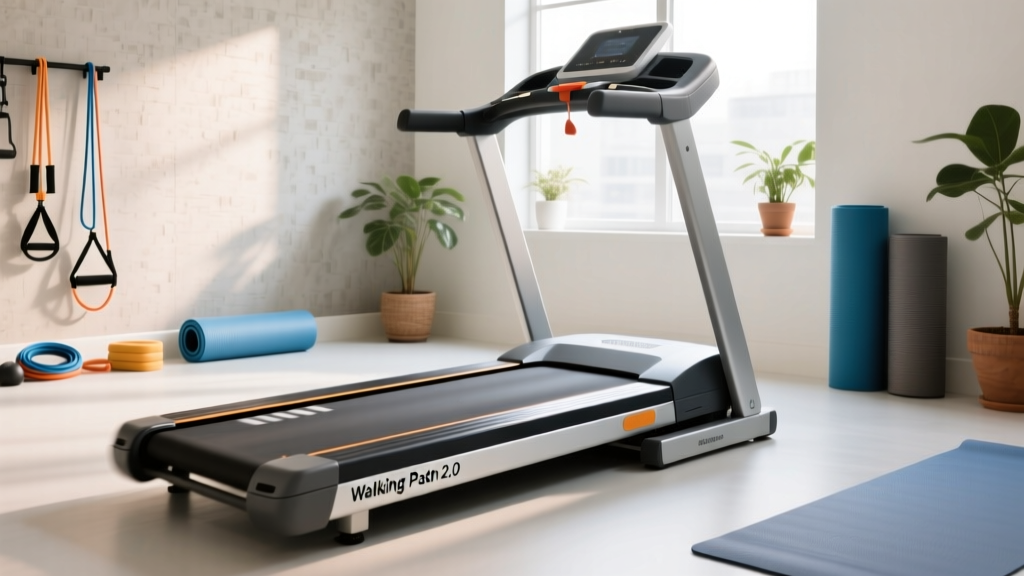
Can You Run 10 mph on Treadmill Desks? Space Layout Guide
Reviewing the best under-desk treadmills for office use, space optimization layouts, and the reality of hitting 10 mph while working from home.

The Ergonomic Reality: Why Under-Desk Treadmills Cap at 4 MPH
In the 2026 remote-work landscape, the active office is no longer a luxury; it is a biomechanical necessity. However, a pervasive myth continues to circulate in home-office forums: the idea that you can maintain a sprinting pace of 10 mph on treadmill desks while simultaneously answering emails or coding. As an equipment reviewer specializing in spatial ergonomics, I need to address this immediately. Hitting 10 mph on an under-desk walking pad is not just mechanically impossible for most models—it is ergonomically disastrous.
Typing requires fine motor control and a stabilized center of gravity. According to research on occupational ergonomics, the cognitive load and physical oscillation required to run at 10 mph completely degrades keyboard accuracy and induces severe shoulder strain. The Mayo Clinic notes that while breaking up sedentary time is crucial for cardiovascular health, the intensity of the movement must match the cognitive demand of the task. Walking at 1.5 to 3.0 mph promotes blood flow without compromising fine motor skills; running at 10 mph introduces violent vertical displacement that makes desk work impossible.
Therefore, under-desk treadmills are intentionally governed. Most cap out between 2.5 mph and 4.0 mph. If your fitness goal requires hitting 10 mph on treadmill routines for HIIT or VO2 max training, you must design a dual-zone office layout. This involves integrating an under-desk walking pad for passive work hours and a compact, foldable running treadmill for dedicated sprint zones within the same optimized footprint.
⚠ Safety & Ergonomics WarningNever attempt to bypass the speed governor on an under-desk treadmill. These models lack the extended handrails, deck shock absorption, and motor inertia required to safely support a 10 mph running gait. Doing so risks catastrophic belt slip and severe injury.
Designing the Dual-Zone Office Layout
Space optimization is the primary hurdle when integrating two distinct cardio machines into a home office. You need a setup that allows for 2 mph typing and 10 mph sprinting without turning your workspace into a cluttered gym. Here is the exact spatial framework for a dual-zone layout:
Zone 1: The Active Desk (Under-Desk Pad)
- Desk Footprint: Minimum 55' W x 30' D. You need a 30-inch depth to accommodate the treadmill's front motor housing (which typically extends 8-10 inches past the belt).
- Clearance: Ensure 4.5 to 5.5 inches of vertical clearance under your desk. Standard desk height is 29 inches; if you are over 5'10', you will need an adjustable standing desk raised to at least 42 inches to maintain a 90-degree elbow angle while walking.
- Cable Management: Use a flexible cable spine. Walking pads shift slightly during use; rigid zip-tied cables will snap or pull your monitor down.
Zone 2: The Sprint Corner (Compact Runner)
To achieve that 10 mph on treadmill workouts, you need a dedicated running machine placed in a 'sprint corner'. The Occupational Safety and Health Administration (OSHA) and general equipment safety guidelines mandate a minimum of 24 inches of clearance behind any treadmill to prevent impact injuries in the event of a fall. In a space-optimized office, this means utilizing a folding treadmill that can be stored vertically against a wall when not in use, freeing up the 24-inch safety zone for your office chair during work hours.
Top Under-Desk Treadmills for Office Use (2026 Review)
When evaluating under-desk models, we prioritize motor continuity (CHP vs. Peak HP), belt width (crucial for preventing side-stepping while typing), and acoustic output. Below is our curated comparison of the top three models for office integration.
| Model | Motor | Max Speed | Belt Size | Est. Price |
|---|---|---|---|---|
| UREVO Strol 2E | 2.5 HP (Peak) | 2.5 mph (Desk) / 4.0 mph (Handle) | 15' x 41' | $239 |
| Lifespan TR1200-Glow | 2.5 CHP | 4.0 mph | 20' x 50' | $1,099 |
| WalkingPad R2 | 2.5 HP (Peak) | 3.7 mph (Folded) / 7.4 mph (Open) | 17' x 47' | $499 |
Deep Dive: Lifespan TR1200-Glow
The Lifespan TR1200-Glow remains the gold standard for heavy daily use. Unlike cheaper models that use peak horsepower ratings, its 2.5 CHP (Continuous Horsepower) motor is designed to run for 6+ hours a day without overheating. The 20-inch belt width is a critical ergonomic feature; when you are distracted by an email, your natural gait widens. A 15-inch belt (like the UREVO) forces you to consciously narrow your stride, leading to hip flexor fatigue. The TR1200-Glow's heavy 115 lb frame also eliminates the 'creep' effect, where the treadmill slowly slides backward on hardwood floors during use.
Deep Dive: WalkingPad R2
The R2 is the ultimate space-optimization tool. Its 180-degree folding hinge allows it to slide under a standard sofa or mount vertically on a wall bracket (sold separately). However, note that the 7.4 mph top speed is only accessible when the handlebar is raised. Attempting to use it at 7.4 mph while sitting or standing at a desk is highly discouraged due to the lack of lateral stability and the short 47-inch belt, which will cause heel-strike clipping for anyone over 5'8'.
Satisfying the Sprint: Compact Treadmills That Hit 10 MPH
If your training plan requires intervals at 10 mph on treadmill equipment, you must allocate a secondary zone in your office layout. Full commercial decks (like the Sole F63) require a massive 32' x 82' footprint, which destroys office space efficiency. Instead, look for compact folding runners.
'The secret to a dual-zone office is verticality. A treadmill that folds flat and stores vertically against a wall reclaims up to 18 square feet of usable floor space, allowing you to maintain a professional office aesthetic while housing serious cardio equipment.' - FitGearPulse Spatial Ergonomics Team
Horizon Fitness T101
Priced around $599, the Horizon T101 is a compact powerhouse. It features a 2.5 CHP motor and a 20' x 55' belt, which is just long enough to safely accommodate a 10 mph sprint for users under 6'0'. Its folding mechanism utilizes a hydraulic soft-drop system, meaning you can release the latch and the deck lowers itself silently—perfect for not disrupting a sleeping partner or a downstairs neighbor. When folded, its footprint shrinks to roughly 28' x 68', making it easy to tuck into a closet or behind a room divider.
XTERRA Fitness TR150
At a budget-friendly $329, the TR150 maxes out at 10 mph. The trade-off for the price is the narrower 16' x 50' belt and a lighter 2.25 HP motor. It is suitable for quick 15-minute HIIT sessions, but running at 10 mph on this narrower deck requires intense focus and a strict center-line stride. It is not recommended for users over 220 lbs due to belt slip risks at maximum velocity.
Acoustic and Vibration Management
Transitioning from a 2 mph walk to a 10 mph sprint introduces massive acoustic and vibrational challenges. According to a study on occupational noise published by Harvard Health, chronic exposure to low-frequency drone noise (like a treadmill motor) can elevate cortisol levels and reduce cognitive focus. Furthermore, the impact force of a 10 mph footstrike generates structural vibrations that can rattle monitors and disrupt video calls.
💡 Pro-Tip: The Anti-Vibration Mat StackDo not rely on cheap PVC mats. For the sprint zone, invest in a high-density EVA foam mat (like the Super Z Outlet 3/4' mat) paired with a specialized rubber treadmill isolation pad. This dual-layer setup absorbs up to 80% of the impact shock, protecting your floor joists and keeping your monitor perfectly still during 10 mph sprints.
Step-by-Step: Transitioning Between Work and Sprint Zones
To make the dual-zone layout functional, you need a behavioral protocol. Here is the optimal workflow for integrating both machines into your 8-hour workday:
- 08:00 AM - 11:00 AM (Deep Work): Stand at the desk with the under-desk pad set to 1.5 mph. Focus on complex tasks. The slow pace promotes cerebral blood flow without distracting from cognitive load.
- 11:00 AM (Transition): Step off the pad, lower your standing desk to seated height, and engage in seated meetings.
- 12:30 PM (The Sprint Zone): Unfold the Horizon T101 from the sprint corner. Perform a 20-minute HIIT session, utilizing the 10 mph intervals.
- 01:00 PM - 04:00 PM (Passive Work): Fold the running treadmill back against the wall. Return to the under-desk pad, but increase the speed to 2.5 mph to combat the post-lunch energy dip.
Frequently Asked Questions
Can I put an under-desk treadmill on thick carpet?
No. Thick carpet compresses under the weight of the motor housing, causing the belt to misalign and the motor to overwork. If your office is carpeted, you must place a rigid, flat plywood board (at least 1/2 inch thick) underneath the treadmill to create a stable, non-compressible foundation.
How much electricity does a dual-treadmill setup use?
An under-desk pad running at 2 mph draws roughly 100-150 watts. A compact running treadmill hitting 10 mph can spike to 900-1200 watts. Ensure your office circuit is a dedicated 15-amp or 20-amp line. Plugging both machines, plus a desktop PC and space heater, into a single standard power strip will trip the breaker.
Is a 10 mph treadmill fast enough for advanced runners?
A 10 mph pace equates to a 6-minute mile. For the vast majority of home users, this is more than sufficient for interval training and VO2 max improvement. However, if you are an elite runner requiring 12 mph to 15 mph capabilities, you will need to abandon space-optimization and invest in a commercial-grade deck like the Sole F63 or NordicTrack 1750, which require significantly more floor space and ceiling height.
Final Verdict on Office Space Optimization
Chasing 10 mph on treadmill setups while trying to answer Slack messages is a fool's errand. The future of the active home office lies in spatial zoning and task-specific equipment. By pairing a premium under-desk walker like the Lifespan TR1200-Glow for ergonomic, low-impact productivity, and a foldable Horizon T101 for high-intensity sprinting, you can achieve peak cardiovascular health without sacrificing a single square foot of professional workspace. Measure your room, respect the biomechanics, and build your dual-zone layout today.
More gear to consider
All reviews
Treadmill Abuse Case Denied? Essential Belt Lubrication Guide

Ditching the Treadmill Routine 12 3 30: Rowing Machine Setup Guide

Echelon Stride Auto-Fold Treadmill Motor Troubleshooting & HP Guide

Walk Barefoot on a Treadmill: Folding Small-Space Reviews & Care

Stair Climber vs Treadmill: Can I Buy a Treadmill With My HSA?