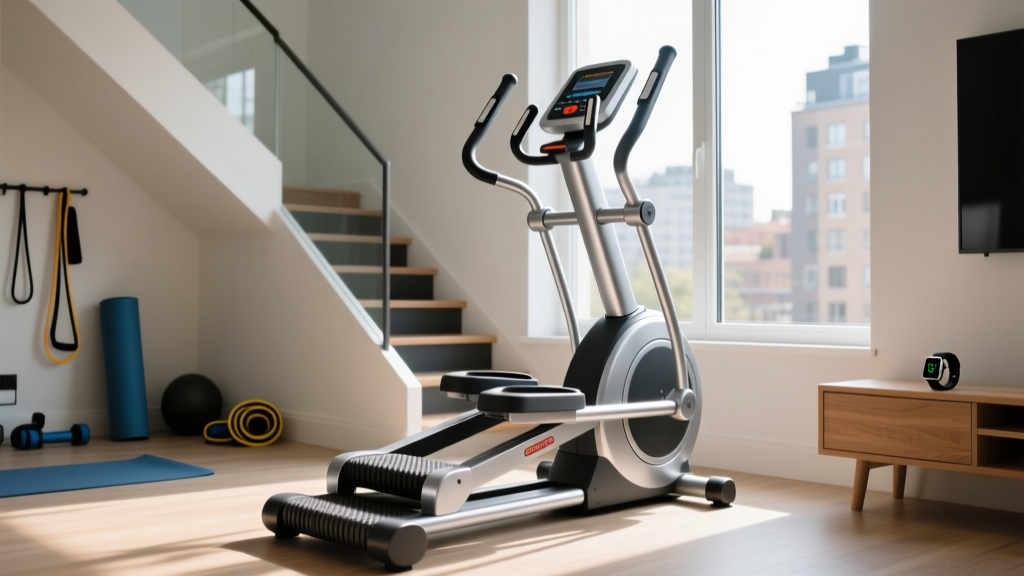
Stair Climber Guide: Bypassing a ProForm Treadmill Incline Problem
Dealing with a proform treadmill incline problem? Discover our beginner-friendly step-by-step guide to choosing and using a home stair climber instead.

You bought your treadmill for the 12% to 15% incline, but today, pressing the 'Incline Up' button yields nothing but a frustrating click, a grinding noise, or an error code on the console. When users search for a proform treadmill incline problem, they are usually facing one of three mechanical failures: a stripped incline motor gear, a failed potentiometer, or a misaligned optical sensor. While recalibrating the console (usually by holding the Speed and Incline buttons for 3-5 seconds) fixes minor software glitches, physical motor failures on popular models like the ProForm Carbon TL or Pro 2000 require a $150 to $250 replacement part and hours of tedious wrench work.
Instead of letting a broken incline motor derail your glute and cardiovascular gains, many home gym owners are making the permanent pivot to a dedicated stair climber. This beginner-friendly, step-by-step guide will show you how to transition from a broken treadmill incline to a highly effective home stair climbing setup, ensuring you never lose your uphill cardio advantage again.
Quick Diagnostic Callout: Is Your Treadmill Salvageable?
Before abandoning your treadmill, check for Error 1 or Error 2. Error 1 typically means the incline motor is moving but the optical sensor isn't reading the gear teeth (often due to dust or misalignment). Error 2 means the motor isn't moving at all (blown capacitor or stripped gear). If it's a stripped gear, bypassing the treadmill for a stair climber is often the most cost-effective long-term cardio solution.
The Biomechanics: Treadmill Incline vs. Stair Climber
Why make the switch? According to Harvard Health Publishing, stair climbing requires roughly twice the energy of walking on a flat surface, engaging the gluteus maximus, hamstrings, and quadriceps with significantly higher activation than a standard 10% treadmill incline. Furthermore, a stair climber relies entirely on your body weight and mechanical resistance, completely eliminating the fragile electronic incline motors that plague budget and mid-tier treadmills.
| Feature | Treadmill (15% Incline) | Dedicated Stair Climber |
|---|---|---|
| Motor Dependency | High (Prone to failure) | Low to None (Hydraulic/Magnetic) |
| Caloric Burn (150 lbs user) | ~11-14 kcal / min | ~13-16 kcal / min |
| Joint Impact | Moderate (Heel strike) | Low (Continuous flexion) |
| Space Footprint | ~70" L x 30" W | ~45" L x 25" W (Mini-Steppers) |
Step-by-Step Guide: Choosing the Right Home Stair Climber
Transitioning to a stair climber requires careful spatial planning. Unlike treadmills, vertical clearance is your biggest enemy.
Step 1: Calculate Your Ceiling Clearance
The most common mistake beginners make is buying a commercial-style StepMill for a room with standard 8-foot (96-inch) ceilings. To avoid hitting your head at the top of the step, use this formula:
- User Height + 15 Inches = Minimum Ceiling Height Required.
- Example: If you are 6'0" (72 inches), you need at least 87 inches of clearance. A standard 8-foot ceiling (96 inches) will work, but if you have low basement ceilings or a pedaling stair climber that adds 10 inches of pedal height, you will strike the ceiling.
Step 2: Select Your Resistance Type
Stair climbers generally fall into three categories based on their resistance mechanism:
- Hydraulic Cylinder Steppers (Budget): Use fluid-filled pistons. Great for small spaces, but cylinders can lose pressure over 2-3 years of heavy use.
- Magnetic/Eddy Current Pedal Climbers (Mid-Tier): Smooth, quiet, and highly durable. These mimic the motion of a StepMill but with a lower profile.
- Revolving Staircase / StepMills (Premium): The gold standard for simulating actual stairs. Requires high ceilings and a larger budget.
Top Home Stair Climbers to Replace Your Treadmill Incline
If your ProForm is permanently stuck at 0%, here are three highly rated alternatives across different price points for the 2026 home gym market:
1. Sunny Health & Fitness SF-S9002 (The Space-Saver)
Price: ~$159 | Type: Hydraulic Mini-Stepper with Resistance Bands
Perfect for apartments. It lacks the deep range of motion of a full stairmill, but the adjustable height step and included resistance bands provide a full-body burn without the footprint of a broken treadmill.
2. Bowflex Max Trainer M9 (The Hybrid Powerhouse)
Price: ~$1,999 | Type: Magnetic Elliptical/Stair Climber Hybrid
Combines the low-impact footpath of an elliptical with the steep, glute-focused resistance of a stair climber. It features a 20-inch step-up height and an incredibly quiet magnetic drive system that will never suffer from the gear-stripping issues of treadmill incline motors.
3. StairMaster StepMill (The Commercial Standard)
Price: ~$2,500+ | Type: Revolving Staircase
If you have 9-foot ceilings and the budget, this is the ultimate replacement. The rotating staircase forces perfect posture and delivers the most authentic uphill climb available in the fitness industry.
Your First 4 Weeks: A Beginner's Step-by-Step Workout Plan
The American Heart Association recommends at least 150 minutes of moderate-intensity aerobic activity per week. Because stair climbing is significantly more demanding than walking on a flat treadmill, beginners must scale their intensity to avoid Achilles tendonitis and patellar fatigue.
Week 1: Acclimation (Focus on Form)
- Frequency: 3 days a week.
- Duration: 10 minutes per session.
- Pace: 50-60 Steps Per Minute (SPM).
- Form Cue: Do not lean heavily on the handrails. Leaning reduces caloric expenditure by up to 20% and shifts the load away from your glutes. Keep a light grip for balance only.
Week 2: Building Endurance
- Frequency: 3 days a week.
- Duration: 15 minutes per session.
- Pace: 65-75 SPM.
- Progression: Introduce 'skip' steps. Take two steps at a time for 30 seconds every 3 minutes to deeply engage the gluteus maximus, mimicking a steep 15% treadmill incline sprint.
Week 3: Introduction to Intervals
- Frequency: 4 days a week.
- Duration: 20 minutes per session.
- Protocol: 1 minute at 85 SPM (High Intensity), followed by 2 minutes at 60 SPM (Active Recovery). Repeat 6 times.
Week 4: Steady-State Mastery
- Frequency: 4 days a week.
- Duration: 25-30 minutes continuous.
- Pace: Maintain a challenging but sustainable 75-80 SPM. You should be able to speak in short sentences, but not hold a full conversation.
Maintenance: Avoiding the Fate of Your Treadmill
One of the main reasons users abandon treadmills is the high cost of electronic repairs. Stair climbers are inherently simpler, but they still require basic upkeep to ensure longevity:
- Lubricate Pivot Points (Hydraulic Models): Every 6 months, apply a drop of silicone-based lubricant to the pivot joints where the hydraulic cylinders attach to the frame. Never use WD-40, as it attracts dust and degrades rubber bushings.
- Clean the Optical Sensors (StepMills): If your revolving staircase starts jerking or changing speeds erratically, wipe the internal optical speed sensor with a dry microfiber cloth. Dust buildup is the stair climber equivalent of a treadmill's incline sensor failure.
- Check Belt Tension (Pedal Climbers): If the pedals feel 'sluggish' or slip under heavy loads, consult your manual to adjust the internal drive belt tension using a standard Allen wrench.
Final Thoughts: Moving Uphill Without the Motor
A proform treadmill incline problem doesn't have to mean the end of your lower-body cardio progress. By understanding the spatial requirements and biomechanical benefits of stair climbers, you can upgrade your home gym to a machine that relies on your own power rather than a fragile, easily stripped incline motor. Whether you opt for a budget-friendly hydraulic stepper or a premium magnetic hybrid, stepping up to a dedicated climber will protect your joints, maximize your glute activation, and keep your heart rate exactly where it needs to be.
More gear to consider
All reviews
Elliptical vs Treadmill: Can You Train for a Marathon on a Treadmill?

Yosuda Treadmill Review: Under Desk Office Value in 2026

Sunny Smart Treadmill Review: Small Space Care & Longevity

Rowing Machine Buying Guide & Technique: Yamaguchi Treadmill Alternative

Treadmill Motor Setup: Sizing Guide & 100 Meters on a Treadmill Test
