
Home Gym Academy: Mirror Placement and Lighting Budget Guide
Master your home gym academy curriculum with our mirror placement and lighting budget guide. Analyze costs, lumens, and materials for optimal builds.

Welcome to the Home Gym Academy: Visual Infrastructure
When building a dedicated training space, most lifters allocate 90% of their budget to barbells, racks, and cardio machines. However, the visual environment—specifically mirrors and lighting—dictates your form, safety, and psychological drive. In this edition of our Home Gym Academy series, we treat mirror placement and lighting not as mere decorative afterthoughts, but as critical functional infrastructure. We will break down the exact costs, material values, and spatial planning required to optimize your training environment in 2026, ensuring you do not overpay for aesthetics or underinvest in safety.
The Functional ROI of Visual Infrastructure
Why allocate thousands of dollars to glass and LEDs? The return on investment is measured in injury prevention and movement efficiency. According to the National Strength and Conditioning Association (NSCA), visual feedback is a primary component of motor learning and proprioception. Without adequate mirrors, you lose the ability to self-correct spinal alignment during heavy squats or deadlifts. Without proper lighting, shadows obscure joint angles, increasing the risk of form breakdown. Budgeting correctly for these elements ensures you get commercial-grade feedback without commercial-grade overhead.
Mirror Materials: Cost vs. Safety Analysis
The biggest mistake home gym owners make is purchasing standard annealed glass mirrors from big-box hardware stores. When a 45-pound bumper plate is dropped, the resulting shockwave can shatter standard glass into lethal, dagger-like shards. The Home Gym Academy strictly recommends safety-rated materials. Here is the breakdown of your options and their true cost per square foot.
| Material Type | Avg Cost (Per Sq Ft) | Safety Rating | Best Use Case |
|---|---|---|---|
| Standard Annealed Glass | $6 - $9 | Poor (Shatters dangerously) | Low-traffic yoga zones |
| Shatterproof Acrylic | $15 - $22 | Excellent (Will not shatter) | Heavy lifting zones, garage gyms |
| Tempered Safety Glass | $20 - $35 | High (Crumbles into dull cubes) | Premium dedicated home gyms |
| Laminated Glass | $30 - $45 | Maximum (Holds together when broken) | Commercial/Elite home setups |
The Value Winner: Shatterproof Acrylic
For the average 200-square-foot lifting zone, outfitting a 10-foot wide by 6-foot high wall (60 sq ft) with shatterproof acrylic will cost between $900 and $1,320. While this is roughly double the cost of standard glass, the value proposition is immense. Acrylic is lightweight, drastically reducing shipping costs and making DIY installation a one-person job. Furthermore, modern optical-grade acrylics eliminate the 'funhouse' distortion that plagued older plastic mirrors, providing 1:1 visual accuracy.
Strategic Mirror Placement Framework
Do not mirror every wall. Over-mirroring creates a disorienting infinity effect and wastes budget. Instead, apply the Academy's 'Primary Plane' strategy:
- The Frontal Plane (Priority 1): Place mirrors directly in front of your main lifting platform or squat rack. This is where you need real-time feedback on knee valgus, spinal neutrality, and bar path. Budget for a minimum width of 8 feet to capture your entire range of motion.
- The Lateral Plane (Priority 2): Place a narrower mirror (4 to 6 feet wide) on the side wall adjacent to your platform. This is crucial for monitoring depth on squats and hip hinge mechanics on deadlifts.
- The Rear Plane (Skip It): Avoid placing mirrors behind you. Turning your head to look at a rear mirror compromises cervical spine alignment during heavy loads. Use your phone camera on a tripod for rear-angle recording instead.
Lighting Design: Lumens, Kelvin, and Cost Value
Lighting is where budgets are most frequently mismanaged. The goal is not just brightness; it is shadow elimination and color accuracy. The Illuminating Engineering Society (IES) recommends 50 foot-candles (approximately 50 lumens per square foot) for weight rooms. However, for a home gym where detailed form checking is required, we recommend aiming for 75 to 100 lumens per square foot.
Color Temperature (Kelvin) and CRI
The color temperature of your LEDs dictates the psychological environment of your gym.
- 4000K (Cool White): Clean and focused. Ideal for general fitness and yoga.
- 5000K - 5700K (Daylight): The Home Gym Academy standard for heavy lifting. This spectrum mimics natural midday sun, promoting alertness and providing the highest contrast for spotting joint angles.
Equally important is the Color Rendering Index (CRI). A CRI of 80+ is mandatory. Low CRI lighting washes out skin tones, making it difficult to see muscle engagement or spot early signs of skin tearing on your shins during deadlifts.
⚠️ The Shadow Trap Warning
Never rely solely on a single central ceiling fixture. A single overhead light casts harsh downward shadows, obscuring your face, chest, and knee alignment. You must use a grid layout or linear wraparound fixtures placed parallel to your lifting path, not perpendicular, to ensure light washes evenly across your body from multiple angles.
Complete Budget Matrix: 2-Car Garage Gym (400 Sq Ft)
Let us translate these metrics into a concrete budget breakdown for a standard 400-square-foot space. This matrix provides three tiers of investment, allowing you to align your spending with your long-term training goals.
| Component | Tier 1: Budget Builder ($1,200) | Tier 2: Academy Standard ($2,800) | Tier 3: Elite Performance ($5,500+) |
|---|---|---|---|
| Mirrors (60 sq ft) | Standard Glass w/ J-Channel ($500) | Shatterproof Acrylic w/ Z-Clips ($1,200) | Tempered Low-Iron Glass ($2,400) |
| Primary Lighting | 4x Basic LED Shop Lights, 4000K ($160) | 6x High-CRI Wraparound LEDs, 5000K ($600) | 8x Recessed Architectural LEDs + Smart Dimmers ($1,800) |
| Accent/Task Lighting | None ($0) | LED Strip under racks for floor visibility ($200) | Color-tunable RGBW accent lighting ($800) |
| Installation | 100% DIY ($0 materials) | DIY + Pro Electrician for new circuits ($800) | Full Pro Contractor Installation ($2,500+) |
Real-World Installation Costs and Edge Cases
The hidden costs of visual infrastructure usually emerge during installation. Here are the edge cases you must budget for:
Mirror Adhesive vs. Mechanical Fasteners
If you choose to glue acrylic or glass mirrors directly to drywall, you must use a neutral-cure silicone mirror mastic. Standard construction adhesives contain solvents that will eat through the reflective backing of the mirror, causing permanent black spots (mirror rot) within six months. A tube of high-quality neutral-cure mastic costs about $15, and you will need at least four tubes for a 60-square-foot wall. Alternatively, mechanical Z-clips ($5 to $8 per linear foot) allow you to mount the mirrors without adhesive, preserving your drywall and allowing for future relocation.
Electrical Rewiring and Smart Controls
Most older garages have a single 15-amp circuit shared with the garage door opener and exterior lights. Plugging in multiple high-draw LED fixtures, a space heater, and a treadmill will trip the breaker. Budget $400 to $800 for a licensed electrician to run a dedicated 20-amp circuit to your gym ceiling grid. Furthermore, integrating smart switches (like Lutron Caseta) adds roughly $150 per switch but provides immense value, allowing you to adjust lighting intensity via voice or phone without breaking your pre-workout focus to walk across the gym.
Final Academy Takeaway
Treating your mirrors and lighting as a calculated investment rather than an aesthetic expense fundamentally changes the quality of your training. By prioritizing shatterproof materials, strategic lateral placement, and high-CRI daylight LEDs, you build a space that actively protects your joints and accelerates your progress. Follow the Home Gym Academy budget matrices above, and you will achieve a commercial-grade visual environment that pays dividends for every rep you perform.
More gear to consider
All reviews
Body Solid Home Gym With Leg Press: Rental Apartment Setup Mistakes

Complete Home Gym Setup Guide: Floor Plans & DIY Home Gym Equipment

Home Gym Black Walls Setup: Floor Plans & Expert Top Picks
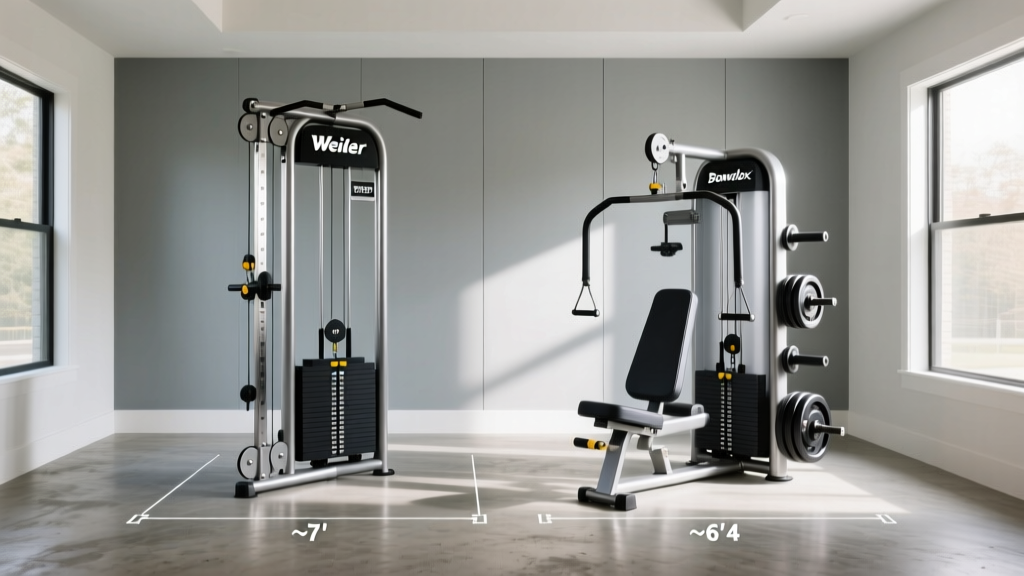
Weider 8530 Home Gym vs Bowflex PR1000: Remodel Guide

Shared Home Gym Setup Guide: Marcy Home Gym MWM 990 for Couples
