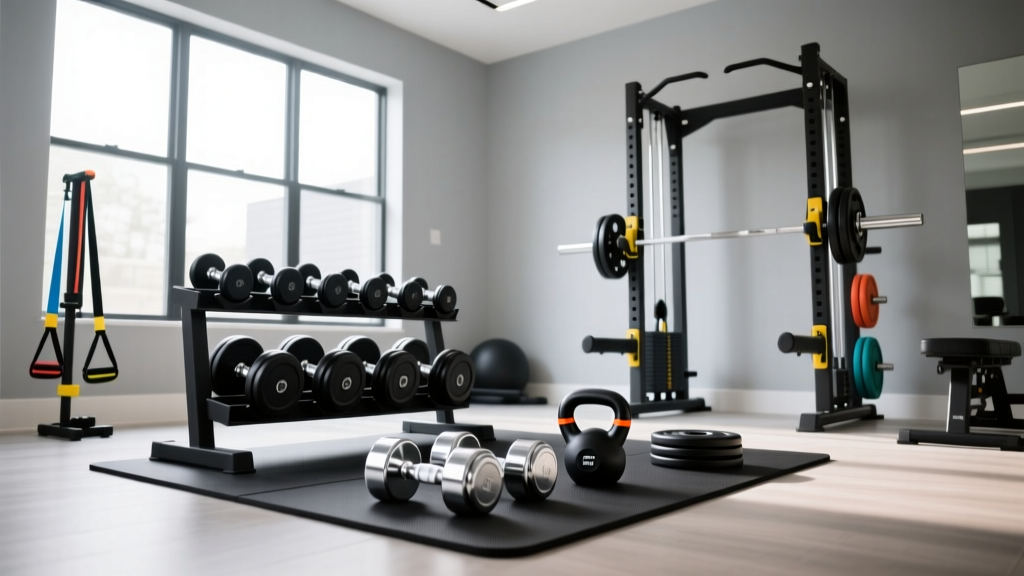
Selecting Good Equipment for Home Gym: How Much Weight You Need
Discover how much weight you actually need. Our guide to selecting good equipment for home gym setups covers plate types, costs, and progressive overload.

The Mathematics of Muscle: Why Most Home Gyms Fail
Building a personal training space is one of the highest-ROI investments you can make for your health, but it is fraught with expensive miscalculations. When sourcing good equipment for home gym environments, weight selection is the most frequently underestimated variable. Most beginners purchase a standard 100-pound or 150-pound plate set, only to outgrow it within four months of consistent training. The result? You are forced to buy a second, heavier set, paying for duplicate 10lb and 25lb plates while dealing with the logistical nightmare of reselling your starter kit.
To avoid this trap, you must approach weight selection not based on your current strength, but on your projected strength 18 months from today. According to the Centers for Disease Control and Prevention (CDC), adults should engage in muscle-strengthening activities of moderate or greater intensity that involve all major muscle groups on two or more days a week. Consistent adherence to this baseline, combined with progressive overload, guarantees rapid strength adaptations.
The 18-Month Projection Rule & Strength Standards
Progressive overload—the gradual increase of stress placed upon the body during training—is the non-negotiable driver of hypertrophy and strength. A landmark dose-response study by Schoenfeld et al. published in the Journal of Strength and Conditioning Research demonstrates a clear, dose-dependent relationship between weekly training volume and muscle growth. As your volume and neurological efficiency increase, your baseline working weights will skyrocket.
Instead of buying for the lifter you are today, buy for the intermediate lifter you will become. Below are the projected intermediate working weights (for 5-rep max sets) based on ExRx strength standards for a 180 lb male and 140 lb female.
| Lift | Beginner (Day 1) | Intermediate (Month 18) | Required Plate Load (Bar + Plates) |
|---|---|---|---|
| Back Squat | 95 lbs | 225 - 275 lbs | ~230 lbs of plates |
| Deadlift | 115 lbs | 275 - 335 lbs | ~290 lbs of plates |
| Bench Press | 85 lbs | 185 - 225 lbs | ~180 lbs of plates |
| Overhead Press | 45 lbs | 115 - 135 lbs | ~90 lbs of plates |
Note: The 'Required Plate Load' accounts for a standard 45 lb Olympic barbell. To comfortably hit intermediate deadlift and squat numbers without maxing out your barbell sleeves, you need a minimum of 250 to 300 pounds of total plate weight.
Plate Material Breakdown: Iron vs. Bumper vs. Urethane
Once you know how much weight you need, you must decide what kind. The material dictates the cost per pound, the acoustic footprint (crucial for garage or basement gyms), and the drop-rating. As of early 2026, global freight stabilization has brought cast iron prices back to historical norms, while urethane remains a premium investment.
| Material | Avg. Cost per Lb (2026) | Durability & Drop Rating | Best Use Case |
|---|---|---|---|
| Cast Iron | $1.50 - $1.80 | High (Do not drop from overhead) | Powerlifting, traditional garage gyms, budget-conscious buyers. |
| Virgin Rubber Bumper | $2.50 - $3.50 | Medium (70A-85A Durometer, high bounce) | Olympic weightlifting, CrossFit, concrete floor setups. |
| Crumb Rubber Bumper | $2.00 - $2.80 | Medium-High (Dead bounce, loud) | General fitness, commercial gym flooring protection. |
| Urethane (PU) | $4.00 - $6.00 | Extremely High (No odor, zero bounce) | Premium home gyms, spare room conversions, noise-sensitive areas. |
⚠️ The Hidden Limit: Barbell Sleeve Capacity
A standard Olympic power bar features a 16.3-inch loadable sleeve. A standard 45 lb cast iron plate is roughly 1.5 inches thick. This means you can fit exactly 10 plates per side, plus the collar. Maximum loadable weight on a standard bar with iron plates is roughly 495 lbs. If your 18-month projection puts your deadlift near 500 lbs, you must invest in calibrated steel plates (which are significantly thinner) or specialized weight releasers, otherwise, the plates will slide off the sleeve during the lift.
The 3-Phase Weight Acquisition Strategy
Rather than dropping $1,200 on day one, use this phased approach to manage cash flow while ensuring you never stall your progressive overload.
Phase 1: The Core Foundation (Months 1-4)
Purchase a 160 lb to 190 lb plate set. This should include pairs of 45s, 25s, 10s, and a set of fractional micro-plates (1.25 lbs and 2.5 lbs). Micro-plates are the secret to breaking through upper-body plateaus on the bench and overhead press, where adding 10 lbs represents a massive 5-8% jump in total load.
Phase 2: The Heavy Expansion (Months 5-12)
As your squat and deadlift surpass 225 lbs, you will run out of 45 lb plates. Instead of buying more small change plates, invest in two to four additional 45 lb bumper or iron plates. This brings your total weight to the 280-350 lb range, safely covering intermediate lower-body lifts.
Phase 3: The Advanced Calibration (Year 2+)
If you transition into specialized powerlifting or Olympic lifting, this is when you diversify. Buy a set of calibrated steel plates for precise competition-style loading, or invest in a high-end adjustable dumbbell set (like the Nuobell 80s or PowerBlock Elite EXP, retailing between $450 and $700 in 2026) to supplement barbell work with unilateral hypertrophy movements.
'The biggest mistake I see home gym owners make is ignoring fractional plates. Progression on the overhead press stalls quickly. Having 0.5 lb and 1 lb plates allows for micro-loading, which keeps the neurological adaptation curve moving upward without risking connective tissue overload.' — NSCA-Certified Strength and Conditioning Specialist
Frequently Asked Questions
Should I buy pounds (LBS) or kilograms (KG)?
If you plan to compete in USA Weightlifting (USAW) or international powerlifting federations, buy KG plates. For 95% of home gym users in North America, LBS is the standard. Mixing the two is highly discouraged, as conversion math mid-workout disrupts focus and increases the risk of asymmetric loading.
Do I need a weight tree or rack storage?
Yes. Stacking plates on the floor creates a tripping hazard and damages the edges of rubber bumpers. A vertical weight tree (approx. $120-$180) or horizontal wall-mounted plate pegs ($60-$100) are mandatory safety investments. Ensure your storage solution is rated for at least 800 lbs to prevent structural buckling over time.
What about adjustable dumbbells vs. fixed weights?
For home gyms under 200 square feet, adjustable dumbbells are the undisputed king of space efficiency. A single pair of 5-50 lb adjustable dumbbells replaces 15 pairs of fixed hex dumbbells, saving roughly 40 square feet of floor space and $1,500 in cumulative iron costs.
More gear to consider
All reviews
Configuring Your Space for a Weider Home Gym Workout Routine

Configuring Your Space for a Strength Home Gym Training Program

CAP Home Gym Weight Guide: How Much Iron Do You Actually Need?

Best Exercise Posters for Home Gyms: 2026 Remodel Guide

Troubleshooting Your Bio Force Home Gym in a Rental Apartment
