Rubber Hex vs Urethane Dumbbells: Space Layouts for a Fly Workout
Designing a compact home gym? Compare rubber hex vs urethane dumbbells for space optimization, rack footprints, and lateral clearance for a fly workout.

The Spatial Dilemma: Compact Gyms and Lateral Movements
In the 2026 home fitness landscape, the average dedicated workout space has shrunk to roughly 8x10 or 10x10 feet. When optimizing a micro-gym, every square inch of floor and wall space dictates your equipment choices. While compound movements like squats or presses require vertical clearance, isolation movements demand strict lateral mapping. The ultimate stress-test for any compact gym layout is the fly workout with dumbbells. This movement requires maximum lateral arm extension, meaning your equipment storage, wall proximity, and dumbbell geometry must be perfectly synchronized to avoid drywall damage and restricted range of motion.
This brings us to a critical, often overlooked spatial debate: rubber hex dumbbells vs. urethane dumbbells. While most buyers focus on grip or drop-test durability, spatial designers and home gym architects look at footprint, roll-out zones, and rack protrusion. Here is how these two materials and shapes dictate the layout of a space-optimized chest isolation zone.
Rack Footprints: Storing Hex vs. Round Urethane
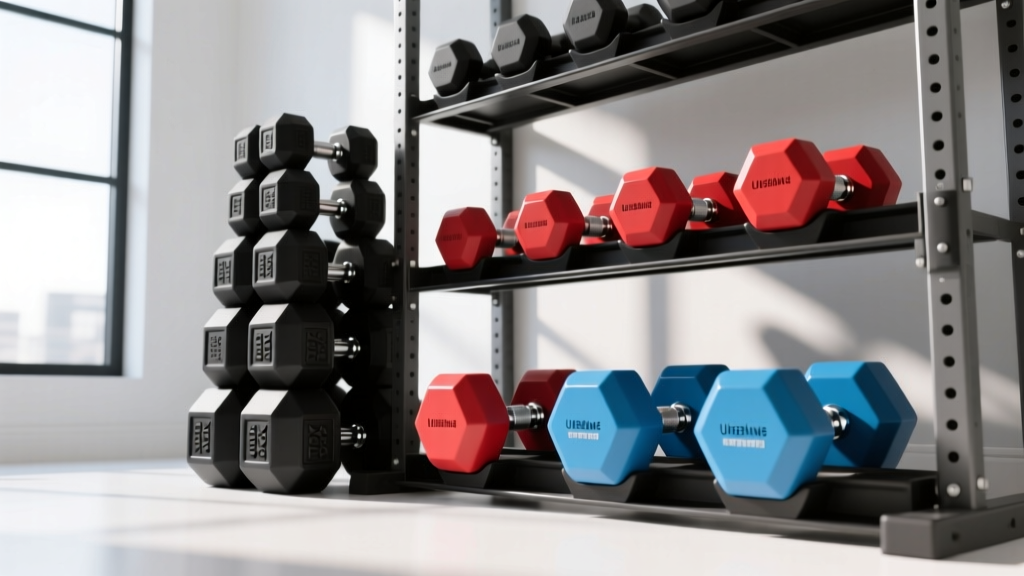
The shape of your dumbbell head entirely dictates the type of storage rack you must use, which directly impacts your gym's floor plan. Rubber hex dumbbells are almost exclusively stored on vertical A-frame racks. Urethane dumbbells, which are traditionally round (though hex urethane exists, round is the commercial standard for space-tiering), require horizontal 3-tier or 5-tier shelving racks.
| Rack Type | Compatible Dumbbell | Floor Footprint | Wall Protrusion | Spatial Impact |
|---|---|---|---|---|
| Vertical A-Frame | Rubber Hex | 24' x 24' (4 sq ft) | Up to 32' wide when loaded | Minimal floor space, but heads protrude into lateral swing zones. |
| 3-Tier Horizontal | Round Urethane | 48' x 28' (9.3 sq ft) | Flush profile (approx 28' deep) | Consumes more floor space, but maintains a flat wall-facing profile. |
Note: Dimensions based on standard 5-50 lb (10-pair) commercial racks.
If your layout places the dumbbell rack parallel to your bench, an A-frame loaded with rubber hex dumbbells will protrude outward. During a fly workout with dumbbells, if your bench is positioned too close to the rack, the protruding hex heads can physically block your elbow drop at the bottom of the eccentric phase.
Clearance Mapping for the Dumbbell Fly
To understand spatial clearance, we must look at the biomechanics of the movement. According to exercise databases like ExRx.net, the pectoral fly requires a wide, sweeping arc that fully stretches the chest fascia.
The Wingspan + Equipment Formula:
The average adult male wingspan is 72 inches. Add a standard 13-inch rubber hex dumbbell to each hand, and your total lateral extension reaches roughly 8.2 feet (98.4 inches). In an 8x10 room, performing a fly workout with dumbbells parallel to the 8-foot wall is biomechanically impossible without striking the drywall.
This is where the roll-out zone becomes a vital layout metric. When you finish a heavy set of flys, you must set the weights down.
- Rubber Hex: The flat edges dead-drop and stay exactly where placed. In a tight layout with only 4 inches of clearance between your bench and the wall, hex dumbbells are safe. They will not roll into baseboards or adjacent plate trees.
- Round Urethane: When set down on a hard floor (rubber mats or concrete), round heads roll. In a space-optimized gym, a rolling 50 lb urethane dumbbell will inevitably crash into a wall, a mirror, or a nearby power rack upright. If you choose urethane for its premium feel, your layout must include a designated 'drop zone' lined with high-density crash pads, or you must invest in a specialized dumbbell tray that attaches to your bench.
Material Degradation in High-Density Zones
Space optimization isn't just about square footage; it's about spatial maintenance. In a compact garage or basement gym, equipment is packed tightly, leading to frequent micro-collisions.
Warning: The Hex Edge Crumble Effect
Rubber hex dumbbells are manufactured by pouring liquid rubber into a mold around a steel core. Over 3 to 5 years, the thin outer edges of the hexagon begin to dry-rot and crumble. In a tight layout where you are constantly navigating around the weights, these crumbling edges leave aggressive black scuff marks on light-colored walls and adjacent equipment. Urethane, conversely, is a solid, highly dense polymer that does not chip, crumble, or scuff, making it vastly superior for high-density, narrow-clearance layouts where wall preservation is a priority.
2026 Cost-to-Space Analysis
When designing your layout, you must weigh the spatial benefits against the financial investment. As of early 2026, the pricing gap between commercial-grade rubber hex and premium urethane remains significant. Based on current market data from major suppliers like Rogue Fitness, here is the breakdown for a standard 5-50 lb set (10 pairs, 550 total lbs):
- Rubber Hex Set: ~$1.30 - $1.60 per pound (Total: $715 - $880)
- Urethane Round Set: ~$3.20 - $4.00 per pound (Total: $1,760 - $2,200)
While urethane costs roughly 2.5x more, its flush-profile storage on horizontal racks and zero-scuff material can save hundreds of dollars in drywall repair and spatial reconfiguration in ultra-compact rooms.
Layout Blueprint: The 8x10 Dumbbell Fly Zone
If your primary goal is executing a flawless fly workout with dumbbells in a restricted 8x10 foot space, follow this exact layout blueprint to maximize clearance and safety.
- Orient the Bench Diagonally: Instead of placing your bench parallel or perpendicular to the walls, angle it at 45 degrees from the corner. This exploits the room's diagonal hypotenuse (approx. 12.8 feet), providing the necessary 8.5+ feet of lateral wingspan clearance required for heavy flys.
- Rack Placement: Place a 3-tier horizontal urethane rack flat against the shortest wall (the 8-foot wall). This keeps the protrusion depth to 28 inches, leaving the center of the room entirely open for bench positioning.
- Mirror Mapping: Mount a shatterproof acrylic mirror on the wall directly behind the bench head. Avoid glass in tight fly zones where a dropped dumbbell head could ricochet off the floor and shatter standard glass.
- Floor Matting Strategy: Use interlocking 3/4-inch horse stall mats, but leave a 2-inch gap between the mat and the drywall. This gap acts as a buffer zone; if a round urethane dumbbell rolls off the mat, it drops into the gap rather than smashing into the baseboard.
Final Verdict on Spatial Design
If your home gym features tight wall clearances, low-budget constraints, and you frequently drop weights after a grueling fly workout with dumbbells, rubber hex is your most practical choice. The dead-drop geometry prevents rolling hazards in cramped quarters. However, if you are designing a premium, flush-profile layout where wall preservation and sleek horizontal storage are paramount, investing in urethane will yield a vastly superior, low-maintenance spatial environment.
More gear to consider
All reviews
Power Rack vs Squat Rack vs Squat Stand: Dumbbell Twist Press Errors

Compact Gym: EZ vs Straight Bar & Workout Pecs with Dumbbells
What Size Dumbbells Should I Use? The Case for Kettlebells in 2026
Barbell Collar & Clamp Types Comparison: Securing Dumbbell Step Downs
Beyond the Dumbbell Yoga Workout: Olympic Barbell Weight & Knurling