
Hex vs Urethane Dumbbells: Gym Layouts & Arnold Press GIF Tips
Optimize your home gym layout by comparing rubber hex vs urethane dumbbells. Includes rack spacing, acoustic mapping, and tight-space form tips.

The Spatial Dilemma: Hex vs. Round Urethane Footprints
Designing a high-functioning home gym in a constrained footprint—whether a 60-square-foot apartment corner or a cramped two-car garage bay—requires ruthless spatial efficiency. When selecting free weights, the debate between rubber hex dumbbells and urethane dumbbells is rarely just about material durability; it is fundamentally a question of geometry, rack compatibility, and layout optimization. While Rogue Fitness dumbbell specifications highlight the premium feel and acoustic dampening of urethane, the flat edges of rubber hex models offer distinct advantages for high-density storage. Understanding the exact dimensional differences between these two styles is the first step in engineering a micro-gym that maximizes usable floor space without sacrificing heavy lifting capabilities.
Material Science Snapshot: Rubber hex dumbbells are typically cast with a Shore A hardness of 85-90, utilizing recycled or virgin rubber bonded to a steel core. Urethane (polyurethane) is a synthetic elastomer that offers superior UV resistance, zero off-gassing (VOCs), and a denser molecular structure, allowing for slightly more compact head profiles at higher weight increments.Dimensional Data & Rack Capacity Matrix
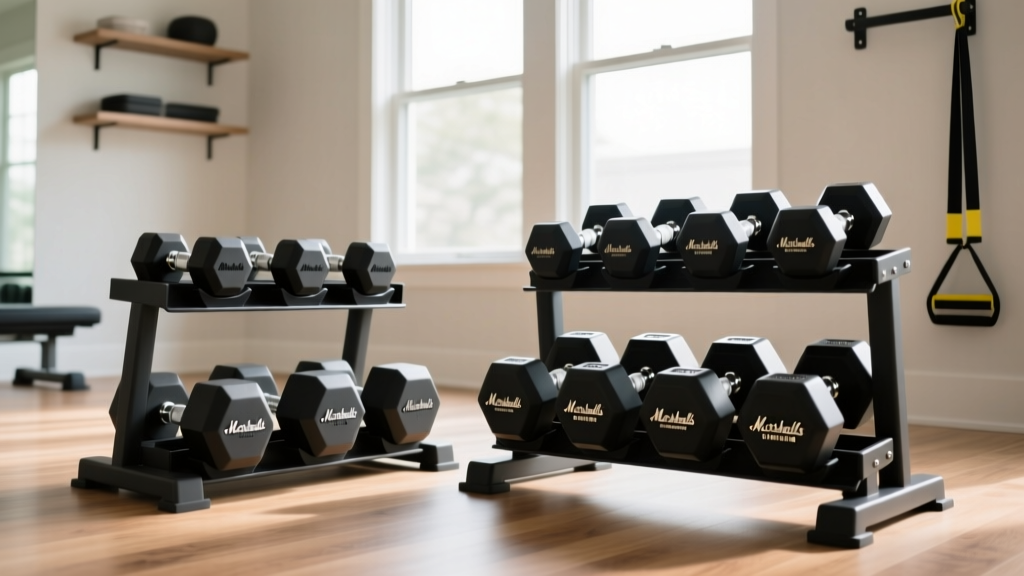
The physical footprint of your dumbbell set directly dictates the type of storage rack you can deploy. Standard 3-tier dumbbell racks (such as the popular 34-inch wide models) are designed with specific tier depths and lip heights. Because hex dumbbells feature flat sides, they can be placed flush against one another. Round urethane dumbbells, however, require a lateral buffer zone of 0.5 to 1.0 inches to prevent friction damage to the urethane coating and to allow the user's hand to grip the head safely when racking.
| Feature | Rubber Hex (e.g., Rep Fitness) | Urethane (e.g., Rogue / Eleiko) |
|---|---|---|
| Price per Pound (Avg) | $1.50 - $2.25 / lb | $3.50 - $6.00 / lb |
| 50lb Pair Head Width | ~6.8 inches | ~6.2 inches (Cylindrical) |
| Rack Compatibility | Flat Shelves (Flush Stacking) | Contoured Saddles / Tray Racks |
| Max Pairs on 34" Tier | 5 to 6 Pairs | 4 to 5 Pairs |
| Acoustic Impact | High (Hard thud, vibrations) | Low (Dense, muted absorption) |
Designing the Drop Zone: Acoustics and Floor Clearance
In a space-optimized gym, your lifting platform or drop zone often serves multiple purposes. It is where you deadlift, perform walking lunges, and occasionally drop heavy dumbbells at the end of a grueling set. According to facility layout guidelines referenced by ExRx.net weight room standards, you must account for both the physical clearance of the lift and the acoustic footprint of the equipment.
The Urethane Advantage in Shared Spaces
If your micro-gym is located in an apartment, a finished basement, or a garage with shared walls, urethane is the undisputed champion of spatial acoustics. The molecular density of polyurethane absorbs kinetic energy far more efficiently than vulcanized rubber. When a 70lb urethane dumbbell is dropped from waist height onto a 3/4-inch horse stall mat, the decibel spike is significantly lower, and the low-frequency vibration transfer through the subfloor is minimized. Rubber hex dumbbells, conversely, tend to 'bounce' and transmit a sharp, high-impact thud that can rattle drywall fixtures in tight rooms.
Wall Clearance & Digital Form Coaching
One of the most overlooked aspects of compact gym design is the 'swing radius' required for rotational and lateral movements. In a 6x8 foot gym corner, wall-strikes during exercises like the Arnold Press are a primary concern. The Arnold Press requires a deep tuck at the bottom of the movement, followed by a lateral elbow flare and external rotation as the weight is pressed overhead.
To prevent drywall damage or elbow strikes, smart micro-gym designers often mount a tablet or small monitor to their power rack uprights or a wall-mirror frame. By looping a dumbbell arnold press gif on the screen, lifters can visually confirm their rotation arc and elbow tuck stay within the designated 24-inch safety envelope without having to turn their head and break their neck alignment. This digital coaching setup allows you to push the boundaries of your spatial layout safely, ensuring your biomechanics remain pristine even when the wall is only two feet away from your peripheral workspace.
Pro Layout Tip: Never place your dumbbell rack directly adjacent to your primary lifting zone. The American Council on Exercise (ACE) recommends a minimum of 36 inches of clear walkway between storage apparatus and active lifting spaces to prevent tripping hazards during fatigue-induced weight drops.
Step-by-Step Blueprint: The 80-Square-Foot Micro-Gym
To visualize how rubber hex and urethane dumbbells dictate layout, let us map out an 8x10 foot (80 sq ft) garage bay. Here is how you optimize the space based on your material choice.
- Establish the Perimeter (0-12 inches from wall): Mount your digital form display (for your exercise GIF references) and install vertical wall-hooks for resistance bands. This utilizes 'dead space' that floor racks would otherwise consume.
- Deploy the Rack (Corner Placement):
- If using Rubber Hex: Position a 5-tier flat-shelf rack in the corner. Because hex bells stack flush, you can store 25 pairs (5-50lbs) in a mere 6 square feet of floor space.
- If using Urethane: Opt for a 3-tier contoured saddle rack. You will sacrifice vertical density to accommodate the rolling nature of round bells, requiring roughly 8 square feet for the same weight range.
- The Active Drop Zone (Center): Lay down four 4x6 foot interlocking EVA foam or rubber mats. Leave a 12-inch gap between the mat edge and the dumbbell rack to allow for easy weight retrieval without shin-scraping.
- Overhead Clearance Check: Stand in the center of the mat with your heaviest dumbbells. Press overhead. If your ceiling is 8 feet, ensure the dumbbell handle plus your arm length does not exceed 90 inches, leaving a 6-inch buffer for ceiling joists or garage door tracks.
Climate, Degradation, and Long-Term Spatial Planning
Space optimization is not just about today's footprint; it is about how the equipment ages in your specific environment. If your layout places the dumbbell rack near a garage window or an exterior door, UV exposure and temperature fluctuations become critical factors.
Rubber hex dumbbells are highly susceptible to thermal expansion and contraction. In unclimate-controlled garages, the rubber can become brittle in freezing winter months and overly soft or sticky in peak summer heat. Furthermore, the off-gassing of volatile organic compounds (VOCs) from cheap rubber can make a small, poorly ventilated 80-square-foot room unbearable. Urethane, being a closed-cell synthetic polymer, is entirely impervious to UV degradation and temperature swings. While the initial financial investment for urethane is nearly triple that of rubber hex, the spatial consistency—meaning the heads won't warp, crack, or degrade into a powdery mess on your rack shelves—makes it the superior long-term choice for permanent micro-gym installations.
Final Verdict on Spatial Efficiency
If your primary constraint is absolute maximum storage density on a flat-shelf rack and a strict budget, rubber hex dumbbells win the geometry game. Their flat edges allow for zero-gap stacking, squeezing every ounce of storage potential out of a 34-inch rack tier. However, if your space optimization strategy prioritizes acoustic dampening, multi-purpose drop zones, and premium ergonomic clearance without the risk of rolling off flat shelves, urethane dumbbells paired with a contoured saddle rack provide a vastly superior, user-friendly layout for the modern home lifter.
More gear to consider
All reviews
Cable Flyes vs Dumbbell Flys: Adjustable Dumbbell Guide
Marshalls Dumbbells vs Urethane: Space & Layout Guide
Barbell Collars Compared: Securing Squats & Dumbbell Floor Press

Dumbbell Side Lateral Raises: Adjustable Dumbbell Mistakes & Fixes

Top Loadable Dumbbells to Accelerate Dumbbell Fat Loss (2026 Review)
