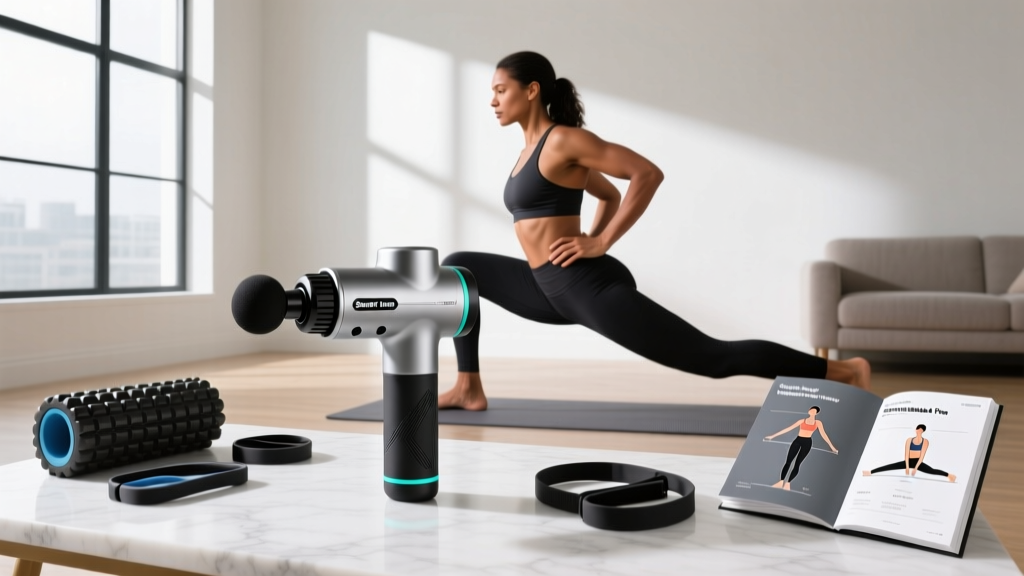
Heat Pad vs Wrap: Troubleshooting & Massage Gun for Knee Pain
Troubleshoot knee recovery mistakes. Compare heat therapy pads vs wraps, and learn critical safety rules for using a massage gun for knee pain.

The Knee Pain Recovery Dilemma: Heat vs. Percussion
When treating lower-extremity joint issues, consumers frequently conflate different recovery modalities, leading to prolonged discomfort or exacerbated injuries. The knee is a complex hinge joint stabilized by ligaments, tendons, and cartilage, making it highly sensitive to improper recovery techniques. In 2026, the market is saturated with advanced recovery tools, but having the right gear is only half the battle; knowing how to troubleshoot common application errors is where true recovery happens.
Two of the most common points of confusion involve choosing between a heat therapy pad and a compression wrap, and understanding the strict anatomical safety rules when searching for a massage gun for knee pain. Misapplying percussive therapy or thermal compression can turn a minor patellar tendon strain into a chronic issue. This guide breaks down the exact failure modes, product specifications, and troubleshooting protocols you need to optimize your knee recovery.
Heat Therapy Pad vs. Wrap: Troubleshooting the Core Differences
Many athletes and physical therapy patients use the terms "heat pad" and "heat wrap" interchangeably, but their biomechanical effects on the knee joint are vastly different. A standard heat therapy pad (like the Therabody RecoveryTherm Heat Knee, retailing around $199) relies on gravity and basic strapping to deliver thermal energy. In contrast, a smart heat wrap (like the Hyperice Venom 2 Knee, priced at $249) combines targeted thermotherapy with pneumatic or neoprene-based compression and localized vibration.
Specification and Use-Case Comparison Matrix
| Feature | Flat Heat Therapy Pad | Compression Heat Wrap (Smart) |
|---|---|---|
| Primary Mechanism | Surface-level conductive heat | Heat + Compression + Vibration |
| Patellar Coverage | Uneven; gaps around the kneecap | Contoured; uniform contact |
| Blood Flow Enhancement | Moderate (vasodilation only) | High (vasodilation + mechanical pump) |
| Best For | General quad/hamstring stiffness | Patellar tendinopathy, joint arthritis |
| Common Mistake | Strapping too tight, cutting off circulation | Using on acute swelling (traps inflammation) |
Troubleshooting Thermal Therapy Mistakes
Mistake 1: Applying Heat to Acute Inflammation. If your knee is swollen, red, or hot to the touch within 48 hours of an injury, applying heat is a critical error. According to the Mayo Clinic, heat increases blood flow, which will exacerbate acute swelling and tissue damage. You must use cryotherapy (ice) first. Heat is strictly for chronic stiffness, osteoarthritis, or pre-workout tissue prep.
Mistake 2: Erythema Ab Igne (Toasted Skin Syndrome). Leaving a high-temperature heat wrap on the knee for longer than 20 minutes repeatedly can cause a reticulated, hyperpigmented rash known as erythema ab igne. Always limit smart wrap sessions to 15-minute intervals and utilize the medium heat setting (usually around 135°F to 140°F) rather than the maximum setting.
Critical Mistakes When Using a Massage Gun for Knee Pain
The search volume for a massage gun for knee pain has skyrocketed, but percussive therapy devices were primarily engineered for muscular tissue, not complex articular joints. Using a device like the Theragun PRO Plus ($599) or the Hyperice Hypervolt 2 PRO ($399) on the knee requires strict anatomical awareness. Here are the most dangerous troubleshooting failures we see in the field.
1. Percussing the Patella and Joint Line
The most severe mistake users make is driving a massage gun directly into the patella (kneecap) or the medial/lateral joint lines. Percussive devices deliver up to 60 lbs of stall force. Striking bone or the meniscus cartilage can cause micro-fractures, bone bruising, and severe joint effusion. Correction: Never let the attachment touch the kneecap. Keep the device strictly on the muscular bellies of the quadriceps, hamstrings, and calves that cross the knee joint.
2. The Popliteal Fossa Danger Zone
The popliteal fossa (the hollow directly behind the knee) contains the popliteal artery, popliteal vein, and the tibial nerve. Applying high-frequency percussion here can cause vascular damage or nerve neuropraxia. The Cleveland Clinic warns against aggressive deep-tissue manipulation near major nerve bundles and arteries. Correction: Avoid the back of the knee entirely. If you need to release the hamstring tendons or gastrocnemius origins, use a soft foam roller or manual trigger-point ball instead of a percussive gun.
3. Using the Wrong Attachment and RPM Setting
Using the hard plastic "Standard Ball" or "Cone" attachment near the IT band insertion (just above the lateral knee) will cause severe fascial irritation. Furthermore, running the device at 2400 RPM on a sensitive tendon triggers a neurological stretch reflex, causing the muscle to spasm and tighten further.
- Correct Attachment: Use the Dampener or Soft Ball attachment. These are designed for bony areas and sensitive tendons.
- Correct Speed: Set the device between 1750 and 2100 RPM. This range stimulates the Golgi tendon organs to promote relaxation without triggering a defensive spasm.
- Correct Technique: Use 15-second sweeping motions along the muscle belly. Do not hold the gun statically on one spot near the knee.
Troubleshooting Your Recovery Protocol: A Decision Matrix
To eliminate guesswork, use this troubleshooting matrix to determine which tool to deploy based on your specific knee symptoms. Combining modalities incorrectly is a primary cause of recovery stagnation.
Symptom: Chronic Morning Stiffness (Osteoarthritis)
Protocol: Heat Therapy Wrap (15 mins) followed by gentle, unweighted mobility work.
Avoid: Massage guns (percussion irritates arthritic joint capsules).
Symptom: Patellar Tendinopathy (Jumper's Knee)
Protocol: Massage gun on the quadriceps belly only (to reduce tensile pull on the tendon) + Isometric loading exercises.
Avoid: Direct heat on the tendon (can increase localized inflammation in reactive tendinopathy).
Symptom: Acute Post-Run Swelling & Pain
Protocol: Cryotherapy (Ice) + Elevation + Compression.
Avoid: Heat wraps and massage guns entirely for the first 72 hours.
Real-World Edge Cases and Failure Modes
"One of the most overlooked failure modes in knee pain recovery is treating the knee when the root cause is upstream or downstream. A tight hip flexor or a restricted ankle dorsiflexion joint will alter your gait, placing massive valgus stress on the knee. No amount of heat wrapping or percussive therapy on the knee itself will fix a biomechanical tracking issue."
— Sports Biomechanics & Recovery Consensus, 2025
Edge Case: IT Band Syndrome Misdiagnosis. Many users experience lateral knee pain and assume it is an IT band issue. They aggressively attack the lateral thigh with a massage gun, bruising the tissue. In reality, lateral knee pain is often referred from the lateral meniscus or the popliteus muscle. If your lateral knee pain features "clicking" or "locking," stop using percussive therapy immediately and consult an orthopedic specialist.
Edge Case: Smart Wrap Battery Degradation. If your Hyperice Venom or similar smart wrap is no longer holding a charge or heating unevenly, it is usually due to improper storage. Lithium-ion batteries in wearable tech degrade rapidly if stored in extreme heat (like the trunk of a car in summer) or left completely depleted for months. Always store recovery tech at room temperature with a 50% charge if not using it for extended periods.
Frequently Asked Questions
Can I use a massage gun for knee pain caused by a meniscus tear?
No. A meniscus tear involves structural damage to the fibrocartilage inside the joint capsule. Percussive therapy cannot heal cartilage and the vibrations can aggravate the tear, causing further fraying. Stick to physical therapy protocols and avoid direct percussion around the joint line.
How tight should a heat therapy wrap be strapped around the knee?
The wrap should be snug enough to maintain full skin contact for optimal heat transfer, but loose enough that you can comfortably slide two fingers under the neoprene strap. If your foot begins to tingle, turn purple, or feel cold, the wrap is too tight and is occluding venous return.
Is it safe to use a heat pad and a massage gun on the same day?
Yes, but sequence matters. Always use the heat pad or wrap first to induce vasodilation and increase tissue extensibility. Follow up 15 minutes later with the massage gun on the surrounding muscular tissue (quads, hamstrings, calves). Never use a massage gun while the heat wrap is still strapped to your leg, as the combined mechanical stress and heat can cause superficial capillary damage.
More gear to consider
All reviews
Home Ice Bath Layouts & Sharper Image Massage Gun Battery Stations
Massage Gun Dildo Trend: Safe Pelvic Stretching Tools

Heat Pads vs Wraps Setup: Can You Use a Massage Gun on Your Stomach?

Should I Use a Massage Gun on a Pulled Muscle? Percussion vs Vibration

Theragun vs Hyperice vs Hethtec Massage Gun: Value Breakdown