Gym Layouts: Kettlebell Sizing & How to Adjust Bowflex Dumbbells
Optimize your home gym footprint. Compare cast iron vs competition kettlebell dimensions for rack planning, and learn how to adjust Bowflex dumbbells safely.

The Geometry of Iron: Cast Iron vs. Competition Kettlebells
When planning a tight garage or spare-room gym layout, the physical dimensions of your free weights dictate your storage infrastructure. The debate between cast iron and competition kettlebells is usually framed around grip feel or lifting mechanics, but from a space optimization perspective, the difference is entirely about volumetric predictability.
Competition Kettlebells: The Uniform Advantage
Competition kettlebells are manufactured to strict International Weightlifting Federation (IWF) and GSU standards. Regardless of whether the bell weighs 8kg or 32kg, the outer dimensions remain identical: typically 210mm in height, 210mm in width, and an 80mm handle width. According to the Rogue Competition Kettlebells specifications, this uniformity is a massive advantage for custom spatial layouts.
- Rack Design: You can build or buy a high-density wall-mounted rack with exact 215mm vertical and horizontal clearances.
- Stacking: Uniform bases allow for safe, flush vertical stacking on the floor if rack space is exhausted.
- Clearance: Predictable handle heights mean your wall-mounted shelf depth only needs to protrude 9 to 10 inches from the wall, preserving crucial floor space for dynamic movements like snatches.
Cast Iron Kettlebells: The Spatial Challenge
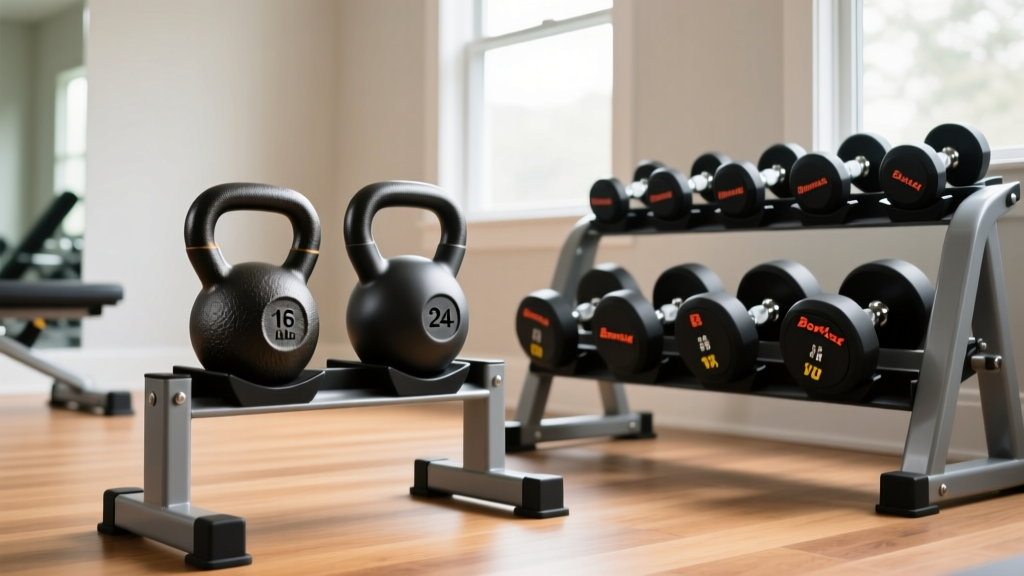
Cast iron bells scale in volume as weight increases. A 16kg cast iron bell might be 225mm tall, while a 32kg bell can exceed 280mm in height with a vastly wider base. The Kettlebell Kings sizing guide highlights these dimensional variances across different product lines. In a space-optimized layout, this variance creates 'dead air' on standard shelving and prevents tight, uniform spacing.
| Weight (kg) | Competition Dimensions (H x W) | Cast Iron Dimensions (Approx. H x W) | Spatial Layout Impact |
|---|---|---|---|
| 12kg | 210mm x 210mm | 195mm x 160mm | Cast iron wastes shelf depth; competition allows flush mounting. |
| 16kg | 210mm x 210mm | 225mm x 185mm | Cast iron requires deeper shelves (min 10"). |
| 24kg | 210mm x 210mm | 255mm x 215mm | Cast iron base widens, requiring wider lateral rack spacing. |
| 32kg | 210mm x 210mm | 280mm x 245mm | Cast iron demands heavy-duty, deep-stance floor racks. |
The 2026 Pricing Reality: While cast iron remains budget-friendly at roughly $1.60 to $2.20 per pound, competition bells command $4.50 to $6.00 per pound due to CNC machining tolerances. However, in micro-gyms (under 100 sq ft), the spatial efficiency of competition bells often justifies the premium by eliminating the need for bulky, deep-stance floor racks.
Integrating Adjustable Dumbbells into Micro-Gyms
To maintain a functional layout, you must eliminate traditional dumbbell racks. A standard 5-to-50-pound hex dumbbell set requires over 15 square feet of floor space and a 7-foot heavy-duty rack. Transitioning to adjustable dumbbells reclaims this footprint, but it introduces new spatial constraints regarding their cradles and adjustment mechanisms.
The Bowflex SelectTech series (specifically the 552 and 1090 models) are industry staples. The SelectTech 552 cradle measures 15.75" L x 8" W x 9" H. In a tight layout, these cradles are often pushed into corners or narrow alcoves, which directly impacts how you interact with the equipment.
Step-by-Step: How to Adjust Bowflex Dumbbells in Tight Alcoves
When your gym layout forces the dumbbell cradle into a confined space, improper adjustment is the leading cause of mechanical failure and plate jams. Here is the precise protocol for adjusting these units safely when spatial clearance is limited:
- Verify Cradle Leveling: In garages or basements, floors often slope. If the cradle is not perfectly level, the internal weight plates will bind against the housing. Use a 6-inch torpedo level on the cradle base and shim with rubber matting if necessary.
- Seat the Handle Flush: Push the dumbbell down into the cradle until you feel the base plate click against the bottom tray. The handle grooves must align perfectly with the cradle guides. Never attempt to turn the dials while the dumbbell is partially lifted or resting at an angle.
- Clear the Dial Perimeter: In tight alcoves, dust, chalk, and debris accumulate against the walls and fall into the dial tracks. Wipe the outer dial rim with a dry microfiber cloth before turning.
- Execute the Adjustment: Grip the outer dial and rotate. The SelectTech 552 adjusts in 2.5 lb increments up to 25 lbs, and 5 lb increments thereafter (up to 52.5 lbs). You will hear a distinct mechanical click when the retaining pins lock into the weight plates.
- The 'Zero-Tilt' Extraction: When lifting the dumbbell out of a tight corner, pull it straight up. Tilting the dumbbell laterally before it fully clears the cradle housing can dislodge the outer weight plates, causing them to scatter across your limited floor space.
The Ultimate 8x10 Foot Space-Optimized Floor Plan
If you are designing a dedicated 8x10 foot (80 sq ft) free-weight zone, here is the optimal layout matrix to maximize movement clearance while storing a full complement of kettlebells and adjustable dumbbells.
Zone 1: The Flush-Mount Kettlebell Wall (Rear Wall)
Install a custom or modular wall-mounted rack (like the Fringe Sport 3-Tier Wall Mount) directly into the wall studs.
- Depth: 10 inches off the wall.
- Height: Bottom tier at 12 inches from the floor (allows for easy deadlift extraction without shin scraping).
- Capacity: Using competition bells, you can store 6 to 9 bells in a footprint that protrudes less than a standard baseboard heater.
Zone 2: The Adjustable Dumbbell Alcove (Side Wall)
Mount a floating shelf (24" W x 12" D) at exactly 30 inches high to house the Bowflex cradles. This height allows you to adjust the dials at waist level without bending over in a tight space, and leaves the floor beneath completely clear for stretching or storing resistance bands.
Zone 3: The Dynamic Movement Corridor (Center)
By pushing storage to the walls, you preserve a central 6x8 foot corridor. This is the critical 'swing zone.' The National Strength and Conditioning Association (NSCA) and general ACE Fitness home gym safety guidelines recommend a minimum clearance of 4 feet in all directions around the user for dynamic kettlebell movements. By utilizing uniform competition bells and adjustable dumbbells, you maintain this vital safety envelope even in micro-gyms.
Final Spatial Considerations: Humidity and Maintenance
Space optimization often means storing equipment in garages or basements where climate control is poor.
- Cast Iron: Highly susceptible to surface rust in humid environments. Rust increases the surface friction, which can scratch custom wooden shelving or metal racks during extraction. Requires periodic wire-brushing and 3-in-One oil application.
- Competition Bells: Typically feature a thick powder-coat or e-coat finish over the steel shell, offering superior rust resistance with zero maintenance, preserving the integrity of your tight-tolerance storage racks.
- Adjustable Dumbbells: The Bowflex SelectTech internal mechanisms are vulnerable to moisture-induced corrosion. In damp layouts, keep a silica gel desiccant pack inside the dumbbell cradle tray to protect the dial gears.
Ultimately, treating your free weights as geometric variables rather than just fitness tools allows you to engineer a home gym that feels expansive, safe, and highly functional, regardless of the square footage available.
More gear to consider
All reviews
Overhead Dumbbell Triceps Extension Guide: Rubber Hex vs Urethane
Beyond the 30 lb Dumbbell: Cast Iron vs Competition Kettlebells

Barbell Knurling & Weight Guide: Beyond the Inclined Dumbbell Press
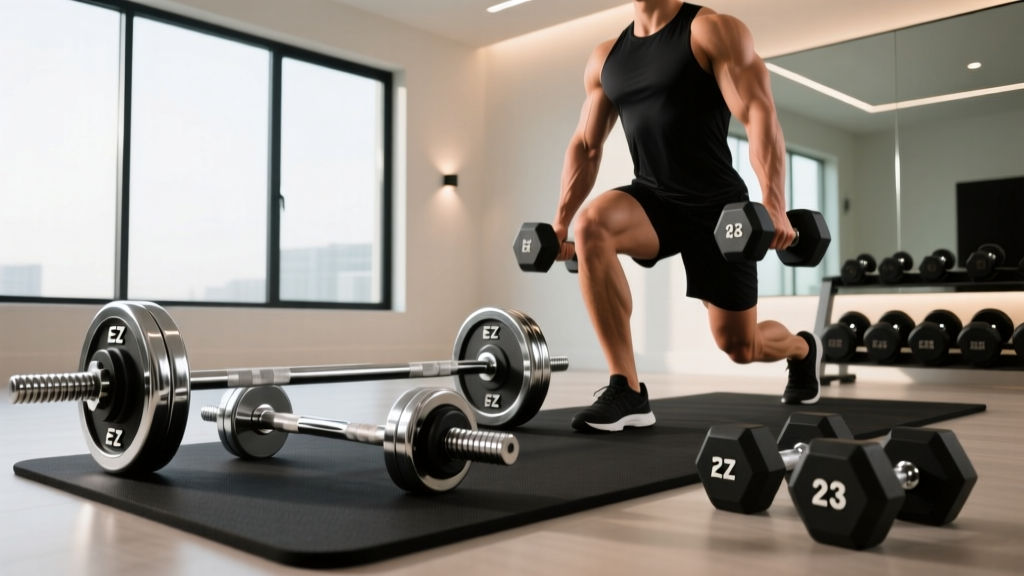
EZ Curl Bar vs Straight Bar Care & Dumbbell Walking Lunges Tips

Dumbbell Shoulder Press Mistakes & Adjustable Dumbbell Fixes