
2026 Glute Market: How Much Is the Leg Press Machine Without Weight?
Analyze 2026 glute training equipment trends, bare machine pricing, starting sled weights, and the best lower-body investments for hypertrophy.

The 2026 Glute Training Equipment Boom
The fitness equipment market has undergone a massive paradigm shift over the last few years. While traditional quad-dominant leg days once ruled commercial and home gyms, the 2026 landscape is undeniably driven by targeted glute hypertrophy. According to recent industry analyses by Grand View Research, the demand for specialized lower-body resistance equipment has outpaced general strength machines by a significant margin, driven by social media fitness trends, sports science advancements, and a growing demographic of female lifters prioritizing posterior chain development.
For gym owners, physical therapists, and serious home-gym builders, this shift requires a complete re-evaluation of purchasing strategies. Facility planners are no longer just buying a standard squat rack; they are curating dedicated glute zones. This brings us to one of the most common, yet misunderstood, procurement queries in the industry.
Decoding the Query: How Much Is the Leg Press Machine Without Weight?
When buyers search for how much is the leg press machine without weight, they are typically wrestling with two entirely different metrics. To provide a comprehensive market analysis, we must separate the financial cost of the bare machine from the mechanical starting weight of the empty sled. Both are critical data points for budgeting and biomechanical programming.
1. The Financial Cost of Bare Machines (Market Pricing)
In 2026, purchasing a commercial-grade leg press without Olympic weight plates (often referred to as a 'bare' or 'unloaded' unit) varies wildly based on the carriage type, bearing system, and brand prestige. Plate-loaded machines remain the gold standard for heavy glute work due to their infinite scalability and lack of cable-pulley friction.
| Machine Type | Popular 2026 Models | Bare Machine Price Range (USD) | Glute Optimization Rating |
|---|---|---|---|
| 45-Degree Linear Bearing | Prime Fitness, Atlantis | $3,200 - $5,800 | Excellent (High/Wide Stance) |
| Horizontal Plate-Loaded | Rogue Fitness, Hammer Strength | $2,800 - $4,500 | Moderate (Limited ROM for Glutes) |
| Hack Squat / Leg Press Combo | Prime Fitness Signature, Panatta | $5,500 - $8,200 | Superior (Multi-angle versatility) |
| Pivot-Joint (Selectorized) | Life Fitness, Technogym | $6,000 - $9,500 | Good (Fixed path limits stance width) |
2. The Mechanical Starting Weight (Sled Resistance)
The second interpretation of the query relates to biomechanics: How much does the empty sled actually weigh? This is a crucial metric for glute training, especially for rehabilitation, warm-up sets, and drop-sets where the user wants to target the gluteus maximus without overloading the lumbar spine.
According to the ExRx biomechanics database, the starting resistance of a 45-degree leg press is not simply the physical weight of the metal carriage. It is the physical weight multiplied by the sine of the angle (approx. 0.707 for a 45-degree angle), minus the friction of the bearings.
- Standard Commercial 45-Degree Sled: The physical carriage weighs between 90 lbs and 135 lbs. However, the effective starting resistance felt by the user is typically 65 lbs to 95 lbs.
- Linear Bearing vs. Pivot Joint: Machines utilizing precision linear bearings (like Prime Fitness) have near-zero friction, meaning the starting weight feels remarkably close to the true mathematical angle. Older pivot-joint models can add 10-15 lbs of 'sticky' friction at the bottom of the movement, which is detrimental to glute activation in the stretched position.
Leg Press Biomechanics for Glute Hypertrophy
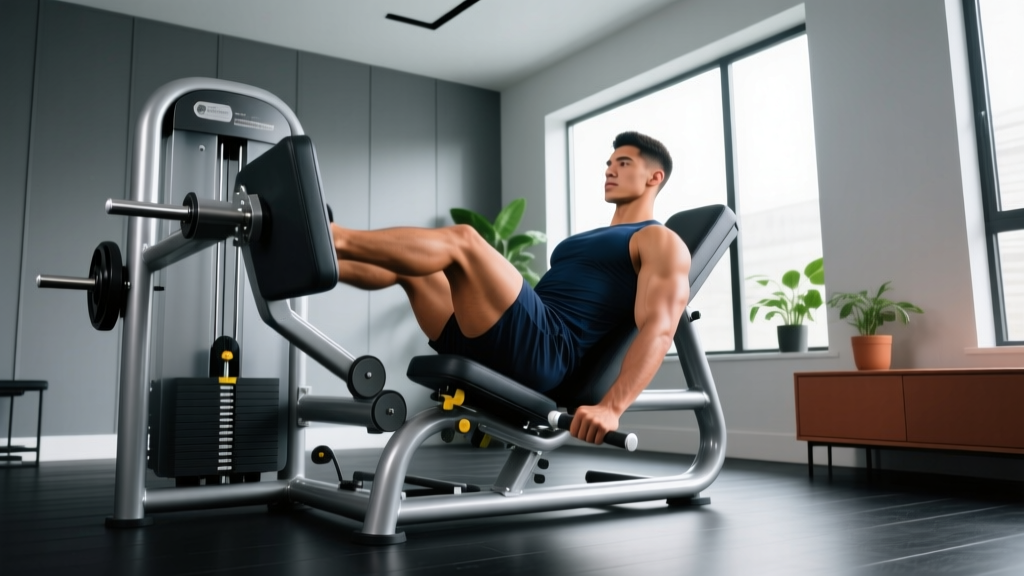
If you are investing in a leg press specifically for glute development, the machine's footprint and footplate dimensions are non-negotiable. Many budget commercial machines feature narrow footplates that restrict the user from taking the wide, externally rotated stance required to maximize gluteus maximus and adductor magnus recruitment.
'To shift the bias from the quadriceps to the glutes and hamstrings on a 45-degree leg press, the user must place their feet high and wide on the platform. This reduces the degree of knee flexion and increases the degree of hip flexion, placing the glutes under a deeper stretch at the bottom of the movement.' — Biomechanics principles outlined by Garage Gym Reviews and leading hypertrophy coaches.
What to look for in 2026: Seek out machines with an oversized, diamond-plated footplate that is at least 38 inches wide. Furthermore, the carriage must allow for a deep range of motion (ROM) without the user's lower back rounding (butt wink). Machines with an adjustable backpad angle (from 45 to 60 degrees) are currently dominating the market because they allow lifters to customize the hip angle to their specific femur length.
Beyond the Leg Press: Dedicated Glute Machines Dominating 2026
While the leg press is a phenomenal compound movement, the modern glute-focused facility requires isolation equipment. The market has responded with highly specialized machines that isolate the hip extension function of the glutes.
The Hip Thrust Revolution
The barbell hip thrust is the undisputed king of glute isolation, but setting it up with a bench and barbell is inefficient in a busy gym. Enter the dedicated hip thrust machine.
- Booty Builder V8: Retailing around $4,200 (bare), this machine utilizes a specialized belt and cam system to provide consistent tension throughout the entire ROM, unlike a barbell which loses tension at the top.
- Kas Glute Builder: Priced between $3,500 and $4,800, this unit features a shorter ROM designed specifically to keep the glutes under constant tension while minimizing quad and hamstring takeover.
- Pad Density Matters: When evaluating these machines, check the Shore A hardness of the pelvic pad. A pad that is too soft (below 40 Shore A) will compress and cause pelvic bruising under heavy loads. The 2026 industry standard is a high-density EVA foam core wrapped in vinyl, rated around 60-70 Shore A.
Cable Towers and Low-Pulley Systems
For glute kickbacks and lateral abductions, functional trainers are essential. However, not all cable machines are created equal for lower-body work.
The Pulley Ratio: Most commercial functional trainers use a 2:1 pulley ratio (meaning 20 lbs on the stack feels like 10 lbs in your hand). For heavy glute kickbacks, a 2:1 ratio is often too light and runs out of travel distance before the hip reaches full extension. In 2026, the trend is shifting toward 1:1 ratio cable columns or specialized low-pulley glute stations that offer a 150+ lb maximum resistance and a longer cable travel path.
Purchasing Framework: Bare Machine vs. Fully Loaded
When sourcing equipment, buyers must decide whether to purchase bare machines and source Olympic plates separately, or buy 'fully loaded' packages. Here is a strategic framework for 2026 buyers:
Buy Bare If...
- You already own a surplus of calibrated or standard Olympic plates.
- You are outfitting a commercial facility where plates are shared across multiple stations (squats, deadlifts, presses).
- You want to negotiate freight shipping separately to reduce overall logistics costs.
Buy Loaded If...
- You are building a home gym and need a turnkey solution.
- You require specialized plates (e.g., fractional plates, grip plates) that are heavily discounted in manufacturer bundles.
- You want a single warranty point of contact for the entire station.
Market Forecast & Final Sourcing Advice
The leg training equipment market in 2026 is highly segmented. If your primary goal is overall lower-body mass and athletic power, investing $4,000+ in a premium, bare 45-degree linear bearing leg press is a non-negotiable foundation. The ability to load the sled heavily while utilizing a high-and-wide foot placement will yield massive glute and hamstring dividends.
However, if your facility caters strictly to glute-focused aesthetics, you may find a better ROI in allocating that same budget toward a dedicated Kas Glute Builder, a 45-degree back extension (for glute-focused rounding), and a 1:1 ratio low-pulley system.
Ultimately, understanding exactly how much the leg press machine is without weight—both in terms of your financial budget and the mechanical starting resistance—empowers you to make data-driven purchasing decisions that align perfectly with modern hypertrophy science.
More gear to consider
All reviews
Sled Push vs Vertical Leg Press Machine: Beginner Guide

Squat Rack & Lying Down Leg Press Machine: Space Layout Guide

The World Checklist: A Practical, Field-Tested Inventory for Global Equip Body Legs Deployment

Optimizing Space: Power Cage & Force USA Leg Press Machine Layouts
Glute Equipment Guide: Leg Press Machine Form in 2026
