
Is Home Gym Equipment FSA Eligible? Dual Budget Setup Guide
Discover if home gym equipment is FSA eligible and how couples can use dual health accounts to fund a shared, adjustable home gym setup in 2026.

The Core Question: Is Home Gym Equipment FSA Eligible?
Building a shared home gym for a couple often means reconciling two vastly different fitness profiles, strength baselines, and spatial preferences. But before you start measuring the garage, there is a massive financial lever many couples overlook: utilizing dual Flexible Spending Accounts (FSAs) or Health Savings Accounts (HSAs). This brings up the most common question we receive at FitGearPulse: is home gym equipment FSA eligible?
The Quick Answer
Under standard IRS rules, home gym equipment purchased for general health and fitness is not FSA or HSA eligible. However, if a physician prescribes specific equipment to treat a diagnosed medical condition (e.g., obesity, hypertension, or joint rehabilitation), it becomes eligible when accompanied by a Letter of Medical Necessity (LMN). As a couple, this means if one or both partners have a qualifying condition, you can potentially use pre-tax dollars to fund high-end, shared adjustable equipment.
According to IRS Publication 502, capital expenses for medical care can include home modifications and equipment if their primary purpose is medical. Navigating this as a couple requires strategic equipment selection—choosing versatile, adjustable gear that serves the medical needs of one partner while fulfilling the general fitness goals of the other.
The LMN Framework: Getting Your Shared Gear Approved
If you are planning to use your combined 2026 FSA limits (up to $3,300 per individual, or $6,600 per household) to buy shared gym equipment, you cannot simply add a treadmill to your cart and submit the receipt. You need a bulletproof Letter of Medical Necessity (LMN).
- Identify the Qualifying Condition: General weight loss is frequently rejected by FSA administrators. Instead, focus on diagnosed conditions like essential hypertension, type 2 diabetes, or physician-documented osteoarthritis requiring low-impact cardiovascular therapy.
- Secure the LMN Before Purchasing: Have your primary care physician or physical therapist draft an LMN on official letterhead. It must explicitly state the diagnosis, the specific equipment required (e.g., 'air-resistance stationary bike for low-impact cardiac rehab'), and the duration of the treatment.
- Submit to Your FSA Administrator: Upload the LMN to your benefits portal for pre-approval before the transaction clears. As noted by benefits experts at NerdWallet, pre-approval prevents the headache of out-of-pocket reimbursement denials later in the tax year.
Hands-On Review: FSA-Friendly Adjustable Gear for Couples
When two people share a gym, fixed-weight equipment is a waste of space and money. Below are our top hands-on picks for adjustable, dual-user equipment that easily qualifies under an LMN for rehabilitation, mobility, or prescribed cardiovascular therapy.
| Equipment Model | Best For (Couple Profile) | 2026 Price | LMN Justification Angle |
|---|---|---|---|
| Concept2 RowErg (Standard) | Height-disparate couples; full-body conditioning | $1,100 | Zero-impact joint rehabilitation; posture correction |
| PowerBlock Elite EXP | Strength-gap couples (expandable 5-90 lbs) | $449 / pair | Prescribed resistance training for bone density/osteopenia |
| Rogue Fitness Echo Bike | High-intensity cardio; metabolic conditioning | $995 | Cardiac rehab; low-impact metabolic syndrome management |
Deep Dive: Concept2 RowErg (Model D / Standard)
The Concept2 RowErg remains the gold standard for shared spaces. With a 14-inch seat height on the standard model, it accommodates users with limited hip mobility (a common LMN requirement). The adjustable footrests slide effortlessly along the rail, meaning a 5'2" partner and a 6'4" partner can transition in under 10 seconds. The damper setting (1-10) allows one user to simulate heavy water resistance for muscle endurance, while the other uses a setting of 3-4 for prescribed aerobic base-building.
Deep Dive: PowerBlock Elite EXP Dumbbells
Traditional adjustable dumbbells often fail couples because they max out at 50 lbs, leaving the stronger partner without room to progress. The PowerBlock Elite EXP solves this. The base set ranges from 5 to 50 lbs, but the unique internal expansion pin allows you to drop in 40 lb expansion kits later. The blocky cage design, while polarizing, is incredibly durable and prevents the rolling hazard common with round dial-adjustable dumbbells—a crucial safety feature for home physical therapy routines.
Space Planning: The 120-Square-Foot Dual-Zone Layout
Sharing a gym means managing simultaneous workouts without colliding. For a standard 10x12 foot (120 sq ft) garage bay or spare room, we recommend a 'Dual-Zone' layout rather than pushing everything against the walls.
- Zone 1 (Cardio & Rehab - 40 sq ft): Place the Concept2 Rower or Rogue Echo Bike facing a wall-mounted mirror. This allows for form-checking during physical therapy exercises.
- Zone 2 (Strength & Floor - 80 sq ft): A centralized 4x6 foot lifting platform or interlocking rubber mat area for dumbbell work and mobility.
- Flooring Specification: Skip the cheap PVC tiles. Invest in 3/4-inch thick vulcanized horse stall mats (approx. $55 each at Tractor Supply Co). They provide the necessary shock absorption for dropped PowerBlocks and offer a stable, non-compressing surface for balance and rehabilitation work.
"When designing for couples, the biggest failure mode is inadequate ventilation. Two people generating heat in a 120-square-foot enclosed space will spike humidity and degrade rubber flooring over time. Install a dedicated 20-inch wall-mounted exhaust fan rated for at least 1,500 CFM to ensure cross-ventilation."
2026 Financial Breakdown: Maximizing Dual FSA Limits
Let us look at how a couple can strategically build this exact shared setup using pre-tax FSA/HSA funds, assuming Partner A has an approved LMN for cardiovascular rehabilitation, and Partner B pays out-of-pocket for general fitness accessories.
| Item | Cost | Funding Source | Tax Savings (Est. 24% Bracket) |
|---|---|---|---|
| Concept2 RowErg | $1,100 | Partner A FSA (via LMN) | $264 |
| Rogue Echo Bike | $995 | Partner A FSA (via LMN) | $238 |
| PowerBlock Elite EXP | $449 | Partner B HSA (via LMN) | $107 |
| 3/4" Rubber Mats (x4) | $220 | Out-of-Pocket (General) | $0 |
| Total Build Cost | $2,764 | Mixed | $609 Saved |
By accurately targeting the LMN toward the high-ticket cardiovascular and bone-density equipment, this couple saves over $600 in federal taxes (excluding state tax savings), effectively subsidizing the cost of the flooring and any future expansion kits.
Final Expert Takeaway
So, is home gym equipment FSA eligible? The answer relies entirely on your medical documentation and equipment selection. By treating your shared home gym not just as a fitness space, but as a prescribed wellness environment, couples can leverage 2026 FSA/HSA limits to acquire premium, adjustable gear. Secure your LMN, invest in rapid-adjust equipment like the PowerBlock EXP and Concept2 Rower, and build a dual-zone layout that respects both partners' training modalities.
More gear to consider
All reviews
Build a Home Gym Chuck Norris Style: Budget Setup Under $500

CAP Home Gym With 125 lb Weight Stack: Complete Floor Plan Setup

Avoid These Rental Apartment Gym Mistakes With Home Gym Glass Doors
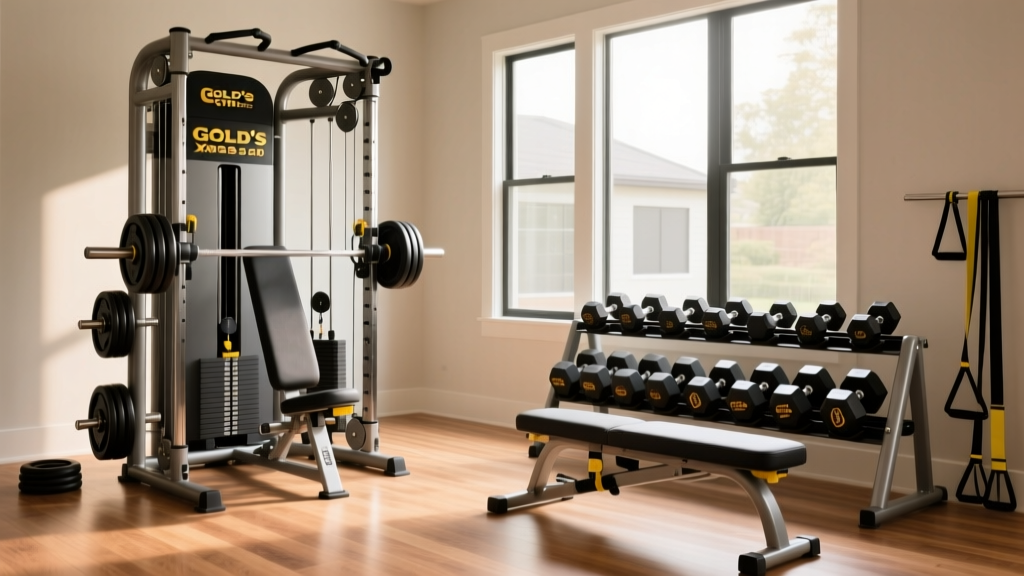
Gold's Home Gym vs. DIY: Best Budget Setup Under $500 in 2026

Home Gym Build UK: Budget Guide to Mirrors & Lighting
