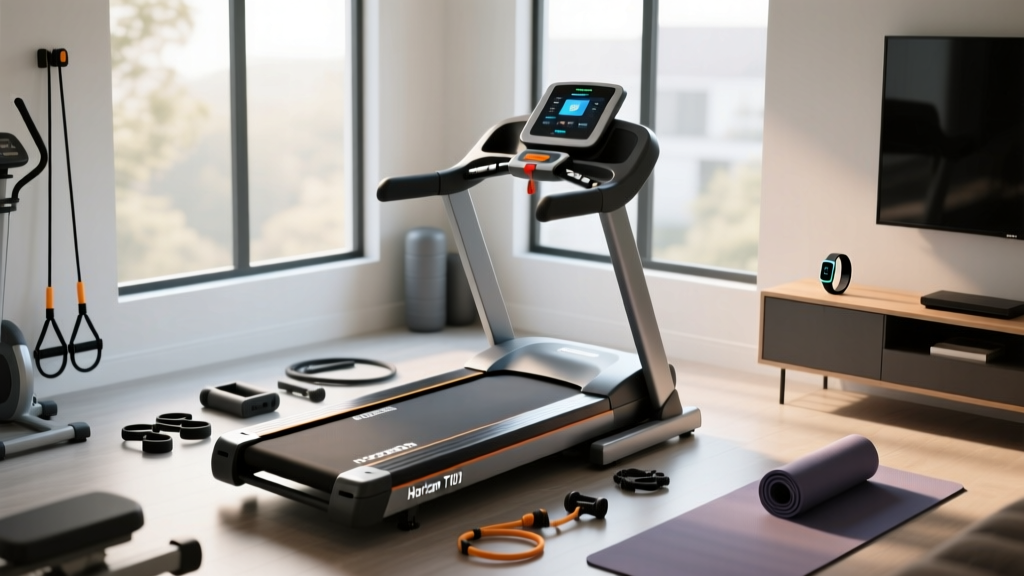
Best Folding Treadmill for Small Spaces & Beginner Running Programs
Discover top folding treadmills for small spaces in 2026. Learn micro-gym layout design, spatial friction tips, and how to run a beginner program at home.

The Spatial Friction Problem: Why Layout Dictates Beginner Success
When optimizing a small apartment or compact home office for fitness, the physical footprint of your equipment is only half the battle. The true enemy of consistency is spatial friction. If your folding treadmill requires moving furniture, untangling cords, or executing a complex unfolding sequence, you will skip your workout. For those embarking on a CDC-recommended physical activity routine, minimizing the barrier to entry is critical.
Selecting the right beginner running program treadmill for a compact layout means balancing deck length with foldability. A machine that folds flat but offers a 45-inch deck will cause biomechanical clipping when you transition from walking to running. Conversely, a commercial-grade folder might fit the floor plan but overwhelm the visual space, creating psychological clutter. In this 2026 guide, we bridge the gap between interior space optimization and functional cardio hardware.
2026 Folding Treadmill Review: Top Picks for Compact Apartments
After testing the latest compact cardio releases, we evaluated machines based on folded volume, motor thermal management in tight spaces, and deck adequacy for novice runners. Here are the standout models for space-constrained environments.
1. Horizon Fitness T202 (Best Overall for Actual Running)
The Horizon T202 remains a benchmark for small-space runners. Unlike cheap walking pads that masquerade as running machines, the T202 features a 55-inch by 20-inch deck, providing adequate stride length for beginners progressing to a 6.0 MPH jog. Its 2.75 CHP DC motor is robust enough to handle continuous intervals without thermal throttling, provided you respect the ventilation clearances.
- Folded Dimensions: 34" L x 28" W x 85" H
- Footprint (Unfolded): 70" L x 28" W
- Price Range: $649 - $699
- Space Feature: Hydraulic soft-drop folding mechanism allows one-handed deployment, reducing setup friction to under 5 seconds.
2. NordicTrack T Series 10 (Best Smart Integration)
For users who want guided beginner running programs without sacrificing floor space, the T Series 10 integrates seamlessly with interactive coaching. The 55-inch deck is slightly narrower at 18 inches, which demands better lateral balance from novices, but its folded profile is exceptionally slim.
- Folded Dimensions: 29" L x 30" W x 73" H
- Motor: 2.6 CHP
- Price Range: $499 - $549
3. Sunny Health & Fitness SF-T723016 (Strictly for Walk-Jog Transitions)
If your space is severely limited to a bedroom corner, this ultra-compact folder is a viable option, but with strict limitations. The 49-inch deck is too short for continuous running at speeds above 5.0 MPH. It is strictly recommended for walk-jog interval programs where the jogging segments remain under 60 seconds.
- Folded Dimensions: 26" L x 26" W x 64" H
- Motor: 2.0 HP (Peak)
- Price Range: $279 - $319
Compact Treadmill Dimension & Spec Matrix
| Model | Deck Length | Motor (Continuous) | Folded Volume (cu ft) | Max User Weight |
|---|---|---|---|---|
| Horizon T202 | 55 inches | 2.75 CHP | 46.6 | 300 lbs |
| NordicTrack T10 | 55 inches | 2.6 CHP | 37.2 | 300 lbs |
| Sunny SF-T723016 | 49 inches | 1.5 CHP | 25.1 | 220 lbs |
Designing the 'Zero-Friction' Micro-Gym Layout
Placing a folding treadmill in a small room requires more than just measuring the floor. You must account for operational clearance, acoustic dampening, and visual weight. Follow this spatial framework to optimize your layout.
The 3-Inch Rule for Motor Heat Dissipation
⚠️ Critical Edge Case: Many apartment dwellers push their folded treadmills flush against a wall or into a tight closet alcove. DC treadmill motors rely on an intake fan located at the front or side of the motor hood. If you leave less than 3 inches of clearance between the motor housing and a wall, the motor will suffocate, leading to thermal shutdown after 25-35 minutes of continuous running. Always store and operate the machine with a minimum 4-inch rear and lateral wall buffer.Acoustic Isolation for Multi-Family Dwellings
Running on a treadmill generates low-frequency impact vibrations that easily penetrate standard subflooring, disturbing downstairs neighbors. To mitigate this, do not rely on cheap PVC puzzle mats. Invest in a 3/8-inch thick vulcanized rubber mat (such as the MegaMat or Horse Stall mats cut to size). This specific density absorbs the kinetic energy of heel strikes, reducing low-frequency acoustic transfer by up to 40%.
The Fall-Zone Clearance
According to American Heart Association guidelines, safety is paramount when starting a new cardiovascular regimen. Your layout must include a 78-inch rear clearance zone behind the treadmill. This accounts for the length of the safety key lanyard and provides a safe deceleration zone if you lose your footing and are ejected off the back of the deck.
Pairing Your Hardware with a Beginner Running Program
Hardware is useless without a structured progression. When utilizing a folding treadmill for a Couch-to-5K style routine, you must adapt the program to the physical limitations of compact decks. Here is how to structure your first 8 weeks.
Phase 1: Walk-Jog Intervals (Weeks 1-4)
During the first month, your focus is on tendon adaptation and cardiovascular baseline building. Because compact treadmills often have slightly stiffer shock absorption systems than commercial gym models, keep your jogging intervals short to prevent shin splints.
- Warm-up: 5 minutes at 3.0 MPH (0% incline).
- Interval Block: Jog at 4.5 - 5.0 MPH for 60 seconds, followed by 90 seconds of walking at 3.2 MPH. Repeat 6 times.
- Cool-down: 5 minutes at 2.5 MPH.
- Layout Tip: Keep a small wall-mounted shelf or magnetic hook next to the treadmill for your water bottle and towel. Bending down to the floor in a tight space disrupts your heart rate recovery.
Phase 2: Continuous Running & Stride Biomechanics (Weeks 5-8)
As you transition to continuous running, stride length becomes a factor. If you are using a 55-inch deck (Horizon or NordicTrack), you have adequate room for a natural gait. If you are on a 49-inch deck, you must consciously shorten your stride and increase your cadence (steps per minute) to avoid clipping the front motor housing.
"Aim for a cadence of 160-170 steps per minute when running on compact home treadmills. A higher cadence naturally shortens your stride length, keeping your center of gravity safely over the middle of the deck and reducing the impact force on your knees by up to 20%."
Common Edge Cases and Failure Modes in Compact Setups
Even with the best equipment, small-space environments introduce unique failure modes that you must proactively manage.
1. Belt Slip on 2.0 HP Motors
If you purchase a budget folding treadmill with a peak-rated (rather than continuous-duty) motor, you will likely experience belt slip when you transition from walking to running. This happens because the motor lacks the torque to overcome the sudden kinetic friction of your body weight landing on the belt. The Fix: Lubricate the belt with 100% silicone treadmill lubricant every 45 days, and ensure the belt tension is adjusted so it cannot be lifted more than 2 inches off the deck at the midpoint.
2. Visual Clutter and Psychological Fatigue
In a studio apartment, a large black treadmill dominates the visual field, which can induce psychological fatigue. The Fix: Utilize a folding privacy screen or a tall, open-back bookshelf to create a visual barrier when the machine is folded. Alternatively, choose a machine with a lighter colorway (like the NordicTrack's grey/silver accents) to reduce the visual weight of the equipment in a naturally lit room.
3. Doorway Clearance Bottlenecks
A common mistake is buying a folding treadmill based solely on its folded dimensions, forgetting it must be delivered and moved through standard interior doorways. Standard interior doors are 28 to 32 inches wide. The Horizon T202, with a folded width of 28 inches, will barely clear a 28-inch door frame if the packaging is removed. Always measure your narrowest doorway and subtract 2 inches for hand-clearance before finalizing your purchase.
Final Thoughts on Space-Optimized Cardio
Successfully integrating a beginner running program treadmill into a small space requires a holistic approach. It is not just about buying a machine that folds; it is about engineering a micro-environment that eliminates friction, manages acoustics, and respects the biomechanical realities of novice runners. By selecting a model with a minimum 55-inch deck, enforcing strict motor ventilation clearances, and pairing your layout with a cadence-focused running program, you can achieve commercial-gym results without sacrificing your living space.
More gear to consider
All reviews
Elliptical vs High Interval Training Treadmill: Maintenance
ProForm 505 CST Treadmill: Setup Walkthrough & Feature Comparison

What Is a Good Walking Speed on Treadmill to Reduce Noise?
Horizon Fitness T101 Treadmill Review: 2026 Small Space Market Trend

Walk Barefoot on a Treadmill: Folding Small-Space Reviews & Care