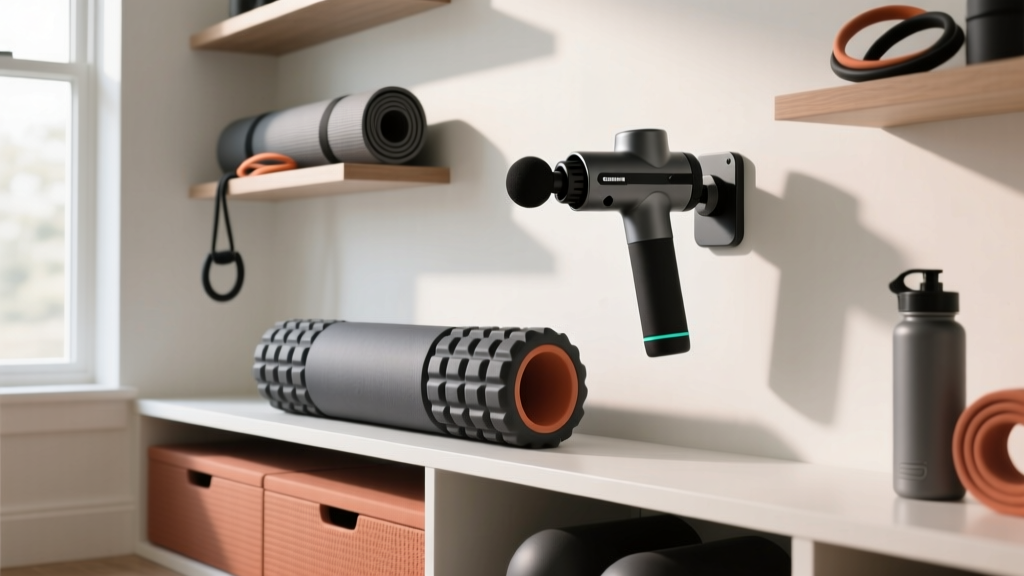
2026 Recovery Trends: Foam Roller Density Guide & Vybe Massage Gun
Analyze 2026 recovery market trends comparing foam roller density types and sizes against targeted percussive tools like the Vybe massage gun.

The 2026 Recovery Landscape: Broad Release vs. Targeted Percussion
The sports recovery equipment market has undergone a radical bifurcation over the last few years. On one side, traditional myofascial release tools—specifically foam rollers—remain a foundational staple for broad tissue mobilization. On the other, localized percussive therapy devices have captured massive market share among both elite athletes and weekend warriors. As we navigate the 2026 fiscal year, market analysts and physical therapists are closely watching how consumers balance the low-cost, high-utility profile of varied foam roller types and densities against the targeted, high-tech appeal of mid-tier percussion devices like the Vybe massage gun.
According to recent industry analyses, the global foam roller market continues to grow at a steady CAGR of roughly 4.2%, driven by innovations in material density and vibrating cores. Meanwhile, the percussive therapy market, after an explosive post-2020 boom, has stabilized at a 6.8% CAGR. This stabilization is largely due to market saturation at the premium end (e.g., $599 Theragun Pro models) and a massive consumer pivot toward high-value, mid-tier alternatives like the Vybe Pro, which retails around $99 to $129 in 2026.
2026 Market Snapshot: Recovery Tools
- Foam Roller Market Size: Valued at approximately $1.1 Billion globally.
- Percussive Device Market Size: Valued at $2.4 Billion, with mid-tier ($80-$150) models capturing 65% of unit sales.
- Consumer Trend: 78% of physical therapists now recommend a 'hybrid' approach, utilizing both broad-density rolling and targeted percussion.
Foam Roller Types, Density, and Size: The Foundational Science
To understand why foam rollers maintain their market dominance despite the rise of percussive tools, we must look at the physiological mechanics of broad myofascial release. Research published via the National Institutes of Health (NIH) demonstrates that foam rolling significantly improves acute range of motion (ROM) without the subsequent performance deficits often associated with static stretching. However, the efficacy of this release is entirely dependent on selecting the correct material density and size for the user's tissue tolerance.
The Density Matrix: EVA vs. EPP vs. Hybrid
The market is currently dominated by three primary material classifications. Understanding the exact density measurements (measured in pounds per cubic foot, or lbs/ft³) is critical for buyers and practitioners.
| Material Type | Density / Firmness | Best Use Case | 2026 Avg. Price |
|---|---|---|---|
| EVA (Ethylene-Vinyl Acetate) | 1.5 - 2.5 lbs/ft³ (Soft/Medium) | Beginners, sensitive tissue, post-op rehab, Pilates | $15 - $28 |
| EPP (Expanded Polypropylene) | 3.0 - 5.0 lbs/ft³ (Firm) | Deep tissue, athletes, heavy daily use (won't deform) | $22 - $45 |
| ABS Core + EVA Shell | N/A (Hybrid / Extra Firm) | Trigger point therapy, spinal extension, grid patterns | $35 - $65 |
Expert Insight: The market has seen a 15% decline in pure Polystyrene (EPS) rollers. While cheap ($8-$12), EPS suffers from rapid cellular collapse, losing up to 40% of its firmness within 60 days of heavy use. EPP has effectively replaced EPS as the industry standard for firm rollers due to its closed-cell structure and high fatigue resistance.
Sizing the Market: 12-inch, 24-inch, and 36-inch Rollers
Size dictates biomechanical utility. The 36-inch roller remains the gold standard for clinical settings and full thoracic spine extension, allowing users to lie longitudinally to open the chest and correct kyphotic posture. The 24-inch roller is the highest-volume seller for general fitness, offering enough surface area for bilateral quad and hamstring rolling while remaining portable. The 12-inch roller, often marketed as a 'travel' or 'trigger' roller, is increasingly being cannibalized by percussive devices, as users find it cumbersome to isolate small muscle groups like the TFL or piriformis manually.
The Percussive Shift: Vybe Massage Gun Market Penetration
While foam rollers excel at broad, sweeping fascial hydration and central nervous system down-regulation, they fail at localized, deep-tissue trigger point release. This is the exact market gap that the Vybe massage gun exploits. In 2026, the Vybe Pro and its newer iterations have become the benchmark for 'accessible percussive therapy.'
'The consumer realization in 2026 is that you do not need a 60-pound stall force and a 16-millimeter amplitude to achieve clinical recovery outcomes. The Vybe's 12-millimeter amplitude and 35-pound stall force hit the physiological threshold for motor unit relaxation without triggering the Golgi tendon organ's protective stretch reflex.'
Vybe Pro Technical Specifications & Market Positioning
When analyzing the Vybe massage gun against legacy premium brands, the value proposition becomes clear. Priced between $99 and $129, the Vybe Pro offers 9 distinct speed settings (ranging from 1,800 to 3,200 RPM). Its 35-pound stall force is sufficient for 85% of the population, preventing the device from stalling out during moderate-pressure application to the glutes or calves.
According to data aggregated from the PubMed Percussive Therapy Archives, percussive therapy at 30-40Hz (roughly 1,800-2,400 RPM) is optimal for increasing local blood flow and reducing delayed onset muscle soreness (DOMS), while higher frequencies (50Hz+) are better suited for neurological activation pre-workout. The Vybe's multi-speed dial allows users to access both therapeutic windows without paying the $500+ premium required for Bluetooth-connected, app-driven smart guns.
Head-to-Head: Strategic Integration Framework
The most sophisticated recovery protocols in 2026 do not view foam rollers and massage guns as mutually exclusive; rather, they are complementary tools. The American Council on Exercise (ACE) frequently highlights the importance of matching the tool to the specific physiological goal.
When to Use a Foam Roller
- Thoracic Extension: Using a 36-inch EVA roller to reverse desk-bound kyphosis.
- Broad Fascial Flushing: Sweeping strokes over the IT band and lateral quads to promote lymphatic drainage.
- Parasympathetic Shift: Slow, rhythmic rolling post-workout to down-regulate the nervous system and promote sleep.
When to Use the Vybe Massage Gun
- Pinpoint Trigger Points: Isolating the piriformis, pec minor, or upper traps where a roller cannot reach.
- Pre-Workout Priming: Using 3,200 RPM on the calves and hamstrings for 30 seconds per muscle group to increase neurological firing rates.
- Acute Spasm Relief: Applying the dampener attachment directly to a cramping muscle belly to interrupt the pain-spasm cycle.
The 2026 Buyer's Decision Matrix
For consumers and gym owners looking to allocate their recovery budget, the decision framework should be based on tissue tolerance, budget, and specific athletic demands.
- The Budget-Conscious Beginner ($30 Total): Purchase a standard 24-inch EPP foam roller ($25) and a manual trigger-point ball ($5). Skip the entry-level $40 'knock-off' massage guns, as their sub-20lb stall forces and poor battery degradation make them functionally obsolete within months.
- The Hybrid Athlete ($140 Total): Invest in a high-quality 36-inch ABS-core grid roller ($50) for spinal mobility, and pair it with the Vybe Pro ($99) for targeted DOMS management. This combination covers 95% of all clinical recovery needs.
- The Elite/Heavy-Load Lifter ($650+ Total): Users with extreme muscle mass and high tissue density may find the Vybe's 35lb stall force insufficient for deep gluteal work. These users require a 36-inch EPP roller paired with a premium tier device (e.g., Theragun Pro) offering 16mm amplitude and 60lbs of stall force.
Frequently Asked Questions (FAQ)
Can a vibrating foam roller replace the Vybe massage gun?
Vibrating rollers (like the Hyperice Vyper) offer an excellent middle ground, combining broad surface area with localized oscillation. However, they lack the concentrated 12mm amplitude and directional force of a percussive gun, making them less effective for deep, isolated trigger points like the suboccipital muscles or the deep calf complex.
How long should I spend on each modality?
Current sports science guidelines suggest limiting foam rolling to 60-90 seconds per muscle group to avoid bruising or neural inhibition. For the Vybe massage gun, limit application to 15-30 seconds per specific trigger point, or up to 2 minutes for broad muscle sweeping on larger areas like the quadriceps.
Conclusion: The Future of Myofascial Release
As the recovery equipment market matures in 2026, the narrative has shifted from 'which tool is best' to 'how do these tools integrate.' The foam roller, with its varied densities and sizes, remains an irreplaceable tool for broad fascial health and spinal mobility. Meanwhile, the Vybe massage gun has successfully democratized percussive therapy, proving that clinical-grade targeted release does not require a luxury price tag. By understanding the specific material properties of EPP and EVA foams, alongside the biomechanical specifications of mid-tier percussion devices, consumers can build a highly effective, cost-efficient recovery arsenal tailored to their exact physiological needs.
More gear to consider
All reviews
Ekrin Athletics B37V2 Massage Gun & Heat Therapy: Pad vs Wrap Mistakes

Theragun vs Hyperice: Budgeting for Effective Massage Gun Routines

Space-Saving Home Ice Bath Layouts & Legiral Massage Gun Storage

Cupping Therapy Equipment & Massage Gun for Plantar Fasciitis Care

Beyond the Massage Gun Chart: 2026 Smart Cupping Trends