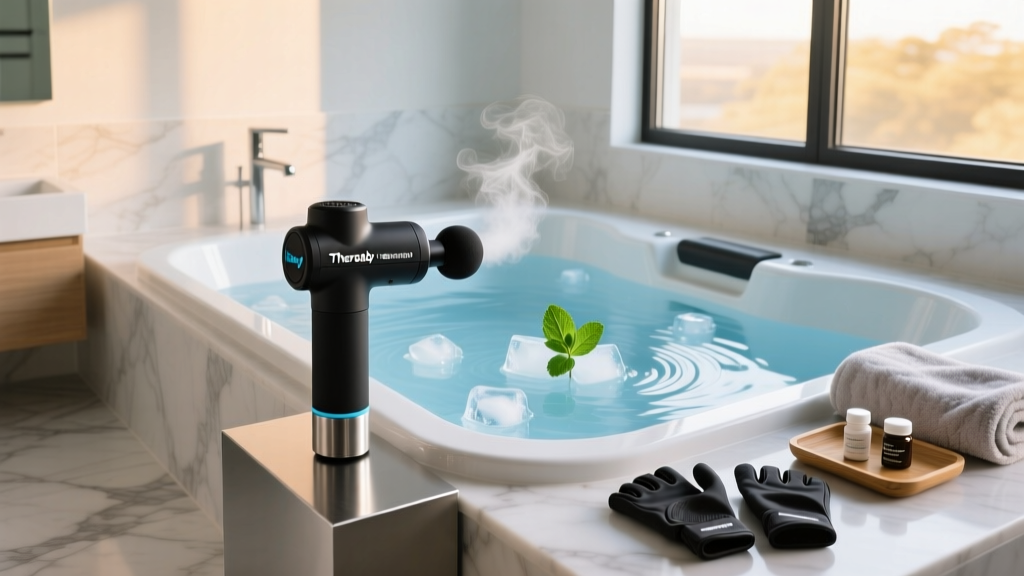
Home Ice Bath & Therabody Theragun Mini Massage Gun Care
Master home recovery maintenance. Learn expert sanitation for your ice bath and longevity tips for your Therabody Theragun Mini massage gun.

The Modern Home Recovery Station: Bridging Wet and Dry Modalities
Investing in a dedicated home recovery sanctuary is a hallmark of modern athletic longevity. In 2026, a comprehensive setup typically bridges systemic water immersion with localized neuromuscular therapy. While an ice bath and cold plunge tub for home use handles full-body vasoconstriction and central nervous system down-regulation, localized fascial tension requires targeted percussive devices. However, the environmental and mechanical demands of these two modalities are vastly different.
A high-end residential cold plunge (such as the Plunge Evolve Series or Sun Home Cold Plunge) represents a $5,000 to $12,000 investment requiring rigorous fluid dynamics and sanitation management. Conversely, portable electronic recovery tools represent a smaller financial footprint but demand strict electrical and battery care. Neglecting either will result in degraded performance, voided warranties, or potential health hazards. This guide provides an expert-level maintenance protocol for both ends of your recovery spectrum.
The Wet Zone: Ice Bath and Cold Plunge Tub Sanitation
Water is a highly effective medium for thermal transfer, but it is also an ideal breeding ground for pathogens like Pseudomonas aeruginosa and Legionella. Maintaining an ice bath and cold plunge tub for home use requires a multi-tiered approach to water chemistry and mechanical filtration.
Water Chemistry and Pathogen Control
Cold water (typically maintained between 39°F and 50°F) fundamentally alters the efficacy of traditional sanitizers. Chlorine, for instance, becomes highly volatile and dissipates rapidly when agitated by the plunge's circulation pump, while also causing severe skin irritation at the concentrations required for cold water.
- Bromine (Preferred): Bromine remains highly stable in cold, low-pH environments. Maintain a residual level of 3 to 5 ppm (parts per million). Use bromine tablets in a floating dispenser rather than inline erosion feeders, which can clog at low temperatures.
- Hydrogen Peroxide (H2O2): For those sensitive to halogens, 35% food-grade hydrogen peroxide is a viable alternative. However, it requires a much higher residual concentration—typically 50 to 100 ppm—and must be paired with a silver-ion catalyst to prevent rapid degradation.
- UV-C and Ozone Systems: Many modern home plunges feature integrated UV-C bulbs. According to guidelines on recreational water safety from the Centers for Disease Control and Prevention (CDC), secondary disinfection systems like UV-C drastically reduce the required chemical load. However, UV-C bulbs lose up to 40% of their germicidal efficacy after 9,000 hours of use and must be replaced annually, even if they still emit visible blue light.
Chiller and Filtration Maintenance
The chiller is the heart of your cold plunge. The condenser coils, usually located on the exterior of the chiller unit, are highly susceptible to environmental debris. If your plunge is installed on a patio or in a garage, pollen, dust, and pet hair will clog the micro-fins of the condenser. This forces the compressor to work harder, leading to thermal throttling and eventual compressor burnout. Use a soft-bristle brush and low-pressure compressed air to clean the coils every 30 days. Additionally, the inline cartridge filter must be removed and soaked in a Trisodium Phosphate (TSP) solution monthly to dissolve accumulated body oils and biofilms that standard rinsing cannot remove.
The Dry Zone: Therabody Theragun Mini Massage Gun Longevity
While your cold plunge manages systemic inflammation, the therabody theragun mini massage gun is your primary tool for localized trigger point release and neuromuscular re-education. Despite its compact footprint, the Theragun Mini houses a high-torque brushless motor and a dense lithium-ion battery pack that require specific care to maintain its 150+ minute battery life and 20 lbs of stall force.
Lithium-Ion Battery Preservation
The most common failure point in portable recovery electronics is battery degradation. The Theragun Mini utilizes high-density lithium-ion cells, which are highly sensitive to voltage stress and thermal extremes.
- The 20-80% Rule: Avoid routinely draining the device to 0% or leaving it plugged in at 100% for days on end. Keeping the battery within the 20% to 80% state-of-charge window minimizes internal cell resistance and prolongs overall lifespan.
- Long-Term Storage: If you are traveling or storing the device for more than 30 days, charge it to exactly 50%. Research on lithium-ion storage from Battery University demonstrates that storing a Li-ion battery at 100% charge in a warm environment can result in a permanent capacity loss of up to 20% in a single year.
- Thermal Boundaries: Never leave the Theragun Mini in a hot vehicle or a freezing garage. Charging a Li-ion battery below freezing (32°F / 0°C) causes lithium plating on the anode, leading to irreversible capacity loss and internal short-circuit risks.
Attachment Hygiene and Motor Care
The Theragun Mini comes with closed-cell EVA foam attachments (Standard Ball, Dampener, Thumb). Because closed-cell foam does not absorb moisture, it is highly resistant to sweat and bacteria absorption. However, the surface texture can trap dead skin cells and massage oils. Wipe the attachments down with a 70% isopropyl alcohol solution after every use. Never submerge the attachments in boiling water or use harsh bleach solutions, as this will break down the EVA polymer matrix, causing the foam to crumble.
Furthermore, the motor housing features ventilation ports to cool the internal piezoelectric sensors and brushless motor. If you use your recovery gear in a home gym environment, airborne magnesium carbonate (lifting chalk) and dust will infiltrate these vents. Use a can of compressed air monthly to blow out the motor housing vents, preventing thermal throttling during extended 15-minute localized sessions.
Comparative Maintenance Matrix
To streamline your recovery room upkeep, use the following schedule to ensure both your wet and dry modalities remain in peak condition.
| Equipment | Maintenance Task | Frequency | Est. Time / Cost |
|---|---|---|---|
| Cold Plunge | Test Bromine/pH levels & adjust | Weekly | 5 mins / $0.50 |
| Cold Plunge | Clean cartridge filter (TSP soak) | Monthly | 30 mins / $2.00 |
| Cold Plunge | Clear chiller condenser coils | Monthly | 15 mins / $0 |
| Theragun Mini | Sanitize EVA attachments | Post-Use | 2 mins / $0.10 |
| Theragun Mini | Compressed air vent cleaning | Monthly | 5 mins / $1.00 |
| Both Systems | Inspect GFCI outlets & power bricks | Bi-Annually | 10 mins / $0 |
Environmental Factors and Troubleshooting Edge Cases
The physical location of your recovery equipment dictates its failure modes. Many homeowners install their ice bath and cold plunge tub in an uninsulated garage or on an outdoor deck, while keeping their Theragun Mini in a climate-controlled bedroom. This discrepancy creates unique troubleshooting scenarios.
Plunge Failure Mode: GFCI Tripping and Micro-Leaks
If your home cold plunge repeatedly trips the GFCI (Ground Fault Circuit Interrupter) breaker, do not simply reset it and ignore the issue. In 90% of cases, this indicates a micro-leak in the internal UV-C bulb housing or the ozone check-valve, allowing moisture to bridge the electrical contacts. Immediately disconnect power, drain the tub below the jet line, and inspect the housing O-rings. Replacing a $4 silicone O-ring will save you from a $1,200 mainboard replacement.
Theragun Failure Mode: Bluetooth Desync and Stall Force Degradation
The Theragun Mini relies on internal firmware to regulate its brushless motor speed (1750 to 2400 PPM). If the device struggles to connect to the Therabody app or exhibits a noticeable drop in stall force (shutting off when moderate pressure is applied), the internal battery management system (BMS) may be out of calibration. To recalibrate, drain the device completely until it powers off, leave it off for 4 hours, and then charge it uninterrupted to 100%. This resets the BMS voltage thresholds and often restores peak torque output.
Conclusion
Whether you are balancing the bromine levels in your backyard ice bath or managing the charge cycles of your therabody theragun mini massage gun, proactive maintenance is non-negotiable. By implementing these specific, data-driven care protocols, you ensure that your home recovery station remains a safe, hygienic, and highly effective environment for years to come.
More gear to consider
All reviews
Stretching Equipment as Addiction Recovery Tools: A Beginner Guide
High-Torque Massage Gun Motor vs. Stretching Equipment

Heat Pad vs Wrap Setup & Legiral Massage Gun Charger Guide

Theragun vs Hyperice: Is a TimTam Massage Gun Worth It?
Percussion vs Vibration Therapy: Budget Breakdown & Value Analysis