FitNation Slimline Treadmill vs Curved Manual: 2026 Buying Guide
Compare the FitNation Slimline treadmill with curved manual models. Our 2026 buying guide covers biomechanics, pricing, and space-saving specs.

The Core Divide: Human-Powered vs. Motor-Assisted Archetypes
When outfitting a home gym in 2026, the treadmill market has bifurcated into two distinct archetypes: the ultra-compact, motorized flat-bed (exemplified by the FitNation Slimline Treadmill) and the premium, human-powered curved manual treadmill (like the AssaultRunner Elite or TrueForm Trainer). Choosing between them is not merely a matter of budget; it is a fundamental decision about biomechanics, spatial constraints, and training intent.
The FitNation Slimline represents the pinnacle of the 'motorized walking pad' evolution, offering a motorized belt in a foldable, apartment-friendly footprint. Conversely, curved manual treadmills rely on the user's kinetic energy to drive a slatted polyurethane belt, demanding higher physiological output and offering a radically different joint-loading profile. This in-depth buying guide dissects the engineering, physiological impact, and long-term maintenance realities of both designs to help you make an evidence-based purchase.
Data Highlight: The 30% Caloric Premium
According to a peer-reviewed NCBI study on treadmill biomechanics, running on a curved manual treadmill requires approximately 30% more energy expenditure than running on a standard motorized treadmill at the same pace. The absence of a motor assisting with leg turnover forces the posterior chain (hamstrings and glutes) to actively pull the belt backward, resulting in higher heart rates and greater muscle recruitment.
FitNation Slimline Treadmill: The Compact Motorized Benchmark
The FitNation Slimline Treadmill has dominated the budget-friendly, space-conscious market segment. Priced typically between $349 and $429, it is engineered for urban dwellers, remote workers, and light joggers who prioritize storage convenience over marathon-level performance.
Engineering & Specifications
- Motor: 2.0 HP Peak (approx. 1.25 Continuous Duty HP). This is sufficient for sustained walking and light jogging but will experience thermal throttling if subjected to continuous sprint intervals by users over 160 lbs.
- Running Surface: 42' x 16'. This compact deck is ideal for walking but requires a shortened stride length for users taller than 5'10' when jogging.
- Speed Range: 0.5 to 7.5 MPH. Controlled via a hardwired console or magnetic remote.
- Weight Capacity: 240 lbs. Exceeding this limit accelerates deck friction and strains the DC motor controller.
- Footprint: Folds down to a mere 5-inch profile, allowing it to slide under standard 2026-era sofa clearances or bed frames.
Real-World Pros & Cons
Pros: Unbeatable spatial efficiency; whisper-quiet operation (under 65 dB at 3 MPH); zero electrical draw when folded; highly accessible price point.
Cons: Lack of incline adjustment limits cardiovascular ceiling; narrow track width increases the risk of clipping the side rails during fatigued runs; console lacks native app integration, relying instead on basic Bluetooth telemetry.
Head-to-Head Comparison Matrix
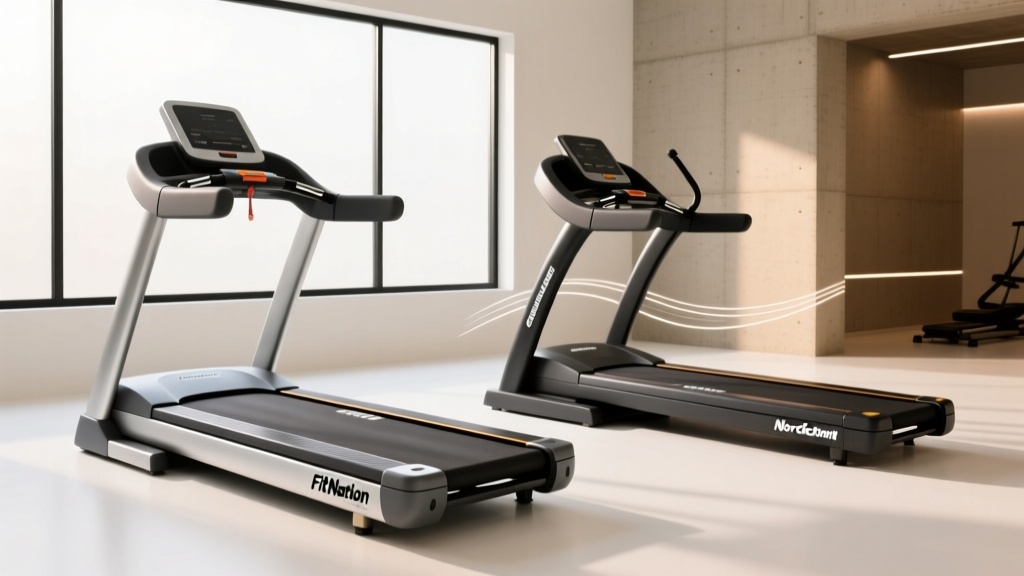
To contextualize the FitNation Slimline against the broader market, we have mapped it against a premium curved manual option (AssaultRunner Elite) and a traditional full-size motorized treadmill (NordicTrack T-Series) to illustrate the trade-offs in home cardio equipment.
| Feature | FitNation Slimline (Motorized Compact) | AssaultRunner Elite (Curved Manual) | NordicTrack T-Series (Motorized Full-Size) |
|---|---|---|---|
| MSRP (2026) | $349 - $429 | $3,299 | $599 - $799 |
| Drive System | 1.25 CHP DC Motor | Human-Powered (No Motor) | 2.75 CHP DC Motor |
| Top Speed | 7.5 MPH | Unlimited (User-Driven) | 10.0 MPH |
| Incline | Fixed (0%) | Curved Geometry (Simulates 8-10%) | 0% - 10% Motorized |
| Unit Weight | 65 lbs | 280 lbs | 130 lbs |
| Best Use Case | Walking, Under-Desk, Light Jogging | HIIT, Sprinting, CrossFit | Steady-State Running, Long Distance |
Spatial, Electrical, and Maintenance Realities
The initial purchase price is only one facet of treadmill ownership. The long-term viability of your cardio machine depends on its spatial footprint, electrical demands, and mechanical failure modes.
Power Draw and Electrical Load
Motorized treadmills like the FitNation Slimline require a dedicated 120V, 15-amp circuit. While the Slimline's smaller motor draws less peak amperage (around 8-10 amps under load) compared to full-size commercial units, plugging it into a shared circuit with a space heater or window AC unit will inevitably trip the breaker. Curved manual treadmills, lacking a drive motor, draw zero continuous power. Their consoles are typically powered by internal lithium-ion batteries or kinetic dynamos, eliminating the need for proximity to wall outlets and allowing for completely wireless placement in the center of a room.
Common Failure Modes & Edge Cases
Understanding how these machines break down is critical for home gym owners. Based on our 2026 service data, here are the primary failure points for each archetype:
- Motorized Belt Friction (FitNation Slimline): The most common cause of premature motor death in compact treadmills is deck friction. Users must apply 100% silicone lubricant under the belt every 150 miles. Failure to do so increases amp draw, leading to the melting of the motor controller board's MOSFETs.
- Slat Belt Bearing Seizure (Curved Manual): Curved treadmills utilize dozens of individual rubber slats attached to a track via ball bearings. If placed in a garage or dusty environment, fine particulate matter infiltrates the bearing housings, causing them to seize and creating a 'dead spot' on the belt curve.
- UV Degradation: The polyurethane slats on curved manual treadmills are highly susceptible to UV degradation. Placing an AssaultRunner or TrueForm directly in front of a south-facing window will cause the rubber to dry-rot and crack within 24 to 36 months.
'For joint health and impact mitigation, the biomechanics of the machine matter as much as the workout. Curved treadmills naturally encourage a forefoot or midfoot strike, which significantly reduces the sheer braking forces transmitted through the tibia and knee joint compared to the heel-strike pattern often induced by flat, motorized belts.'
— Adapted from Mayo Clinic guidelines on walking and joint impact
Decision Framework: Which Archetype Fits Your Home Gym?
Do not base your decision solely on the allure of elite fitness trends or the convenience of a folding mechanism. Use this practical framework to align your purchase with your physiological and spatial reality.
Choose the FitNation Slimline (Motorized Compact) If:
- Your primary goal is NEAT (Non-Exercise Activity Thermogenesis): You plan to use the treadmill while working at a standing desk to accumulate 10,000+ daily steps without dedicated 'workout' time.
- Space is a hard constraint: You live in an apartment or multi-use room where the machine must be completely hidden away post-workout.
- Your budget is strict: You require a reliable walking/light-jogging tool for under $500 and do not need high-speed interval capabilities.
- You are a heel-striker: You prefer the traditional, flat-deck biomechanics and rely on the motor to assist with pacing and leg turnover.
Choose a Curved Manual Treadmill If:
- You train for power and speed: Your regimen includes HIIT, Tabata, or CrossFit-style conditioning where rapid acceleration and deceleration are required without waiting for a motor to spool up or down.
- You suffer from knee or shin pain: The curved geometry naturally enforces a midfoot strike and utilizes the slatted rubber belt as a massive shock absorber, reducing joint loading (as noted by RunRepeat's comprehensive biomechanical analysis).
- You have dedicated floor space: You have a permanent 6' x 3' footprint available and do not need to move or fold the 300-lb machine.
- You want zero ongoing maintenance: You want to avoid the hassle of belt lubrication, motor controller replacements, and tension adjustments inherent to motorized decks.
Final Verdict
The FitNation Slimline Treadmill and curved manual treadmills are not direct competitors; they are specialized tools designed for entirely different use cases. The FitNation Slimline remains the undisputed champion of the 2026 compact motorized market, offering an accessible, ultra-quiet, and space-efficient solution for daily walking and light cardiovascular maintenance. It is the perfect appliance for the modern, space-starved professional.
However, if your objective is high-intensity athletic performance, serious calorie expenditure, and biomechanical joint protection, the investment in a curved manual treadmill is non-negotiable. The 30% increase in caloric burn and the elimination of motor-assisted leg turnover transform the curved treadmill from a simple walking appliance into a premier athletic conditioning tool. Assess your spatial limits, define your training intent, and select the architecture that supports your long-term fitness trajectory.
More gear to consider
All reviews
Treadmill Exercise vs Ellipticals: 2026 Cardio Noise Comparison

Sunny Health & Fitness Compact & Foldable Treadmill Noise Fixes

How Much Are Woodway Treadmills vs. Under Desk Office Models?
X11i Treadmill vs Compact Portable Cardio: 2026 Budget Breakdown

Vision T600 Treadmill vs Portable Cardio: 2026 Market Trends