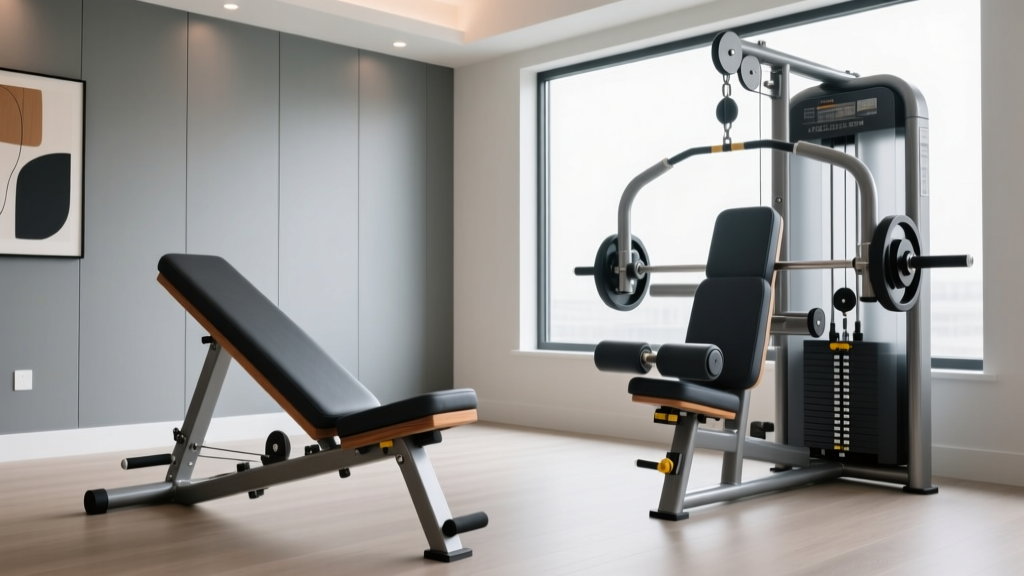
FID Bench vs Machine Chest Press Strength Standards: Space Guide
Optimize your gym layout by comparing FID bench angles to machine chest press strength standards. Discover spatial costs, clearances, and top gear.

The Space-to-Performance Dilemma in Modern Gym Layouts
As home gyms and boutique commercial facilities evolve in 2026, spatial efficiency has become just as critical as biomechanical performance. Facility designers and serious lifters are constantly weighing the spatial ROI (Return on Investment) of dedicated selectorized machines against versatile free-weight setups. A central debate in this space optimization puzzle revolves around the pectoral muscles: does dedicating 40+ square feet to a dedicated chest machine make sense when an adjustable FID (Flat, Incline, Decline) bench can target the exact same muscle heads in a fraction of the footprint?
To answer this, we must bridge the gap between biomechanics and floor plans. By analyzing established machine chest press strength standards and comparing them to the load capacities and spatial requirements of flat, incline, and decline bench variations, we can engineer a gym layout that maximizes both strength progression and usable square footage.
Benchmarking Machine Chest Press Strength Standards
Before deciding whether to allocate space to a machine or a free-weight bench zone, you need to understand the baseline performance metrics. According to aggregated lifting data from Strength Level, machine chest press strength standards vary significantly based on body weight and training experience. Because machines eliminate the need for stabilizer muscle recruitment, lifters can typically move 20% to 30% more weight on a machine than on a flat barbell bench.
| Experience Level | Weight Lifted (lbs) | Spatial Equipment Requirement |
|---|---|---|
| Beginner | 85 lbs | Adjustable Dumbbells + FID Bench |
| Novice | 135 lbs | Adjustable Dumbbells + FID Bench |
| Intermediate | 205 lbs | Heavy Dumbbells or Plate-Loaded Machine |
| Advanced | 295 lbs | Selectorized Machine or Barbell Rack |
| Elite | 390+ lbs | Commercial Plate-Loaded Machine |
Insight: If your goal is to hit Intermediate or Advanced machine chest press strength standards, you will eventually max out standard adjustable dumbbells (which typically cap at 90-120 lbs per hand). At this juncture, lifters must choose between buying a heavy-duty barbell rack with an FID bench or investing in a dedicated plate-loaded chest press machine.
The Biomechanics of Angles: Flat vs. Incline vs. Decline
When space is at a premium, purchasing three separate fixed benches (flat, 45-degree incline, and -15-degree decline) is a catastrophic waste of square footage. The modern solution is the FID bench. Understanding how these angles manipulate muscle activation is vital for layout planning, as it dictates what secondary equipment (like dumbbell racks or cable pulleys) must be placed within arm's reach.
1. The Flat Bench (0 Degrees)
The flat bench remains the cornerstone of chest development, targeting the sternocostal head of the pectoralis major. According to biomechanical analyses referenced by ExRx.net, the flat angle allows for the highest absolute load displacement. In a space-optimized layout, a flat bench requires a standard 4-foot by 4-foot power rack footprint, totaling roughly 16 square feet of dedicated lifting zone.
2. The Incline Bench (30 to 45 Degrees)
Setting the back pad to a 30-degree incline shifts the primary load to the clavicular head (upper chest). A common error in commercial gym layouts is placing incline benches too close to walls; the elevated back pad requires an additional 18 inches of rear clearance to prevent the user's head or dumbbells from striking the drywall during the eccentric phase.
3. The Decline Bench (-15 Degrees)
Decline movements target the abdominal head (lower chest). While highly effective, dedicated decline benches feature bulky leg-roller mechanisms that add 20 inches to the bench's length. In a micro-gym layout, it is vastly superior to utilize an FID bench with a decline-capable frame and a leg-hold attachment, saving approximately 12 square feet of floor space compared to a fixed decline unit.
⚠️ Layout Warning: The Incline Clearance Trap
When designing your incline pressing zone, remember that a 45-degree incline increases the vertical height of the lifter's torso by up to 34 inches. If you are integrating an FID bench inside a standard 84-inch tall power rack, ensure your spotter arms are positioned at least 42 inches from the floor to accommodate the angled bar path without restricting the lifter's range of motion.
Real-World Equipment Spotlight: Rep Fitness AB-5200 2.0
To achieve true spatial efficiency without sacrificing the stability required to chase advanced strength standards, the Rep Fitness AB-5200 2.0 is currently the gold standard for space-conscious lifters. Priced around $599, it features a ladder-based adjustment system rather than a pop-pin, allowing for micro-adjustments in 5-degree increments.
- Dimensions: 17.5" width x 50" length (Flat).
- Weight Capacity: 1,000 lbs (Easily supports Elite-level dumbbell pressing).
- Footprint: 6 square feet (when stored upright).
- Space-Saving Feature: Integrated transport wheels and a vertical storage stance allow the bench to be tucked into a 20" x 20" corner when not in use.
Spatial Footprint and Clearance Matrix
How does a free-weight FID bench setup compare to a dedicated machine when we factor in the mandatory safety clearances outlined by the National Strength and Conditioning Association (NSCA)? The NSCA recommends a minimum of 36 inches of clearance on all sides of free-weight equipment to ensure safe spotting and dumbbell maneuvering.
| Equipment Configuration | Physical Footprint | Required Clearance Zone | Total Spatial Cost |
|---|---|---|---|
| FID Bench + Dumbbell Rack | 12 sq ft | 24 sq ft (36" perimeter) | 36 sq ft |
| Selectorized Chest Machine | 24 sq ft | 16 sq ft (Entry/Exit only) | 40 sq ft |
| Plate-Loaded Incline Machine | 28 sq ft | 20 sq ft (Plate loading zone) | 48 sq ft |
| 3 Fixed Benches (Flat/Inc/Dec) | 36 sq ft | 40 sq ft (Multi-angle access) | 76 sq ft |
The Takeaway: An FID bench paired with a compact, tiered dumbbell rack saves between 4 and 40 square feet of total spatial cost compared to dedicated machines. In a standard 200-square-foot home gym, reclaiming 40 square feet is the difference between having a functional multi-purpose training zone and a cramped, hazardous environment.
Translating Machine Strength to Free Weight Stability
A critical factor in layout design is understanding the user's training goals. If a lifter is strictly chasing machine chest press strength standards for bodybuilding hypertrophy where absolute load and muscle isolation are paramount, a selectorized machine (like the Life Fitness Signature Series, requiring a 54" x 62" footprint) is superior. The machine's fixed camber path eliminates the stabilizer fatigue that limits dumbbell pressing.
However, if the goal is athletic performance, functional strength, or space optimization, the FID bench is unmatched. When transitioning from a machine to an incline dumbbell press on an FID bench, lifters should expect a 25% drop in movable weight due to the neurological demand of stabilizing two independent masses in a 30-degree inclined plane. Designing your layout to include an FID bench forces the recruitment of the rotator cuff and serratus anterior, building a more resilient shoulder girdle that a fixed machine simply cannot provide.
Verdict: Engineering Your Chest Training Zone
For 90% of space-optimized gyms in 2026, the adjustable FID bench is the undisputed champion of layout efficiency. It condenses the flat, incline, and decline modalities into a single, storable footprint while allowing for natural, multi-planar joint articulation. Reserve the premium floor space for a power rack and a high-quality FID bench. Only allocate the extra 20+ square feet for a dedicated plate-loaded chest machine if your primary objective is to safely overload the pectorals past advanced machine chest press strength standards without relying on a human spotter.
More gear to consider
All reviews
Push-Up Bars & Boards vs Seated Chest Press Muscles Worked

Budget Breakdown: How to Use Chest Press Machine & Pec Deck

Chest Press Machine Gym ROI: Dumbbell Fly vs Cable Fly Comparison

Recovery Trends 2026: Science-Backed Innovations Reshaping Athletic and Clinical Rehabilitation

Equip Body Back Tools Checklist: A Field-Tested, Ergonomic Readiness Protocol for Industrial and Clinical Settings
