
EZ Bar vs Straight Bar vs Hammer Bicep Curl Machine Troubleshooting
Fix wrist and elbow pain by comparing the EZ bar, straight bar, and hammer bicep curl machine. Expert troubleshooting for pain-free arm growth.

The Anatomy of an Arm Training Mistake
Walk into any commercial gym in 2026, and you will inevitably see lifters grinding through bicep curls with poor joint alignment, chasing a pump while quietly destroying their connective tissue. Arm training is notoriously unforgiving on the elbows and wrists. When medial wrist pain or lateral elbow tendonitis strikes, most lifters blame their training volume. In reality, the culprit is usually a biomechanical mismatch between their skeletal structure and the equipment they are using.
Troubleshooting arm pain requires a deep understanding of grip angles, joint axes, and muscle bias. In this guide, we break down the three most common arm training implements—the straight bar, the EZ curl bar, and the hammer bicep curl machine—to help you diagnose your pain points and select the right tool for your unique anatomy.
Tool 1: The Straight Bar (And When to Ditch It)
The Olympic straight barbell is the gold standard for absolute load, but it is also the most common source of wrist and elbow impingement in arm training. A standard Olympic bar features a 28mm shaft diameter and forces the wrists into full supination (palms facing directly upward).
The Carrying Angle Conflict
The human arm does not hang perfectly straight; it features a natural outward bend known as the 'carrying angle' or cubital angle, typically ranging from 5 to 15 degrees. When you grip a perfectly straight bar, you are forcing your wrists and elbows to fight this natural valgus angle. According to the EXRX kinesiology database, forcing full supination against a fixed, straight axis creates immense rotational torque on the radioulnar joints and the medial epicondyle.
⚠️ Troubleshooting Warning: If you experience a dull ache on the inside of your elbow (golfer's elbow) or sharp pain on the pinky-side of your wrist during straight bar curls, your carrying angle is likely too steep for the straight bar. Stop immediately. Continuing to push through this pain will lead to chronic tendinopathy, as noted in the Mayo Clinic's clinical overview of epicondylitis.Tool 2: The EZ Curl Bar (The Semi-Supinated Compromise)
The EZ curl bar was invented specifically to solve the straight bar's supination problem. By introducing angled bends in the shaft, it allows for a semi-supinated grip, reducing the rotational stress on the forearms. However, lifters frequently make critical errors in how they utilize these angles.
Common EZ Bar Mistakes
- Using the Steep Outer Bends: Most EZ bars feature inner bends (roughly 30 degrees) and outer bends (roughly 45 degrees). Lifters often default to the wide, steep outer bends to 'keep the bar away from their body.' This extreme angle forces the wrists into excessive extension, shifting the strain from the biceps to the wrist flexors.
- Ignoring Shaft Thickness: Budget EZ bars often feature a thick 30mm+ shaft, which limits grip closure and prematurely fatigues the forearms before the biceps reach failure. Premium bars like the Rogue Curl Bar ($135) or Rep Fitness EZ Curl Bar ($85) utilize a 25mm to 28mm shaft for optimal grip mechanics.
- Falsely Assuming it Targets the Brachialis: While the semi-supinated grip reduces wrist strain, it does not fully engage the brachialis or brachioradialis. It remains a biceps-brachii-dominant movement.
Tool 3: The Hammer Bicep Curl Machine (Neutral Grip Perfection)
When both the straight bar and EZ curl bar cause joint irritation, or when a lifter specifically wants to target the brachialis (the muscle that sits under the biceps and pushes it up, creating the 'peak'), the hammer bicep curl machine is the ultimate troubleshooting solution.
Why the Neutral Grip Changes Everything
The hammer bicep curl machine locks your hands into a neutral grip (palms facing each other). Research published in the Journal of Strength and Conditioning Research demonstrates that a neutral grip significantly increases the electromyographic (EMG) activation of the brachioradialis and the brachialis, while simultaneously placing the wrist in its strongest, most anatomically neutral position. There is zero rotational torque on the radius and ulna.
Troubleshooting Machine Alignment
The most common mistake with a hammer bicep curl machine—such as the plate-loaded Arsenal Strength Hammer Curl ($2,899) or the selectorized Prime Fitness Hammer Curl ($3,450)—is failing to align the body with the machine's axis of rotation.
- Locate the Pivot Point: Find the bolt or cam that acts as the hinge for the machine's lever arm.
- Align the Lateral Epicondyle: Adjust the seat height so that the bony protrusion on the outside of your elbow (the lateral epicondyle of the humerus) sits perfectly in line with the machine's pivot bolt.
- Check the ROM: If your seat is too low, the machine will force your elbow into hyperextension at the bottom of the movement. If the seat is too high, you will experience a 'dead spot' where the resistance curve fails to match your muscle's strength curve.
Biomechanical Breakdown: Straight vs. EZ vs. Hammer Machine
To build a pain-free and comprehensive arm training arsenal, you must match the tool to the specific muscular and structural need. Use the comparison matrix below to guide your equipment selection.
| Equipment | Grip Angle | Primary Muscle Bias | Joint Stress Profile | Best Use Case |
|---|---|---|---|---|
| Straight Bar | Full Supination (0°) | Biceps Brachii (Short & Long Head) | High wrist/elbow torque | Heavy overload for lifters with straight carrying angles |
| EZ Curl Bar | Semi-Supinated (30°) | Biceps Brachii (Slight Brachialis) | Moderate wrist extension | Standard hypertrophy; avoiding medial elbow strain |
| Hammer Bicep Curl Machine | Neutral (90°) | Brachialis & Brachioradialis | Minimal (Anatomically safe) | Rehab, heavy brachialis growth, fixing elbow pain |
Diagnostic Guide: Match Your Pain to the Right Tool
Use this quick-reference troubleshooting guide to adjust your training based on the physical feedback your body provides during your warm-up sets.
🔍 Symptom: Sharp pain on the pinky-side of the wrist.
The Fix: Your wrists are lacking the mobility for full supination. Drop the straight bar immediately. Switch to the EZ curl bar using only the inner, shallow bends, or move to the hammer bicep curl machine for a completely neutral wrist position.
🔍 Symptom: Dull, aching pain on the outside of the elbow (Tennis Elbow).
The Fix: You are likely over-stretching the brachioradialis at the bottom of free-weight movements. Switch to a hammer bicep curl machine, but limit the bottom range of motion by 10-15 degrees to keep constant tension on the muscle belly and off the lateral epicondyle tendon.
🔍 Symptom: Forearms give out before the biceps are fatigued.
The Fix: You are using an EZ bar with a shaft that is too thick, or you are gripping the straight bar too tightly. Utilize lifting straps on your hammer bicep curl machine or EZ bar to remove the grip limitation and isolate the elbow flexors.
Final Verdict: Building a Pain-Free Arm Arsenal
There is no single 'best' tool for arm training; there is only the right tool for your specific biomechanics on any given day. The straight bar remains unmatched for raw mechanical tension on the biceps brachii, provided your carrying angle allows for it. The EZ curl bar serves as an excellent middle-ground for high-volume hypertrophy work. However, when joint preservation, brachialis development, or heavy rehabilitation is the priority, the hammer bicep curl machine is an irreplaceable piece of engineering. By understanding the exact failure modes of your grip and aligning your joints correctly, you can train arms heavy, frequently, and entirely pain-free.
More gear to consider
All reviews
Equip Body Chest Tools Checklist: Precision, Safety, and Clinical Readiness for Respiratory & Cardiac Assessment

Troubleshooting EZ Bar, Straight Bar & Nautilus Biceps Curl Machine
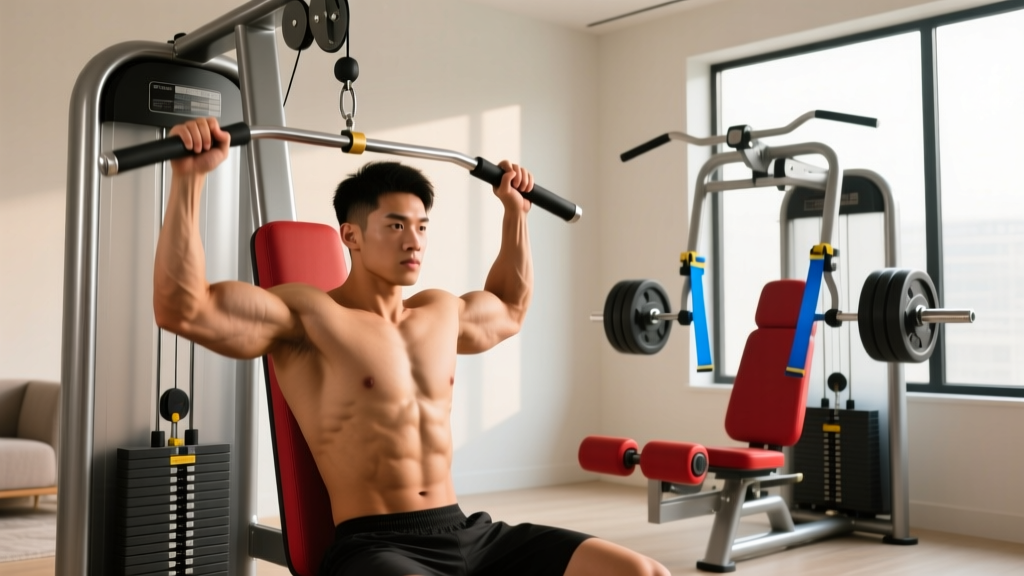
Shoulder Press Machine Maintenance & How to Use Bicep Curl Machine

Best Home Gym Space Budget for Router: Optimizing Floor Area, Clearance, and Cost Without Compromising Safety or Functionality

Bicep Curl Cable Machine Attachments: 2026 Budget & Value Guide
