EZ Bar vs Straight Bar: Incline Dumbbell Press Machine Pairings
Compare EZ curl and straight bars for arm growth, and learn to pair them with the best incline dumbbell press machines for a complete upper-body home gym.

The Biomechanical Breakdown: Wrist Angles and Muscle Activation
When designing a comprehensive upper-body hypertrophy program in 2026, the debate between the EZ curl bar and the straight bar remains a cornerstone of arm development. However, isolation work only tells half the story. To build a truly balanced physique, you must pair your arm isolation tools with heavy, compound pressing movements—specifically, integrating an incline dumbbell press machine or a high-end adjustable bench setup to target the clavicular head of the pectoralis major and the anterior deltoids.
The primary difference between the two curl bars lies in wrist supination and the carrying angle (valgus angle) of the elbow. A standard straight bar forces the wrists into full supination (palms facing directly up). While this maximizes the stretch on the short head of the biceps brachii, it places immense valgus stress on the medial elbow joint. Conversely, the angled grips of an EZ bar (typically set at 135° and 150°) allow for a semi-supinated grip, drastically reducing wrist extension and elbow torque.
Expert Insight: According to biomechanical analyses documented by ExRx (Exercise Prescription on the Internet), individuals with a high carrying angle (cubital valgus) experience significant medial epicondyle strain when using straight bars. The EZ bar is not just a comfort tool; it is a joint-preservation necessity for lifters with specific anatomical variances.
Head-to-Head Comparison Matrix
| Feature | Straight Bar | EZ Curl Bar |
|---|---|---|
| Shaft Diameter | 28mm - 29mm | 25mm - 28.5mm |
| Grip Angle | 0° (Full Supination) | 135° - 150° (Semi-Supinated) |
| Primary Bias | Short Head & Brachialis | Long Head & Brachioradialis |
| Wrist Strain | High | Low to Moderate |
| Average Price (2026) | $85 - $295 | $115 - $315 |
Hands-On Gear Review: Top Bars for the Home Gym
After testing over a dozen Olympic bars this year, we have narrowed down the top performers based on knurling depth, tensile strength, and sleeve rotation mechanics.
1. Rogue Curl Bar (The Premium Standard)
Priced at $225, the Rogue Curl Bar sets the industry benchmark. It features a 25.4mm shaft diameter, making it exceptionally easy to grip for high-rep hypertrophy work. The bar utilizes composite bushings rather than needle bearings, which is actually preferable for slower, controlled isolation movements like preacher curls or lying triceps extensions. The knurl is aggressive but not sharp, biting into the skin just enough to prevent slippage during heavy eccentrics without tearing calluses.
2. CAP Barbell Super Curl Bar (The Budget Workhorse)
For home gym builders on a strict budget, the CAP Barbell Super Curl Bar ($85) offers a functional, albeit basic, alternative. The shaft is slightly thicker at 28.5mm, and the knurling is passive. While it lacks the premium snap and refined sleeve rotation of higher-end models, its cast-iron construction and 350 lb weight capacity are more than sufficient for the vast majority of lifters performing strict curl variations.
Completing the Upper-Body Station: The Incline Dumbbell Press Machine
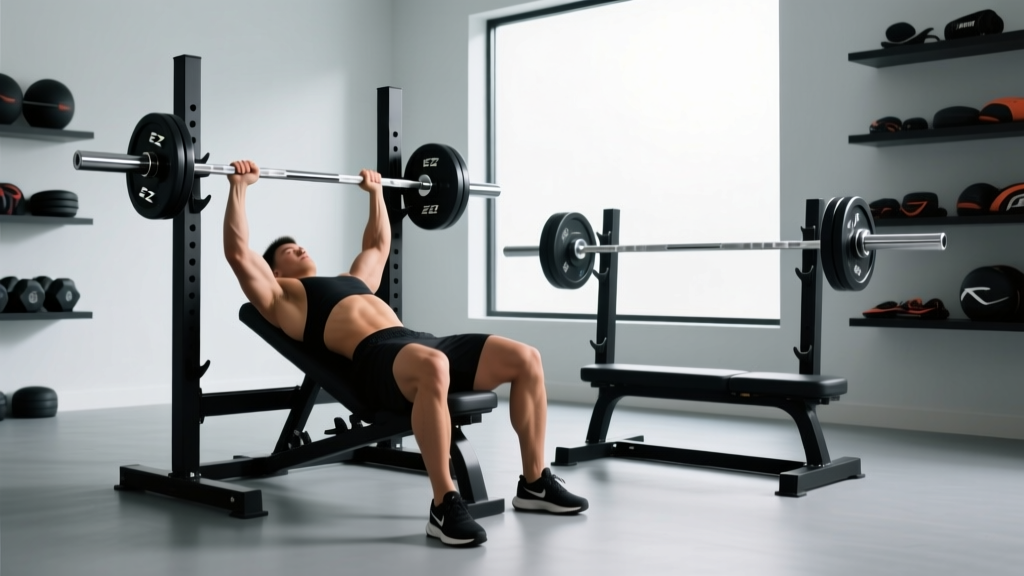
You cannot build a complete upper-body station with just arm bars. To balance the heavy bicep and tricep isolation, you need a dedicated pressing station. This is where the incline dumbbell press machine becomes invaluable. Unlike free dumbbells, which require immense stabilization and often fail due to shoulder fatigue before the pecs are fully exhausted, a converging-axis incline press machine allows you to safely push to absolute muscular failure.
In our 2026 commercial and high-end home gym evaluations, plate-loaded machines like the Arsenal Strength V-Taper Incline Press or the Prime Fitness Incline Press ($3,500 - $5,500) offer an unmatched biomechanical advantage. They utilize a converging range of motion that mimics the natural arc of the pectoral fibers, providing a deep stretch at the bottom and a hard peak contraction at the top. For home gym owners lacking the footprint or budget for a dedicated machine, pairing a heavy-duty FID bench (like the Rep Fitness AB-5200 2.0) with adjustable dumbbells is the most viable alternative, though it lacks the stabilized failure-point safety of a true machine.
The Synergy of the Setup
Pairing an EZ curl bar with an incline dumbbell press machine creates a perfect push/pull micro-cycle. The incline press heavily recruits the anterior deltoids and triceps, while the subsequent EZ bar work isolates the biceps and brachialis without requiring lower-back stabilization, allowing for maximum localized blood flow and hypertrophy.
Programming Framework: The 2026 Upper-Body Hypertrophy Split
To maximize the equipment reviewed above, we recommend the following sequence. This routine leverages the National Strength and Conditioning Association (NSCA) guidelines for exercise ordering: multi-joint compound movements first, followed by single-joint isolation work.
- Incline Dumbbell Press Machine (or FID Bench + Dumbbells): 4 sets of 6-10 reps. (Focus on a 3-second eccentric descent. Leave 1 Rep in Reserve (RIR) on the first two sets, push to failure on the last).
- Standing EZ Bar Curl (Wide Grip): 3 sets of 8-12 reps. (Use the outermost angles of the EZ bar to bias the short head of the biceps).
- Flat Dumbbell Press: 3 sets of 8-10 reps. (Superset with the next exercise).
- EZ Bar Skull Crushers (Close Grip): 3 sets of 10-15 reps. (Use the innermost angles to target the long head of the triceps).
- Straight Bar Drag Curls: 2 sets to failure. (Pull the bar up your torso to eliminate front delt involvement and isolate the bicep peak).
Maintenance, Failure Modes, and Longevity
Even the best equipment will fail if neglected. When maintaining your EZ bars, straight bars, and the guide rods of your incline dumbbell press machine, pay attention to the following edge cases:
- Sleeve Play and Bushing Wear: Over time, composite bushings in budget curl bars can wear down, causing the sleeves to wobble. If you notice excessive lateral play, it is time to disassemble the sleeve, clean out the oxidized metal dust, and re-lubricate with a high-viscosity synthetic grease (like Mobilgrease 28).
- Chrome Flaking on Straight Bars: Cheap straight bars often use decorative chrome rather than hard industrial chrome. In humid garages, this leads to micro-fractures and flaking. Wipe down your straight bar with a silicone-impregnated cloth after every session to displace moisture.
- Machine Guide Rod Friction: If using a selectorized or plate-loaded incline dumbbell press machine, the linear bearings on the guide rods must be wiped clean and lightly oiled monthly. Failure to do so results in a 'sticky' concentric phase, ruining the strength curve of the lift.
By understanding the precise biomechanical differences between the EZ curl bar and the straight bar, and intelligently pairing them with a high-quality incline dumbbell press machine, you can engineer a home gym setup that rivals elite commercial facilities. Precision in equipment selection yields precision in muscle development.
More gear to consider
All reviews
Dumbbell Exercises for Women Over 50: Bumper vs Iron Plate Care

Strict Press Dumbbells Setup: Olympic vs Standard Weight Plates Guide

EZ vs Straight Bar: Space Hacks for Bodyweight and Dumbbell Exercises

Best Layouts for Cold Climates: Engineering Thermal Efficiency, Airflow, and Occupant Comfort
Power Rack vs Squat Rack vs Squat Stand & Dumbbell SVG