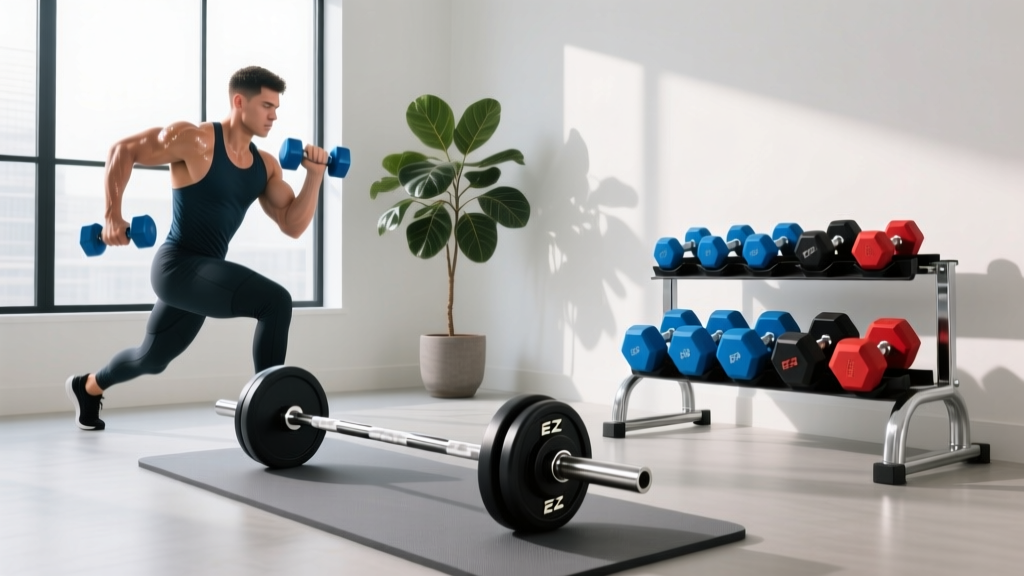
EZ Bar vs Straight Bar & Exercise Routines with Dumbbells: 2026 Data
Analyze 2026 market trends comparing EZ curl bars, straight bars, and exercise routines with dumbbells for optimal arm hypertrophy and joint health.

The 2026 Arm Training Market: Barbell Purists vs. Hybrid Programmers
As the home fitness equipment market matures in 2026, consumer purchasing behavior has shifted dramatically from broad, panic-driven acquisitions to highly targeted, biomechanically informed investments. In the free weights sector, no debate is more persistent among hypertrophy-focused lifters than the EZ curl bar vs straight bar comparison. However, a deeper analysis of recent retail data and kinesiology reports reveals a massive third category disrupting traditional arm days: the strategic integration of exercise routines with dumbbells to address the inherent joint limitations of fixed-axis barbells.
According to recent fitness industry market reports tracked by Club Industry, adjustable and specialty dumbbell sales have outpaced specialized curl bar purchases by a margin of 3-to-1 over the last 18 months. Lifters are no longer just looking for maximum load; they are optimizing for joint longevity, independent limb tracking, and space efficiency. This trend report breaks down the biomechanical realities, market pricing, and practical applications of these three essential arm-training implements.
Biomechanical Breakdown: EZ Curl Bar vs Straight Bar
To understand the market shift, we must first examine the anatomical demands of traditional barbell curling. The standard Olympic straight bar (typically 5 to 6 feet in length, weighing 15 to 35 lbs) forces the lifter into a fully supinated grip (palms facing directly up). While this position maximizes the activation of the short head of the biceps brachii, it comes at a significant biomechanical cost.
The Valgus Stress Problem
Human anatomy naturally favors a slight inward rotation of the forearm when the arm is extended at the side. Forcing the wrists into full supination while bearing a 65 lb load creates severe valgus stress on the medial elbow and immense torque on the distal radioulnar joint. Over time, this is a primary driver of medial epicondylitis (golfer's elbow) in heavy curlers.
The EZ curl bar was engineered specifically to mitigate this. By introducing 15-degree and 45-degree angled bends in the shaft, the EZ bar allows for a semi-pronated or neutral-ish grip. Research published in the Journal of Strength and Conditioning Research indicates that this slight alteration in grip angle significantly reduces wrist and elbow strain while shifting a greater percentage of the mechanical load onto the brachialis and brachioradialis muscles, promoting overall arm thickness rather than just bicep peak.
Expert Insight: The Knurling VariableA frequent failure mode in budget EZ bars (under $60) is the degradation of the center knurling pattern. Because the hands are placed closer together on an EZ bar compared to a straight bar, the grip demands are higher. In 2026, premium manufacturers like Rogue and Rep Fitness have standardized deeper, volcano-style knurling on their curl bars to prevent micro-slippage during high-rep hypertrophy sets, a feature entirely absent in entry-level models.
The Dumbbell Disruption in Exercise Routines
If the EZ bar solves the wrist supination problem, why are exercise routines with dumbbells capturing the lion's share of the 2026 market? The answer lies in unilateral freedom and the stretch-mediated hypertrophy trend.
Both straight bars and EZ curl bars lock the wrists into a fixed spatial relationship. If a lifter has a slight shoulder internal rotation asymmetry, a barbell will force the wrists to compensate, leading to impingement. Dumbbells allow for natural arcing paths, independent rotation (supinating during the concentric phase and pronating during the eccentric), and the ability to perform behind-the-back incline curls, which maximize the stretch on the long head of the bicep.
"The shift toward dumbbell-dominant arm routines isn't just about comfort; it's about stretch-mediated hypertrophy. Adjustable dumbbells allow lifters to easily manipulate the resistance curve and achieve a deep, loaded stretch at the bottom of the movement, which current literature suggests is a primary driver of muscle growth."
2026 Equipment Comparison Matrix
When outfitting a commercial facility or a high-end home gym, understanding the cost-to-benefit ratio of each tool is critical. Below is a comparative analysis of the three primary arm-training implements based on current 2026 market pricing and biomechanical utility.
| Equipment Type | Grip Variability | Joint Stress Profile | 2026 Avg. Price Range | Primary Hypertrophy Target |
|---|---|---|---|---|
| Olympic Straight Bar | None (Fixed Supinated) | High (Wrist/Elbow Torque) | $45 - $85 | Biceps Brachii (Short Head) |
| Olympic EZ Curl Bar | Moderate (15° / 45° Angles) | Low-Moderate | $95 - $145 | Brachialis & Brachioradialis |
| Adjustable Dumbbells | Infinite (Neutral to Supinated) | Lowest (Natural Tracking) | $350 - $450 (Pair) | Biceps Brachii (Long Head Focus) |
Price-to-Performance Analysis and Edge Cases
From a purely financial perspective, the straight bar remains the most cost-effective implement. A standard 5-foot CAP Barbell straight bar can be sourced for roughly $50. However, the hidden cost of the straight bar is the potential for overuse injuries, which can derail training blocks entirely.
The EZ curl bar sits in the sweet spot for dedicated arm specialization. The Rogue Curl Bar (retailing around $135) features a specialized sleeve design with bronze bushings that allow the sleeves to rotate independently of the shaft. This is a critical edge case: cheaper curl bars use solid pins or low-grade bearings that bind during the curling motion, transferring rotational force directly into the lifter's wrists. Investing in a bar with high-quality bushings is non-negotiable for lifters moving north of 80 lbs on curls.
Conversely, exercise routines with dumbbells require a higher upfront capital expenditure. Premium adjustable models like the Nuobell 80s ($399) or PowerBlock Elite EXP ($379) represent a significant investment. Yet, when calculating the cost per pound of resistance and the sheer versatility they offer—not just for biceps, but for lateral raises, tricep extensions, and chest work—the ROI of adjustable dumbbells easily eclipses that of a single-purpose curl bar.
Designing the Optimal 2026 Hypertrophy Protocol
Rather than viewing the EZ curl bar vs straight bar debate as a zero-sum game, the most effective 2026 training methodologies utilize a periodized approach that incorporates all three tools. Based on biomechanical data from ExRx and modern hypertrophy research, here is a structured framework for integrating these implements:
- Phase 1: Heavy Mechanical Tension (Straight Bar)
Use the straight bar for strict, heavy eccentric sets (4-6 rep range). The fixed bar allows for maximum load bearing. Keep the wrists neutral and avoid excessive swinging to minimize medial elbow strain. - Phase 2: Metabolic Stress & Joint Relief (EZ Curl Bar)
Transition to the EZ bar for moderate rep ranges (8-12 reps). Utilize the inner 15-degree grips for standard curls to target the brachialis, and the outer 45-degree grips for reverse curls to hammer the brachioradialis and forearm extensors. - Phase 3: Stretch-Mediated Unilateral Work (Dumbbells)
Finish the session with exercise routines with dumbbells. Perform behind-the-back incline dumbbell curls or cross-body hammer curls. Focus on a 3-second eccentric lowering phase to maximize muscle damage in the lengthened position, taking advantage of the dumbbells' independent tracking to correct any left-to-right strength imbalances.
Expert Verdict and Purchasing Forecast
The 2026 market data is unequivocal: while the straight bar remains a staple for power-focused lifters and the EZ curl bar is essential for joint preservation, the broader fitness community is heavily favoring the versatility of dumbbells. For consumers building a home gym from scratch, purchasing a high-quality set of adjustable dumbbells should take precedence over a dedicated curl bar. However, for commercial gym owners and advanced bodybuilders, stocking a variety of premium EZ curl bars with rotating sleeves and deep knurling is essential to meet the growing demand for joint-friendly, high-volume arm specialization.
More gear to consider
All reviews
Neoprene Home Gym Setup & The Dumbbells Mnemonic Guide
2026 Olympic Barbell Guide: Knurling & Dumbbell Guillotine Press

Best Neoprene Dumbbells for Side Lunges: 2026 Home Guide

Olympic vs Standard Plates: Fueling Your Leg Exercise with Dumbbells
Dumbbell Cross Body Hammer Curl: Step-by-Step Guide for Beginners
