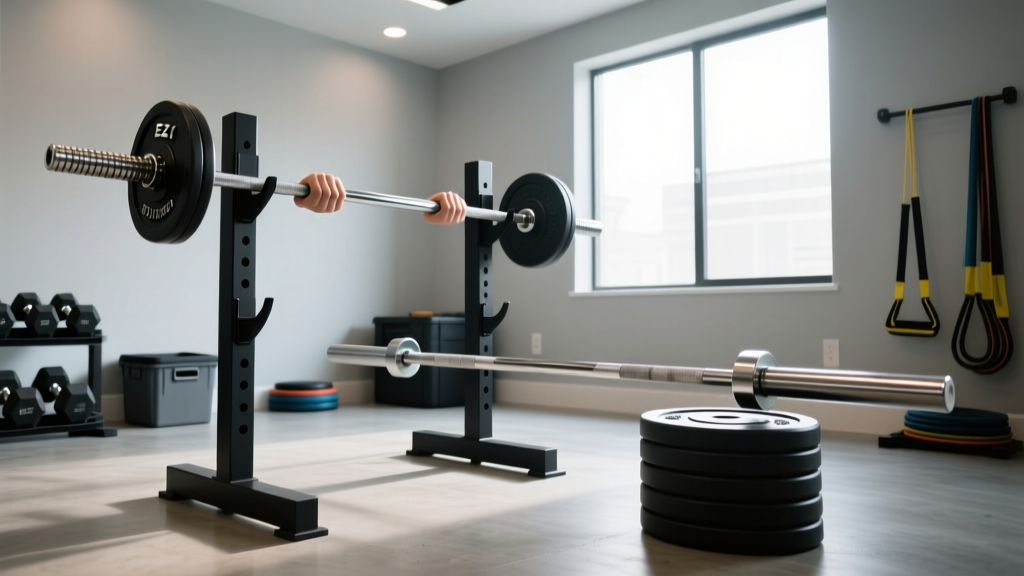
EZ Curl Bar vs Straight Bar: Boosting Dumbbell Shoulder Press Weight
Compare EZ curl bar vs straight bar storage and biomechanics to optimize gym space and safely increase your dumbbell shoulder press weight.

The Space vs. Strength Dilemma in Modern Micro-Gyms
As home fitness layouts continue to shrink in 2026, with the average garage gym now hovering around 120 to 150 square feet, lifters face a critical spatial conflict. You want to push your dumbbell shoulder press weight into the 80lb to 100lb+ range per hand, but achieving that requires heavy accessory work for the triceps and anterior deltoids. This is where the debate of the EZ curl bar vs straight bar enters the conversation. Both implements are non-negotiable for building the lockout strength and stabilizer endurance required for heavy overhead pressing, yet their vastly different physical footprints dictate how you must design your gym layout.
If you are storing a 7-foot Olympic straight bar horizontally on a floor stand, you are actively cannibalizing the lateral clearance required to safely kick up heavy dumbbells. In this guide, we break down the biomechanical carryover, exact spatial dimensions, and layout strategies to integrate both bars into a compact space without compromising your pressing mechanics or safety.
The Biomechanical Bridge: Accessory Bars to Heavier Presses
Before optimizing your floor plan, we must establish why both bars are essential for increasing your dumbbell shoulder press weight. The overhead press is heavily limited by the triceps brachii (specifically the long and lateral heads) during the final 30 degrees of lockout, and by the anterior deltoids during the initial drive off the chest.
According to exercise biomechanics data cataloged by ExRx.net, the dumbbell shoulder press requires significant unilateral stabilization that a barbell press does not. To fortify these stabilizers and the primary movers without overtaxing your central nervous system with heavy barbell overhead presses, you must utilize targeted accessory movements:
- The Straight Bar: Ideal for close-grip bench presses and strict military presses. The 28mm to 29mm shaft diameter and uniform knurling allow for maximum load transfer, directly translating to the raw force production needed to move heavier dumbbells off the rack.
- The EZ Curl Bar: The angled shaft (usually featuring 15-degree and 30-degree bends) places the wrists in a semi-supinated position. This is biomechanically superior for skull crushers and close-grip floor presses, targeting the triceps long head while minimizing wrist extension strain. Stronger triceps directly correlate to a higher dumbbell shoulder press weight by eliminating the 'sticking point' at the top of the movement.
Spatial Footprint: EZ Curl Bar vs Straight Bar Dimensions
To design an efficient layout, you must understand the exact spatial demands of your equipment. A standard power rack takes up a 4x4 foot footprint, but the barbell storage is where compact gyms fail. Below is a dimensional comparison based on industry-standard Olympic specifications, utilizing data from leading manufacturers like Rogue Fitness.
| Barbell Type | Total Length | Shaft Length | Sleeve Length | Min. Horizontal Clearance | Min. Vertical Clearance |
|---|---|---|---|---|---|
| Olympic Straight Bar (e.g., Rogue Ohio Bar) | 86.4 inches | 51.5 inches | 16.4 inches | 90 inches | 90 inches (with lift-off) |
| Olympic EZ Curl Bar (e.g., Rogue Curl Bar) | 47.25 inches | 26.25 inches | 10.5 inches | 50 inches | 52 inches (with lift-off) |
| Standard Super Curl Bar (Budget Tier) | 47.0 inches | 28.0 inches | 9.5 inches | 50 inches | 52 inches (with lift-off) |
Note: Horizontal clearance includes a 2-inch buffer on each side for loading and unloading plates. Vertical clearance accounts for the physical height of the bar plus the 2-4 inches required to lift the barbell off a vertical storage peg.
Layout Strategy: The 'Pressing Triangle' and Lateral Clearance
When attempting to set a new personal record for your dumbbell shoulder press weight, the most dangerous moment is the 'kick-up'—the maneuver where you use your thighs to drive the dumbbells into position while simultaneously leaning back onto an adjustable bench.
If you are using 80lb or 100lb dumbbells, your elbows will flare outward, and the dumbbell heads will swing laterally. A standard 45-inch adjustable bench requires a minimum of 36 inches of lateral clearance on both sides to perform a heavy kick-up safely. This creates a 'Pressing Triangle' that is roughly 117 inches (9.75 feet) wide.
⚠️ Critical Layout Warning: The Sleeve Strike Zone
If you store a 7-foot straight bar horizontally on a floor stand or the J-cups of your power rack, the sleeves will protrude into your Pressing Triangle. Striking a loaded or even unloaded barbell sleeve with a 100lb dumbbell during a kick-up can cause catastrophic wrist injuries or tear the dumbbell's urethane coating. Solution: You must transition to vertical storage or perpendicular wall-mounted storage to keep the lateral drop zone completely sterile.
Implementing Vertical and Wall-Mounted Storage
To reclaim your floor space, abandon horizontal floor stands. Instead, utilize the following layout configurations:
- Vertical Barbell Posts: Mount a vertical barbell holder to the outside upright of your power rack. The straight bar (86.4 inches) will require a ceiling height of at least 92 inches to clear the peg. The EZ curl bar can be stored on a secondary, lower peg on the same post.
- Perpendicular Wall Hangers: Use wall-mounted hangers (such as the Rogue Wall Mounted Barbell Hanger, typically retailing around $45.00) installed on a wall perpendicular to your bench. This keeps the bars accessible but entirely outside the 117-inch lateral swing zone of your dumbbell press.
Edge Cases & Failure Modes in Compact Gyms
Even with a meticulous layout, specific equipment combinations can create spatial failure modes that disrupt your training flow and limit your ability to progressively overload your dumbbell shoulder press weight.
1. The Bumper Plate Sleeve Conflict
Many lifters opt for thick, virgin rubber bumper plates to protect their garage floors. A standard 45lb bumper plate is roughly 3.25 inches wide. If you are using a budget EZ curl bar with 9.5-inch sleeves, you can only fit two 45lb bumpers per side before the collars fail to secure the load. If your triceps accessory work requires more than 135lbs, the EZ bar becomes a spatial and functional bottleneck. Fix: Invest in an Olympic EZ bar with 10.5-inch to 11-inch sleeves, or switch to thinner steel plates for accessory work.
2. The 8-Foot Ceiling Trap
Standard residential garages often feature 8-foot (96-inch) ceilings, sometimes reduced to 90 inches by exposed joists or HVAC ducting. Attempting to store a 7.2-foot straight bar vertically in a space with 90-inch clearance will result in the bar scraping the ceiling drywall when lifting it off the storage peg. In these micro-gyms, the EZ curl bar becomes the undisputed king of vertical storage, while the straight bar must be stored horizontally on the rack's safety straps when not in use.
Quick-Reference Space Optimization Checklist
Use this framework to audit your current gym layout and ensure your equipment storage is actively supporting, rather than hindering, your strength goals:
- Measure the Drop Zone: Verify you have 36 inches of clear space on the left and right of your adjustable bench for heavy dumbbell kick-ups.
- Audit Sleeve Lengths: Ensure your EZ curl bar sleeves can accommodate at least 135lbs of your preferred plate type (bumper vs. steel).
- Check Ceiling Clearances: Measure from the floor to the lowest ceiling obstruction. Subtract 4 inches. If your straight bar is longer than this number, vertical storage is impossible.
- Map the Workflow: Position your dumbbell rack directly behind or immediately adjacent to the head of the bench to minimize the distance you must carry heavy dumbbells before sitting.
Final Thoughts on Layout and Progression
Increasing your dumbbell shoulder press weight is not just about following a linear progression program; it is about creating an environment where heavy, unilateral movements can be executed safely. The EZ curl bar and straight bar are indispensable tools for building the requisite triceps and shoulder stability, but their physical footprints demand respect. By understanding the exact dimensions of your bars, calculating the lateral swing arc of heavy dumbbells, and utilizing vertical or perpendicular wall storage, you can transform a cramped 120-square-foot garage into a highly optimized strength laboratory.
More gear to consider
All reviews
Mistakes Upgrading Past 65lb Dumbbells: Olympic vs Standard Plates

Barbell Buying Guide: Weight, Knurling & Proper RDL Dumbbell Form
Bumper vs Iron Plates & Leaning Away Dumbbell Lateral Raise

Dumbbell Wood Choppers: Maintaining Loadable Interchangeable Plates

Rubber Hex vs Urethane: Best Value for Your Dumbbell Bench Press Rack
