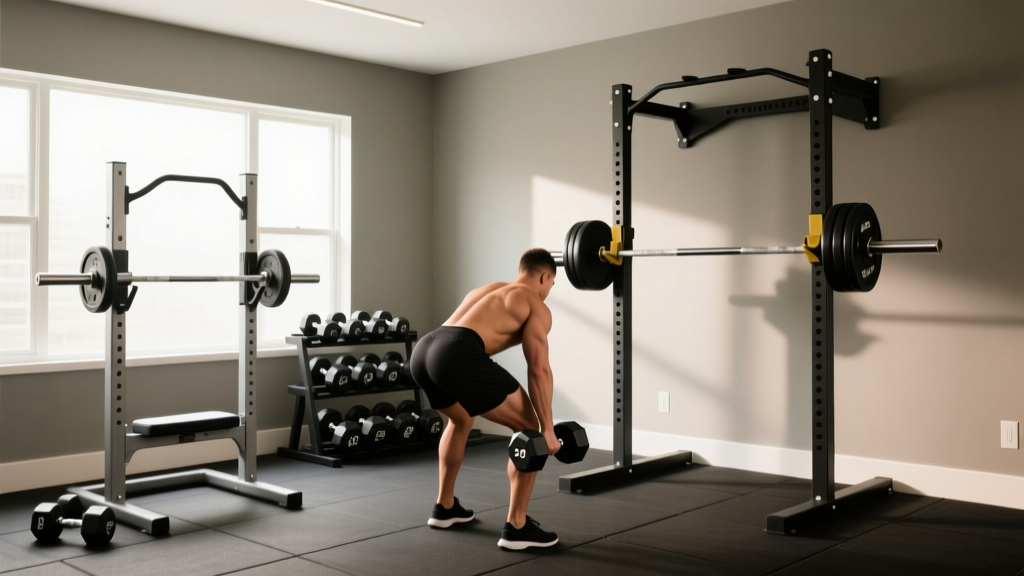
EZ Curl vs Straight Bar Space Layouts & Dumbbell Good Morning Form
Compare EZ curl bar vs straight bar dimensions for small home gyms, plus master dumbbell good morning form when rack space is limited.

As micro-gyms, apartment fitness spaces, and garage conversions continue to dominate the 2026 home fitness real estate market, the debate between an EZ curl bar and a straight barbell has shifted from pure biomechanics to spatial geometry. When you are designing a home gym layout with strict square-footage limitations, every inch of lateral clearance, vertical storage, and floor footprint matters. Choosing the right barbell dictates not only your arm and back training but also how you approach lower-body and posterior chain movements when a full power rack is off the table.
In this comprehensive layout guide, we break down the exact dimensional differences between Olympic EZ curl bars and standard straight bars, analyze the spatial math required for safe operation, and provide a masterclass on adapting your posterior chain training—specifically perfecting your dumbbell good morning form—when ceiling height or lateral clearance restricts your equipment choices.
The Spatial Reality: EZ Curl Bar vs. Straight Bar Dimensions
Before purchasing free weights for a compact layout, you must understand the physical footprint of the equipment. A standard Olympic straight bar is designed for commercial gyms with expansive lifting platforms. An Olympic EZ curl bar, conversely, is inherently a space-saving tool that offers surprising versatility beyond just bicep curls.
| Feature | Standard Olympic Straight Bar | Olympic EZ Curl Bar |
|---|---|---|
| Total Length | 86 inches (7'2") | 47 to 52 inches |
| Minimum Lateral Clearance | 96 inches (8 ft) for safe loading | 60 inches (5 ft) for safe loading |
| Average Weight | 44 lbs (20kg) | 15 lbs to 35 lbs (varies by shaft thickness) |
| Vertical Storage Footprint | Requires 86" ceiling height + 6" clearance | Requires 52" ceiling height + 6" clearance |
| 2026 Avg. Price Range | $180 - $320 | $120 - $240 |
According to equipment footprint standards cataloged by Rogue Fitness, a 7-foot barbell requires a minimum of 8 feet of lateral wall-to-wall clearance to safely slide 45-pound bumper plates on and off the sleeves without scuffing your drywall or damaging the bar's endcaps. If your spare bedroom or garage bay is narrower than 96 inches, a straight bar becomes a spatial liability, making the EZ curl bar the undisputed champion of tight floor plans.
Lateral Clearance and Ceiling Height Constraints
Space optimization is a three-dimensional puzzle. While floor space is often the primary concern, ceiling height dictates your vertical storage and overhead lifting capabilities.
Layout Pro-Tip: If your basement gym has a ceiling height of 7 feet (84 inches) or lower, performing overhead presses with a 7-foot straight bar is nearly impossible without the plates grazing the ceiling joists. An EZ curl bar or a set of adjustable dumbbells completely eliminates this vertical clearance issue, allowing you to utilize the space directly beneath low-hanging HVAC ducts or beams.When designing your wall-storage layout, vertical barbell hangers are the gold standard for saving floor space. A straight bar stored vertically requires over 7.5 feet of vertical wall space. An EZ curl bar, such as the popular 47-inch models from Titan Fitness or Rep Fitness, can be mounted on a wall rack at waist height, taking up less than 4 square feet of wall real estate and leaving the floor entirely open for mat work and stretching.
The Rack Dilemma: Posterior Chain Training in Micro-Gyms
The most significant drawback of omitting a 7-foot straight bar from your home gym is the loss of traditional barbell posterior chain movements, specifically barbell back squats and barbell good mornings. These lifts typically require a 48x48-inch power rack or squat stands, which consume a massive 16-square-foot footprint—plus the 8-foot lateral clearance mentioned earlier.
If your spatial layout forces you to choose between a fold-up wall rack (which limits your barbell options) or relying entirely on free-standing dumbbells and an EZ curl bar, you must adapt your programming. The hamstrings, glutes, and spinal erectors still require heavy, hip-hinge stimulation. This is where mastering dumbbell good morning form becomes a non-negotiable skill for the space-optimized home gym.
Mastering Dumbbell Good Morning Form in Tight Spaces
Without a barbell resting across your upper back, the center of mass shifts during a dumbbell good morning. Biomechanics data cataloged by ExRx.net highlights that altering the load placement changes the lever arm and the stabilization demands on the core. Here is the step-by-step framework for executing flawless dumbbell good morning form when rack space is limited.
- The Setup and Grip: Use urethane hex dumbbells (the hexagonal shape prevents them from rolling away in tight spaces). Select a pair of 35 lb to 60 lb dumbbells depending on your hinge strength. Clean the dumbbells to your shoulders.
- Load Placement (Two Variations):
- Upper Trap Wedge: If you have the shoulder mobility, press the dumbbells slightly overhead and wedge the handles behind your neck, resting the bell ends on your upper trapezius. This closely mimics the high-bar barbell position.
- Front-Rack Hold: Keep the dumbbells racked at your shoulders with a neutral grip. This shifts the center of mass anteriorly, demanding significantly more core bracing and quadriceps engagement to maintain balance.
- The Hinge Mechanics: Plant your feet shoulder-width apart. Maintain a soft bend in the knees (about 15 degrees). Initiate the movement by pushing your hips backward toward the wall behind you, not by bending at the waist.
- Spinal Alignment: The American Council on Exercise (ACE) emphasizes that the spine must remain rigidly neutral throughout the hinge. Imagine a steel rod connecting your tailbone to the base of your skull. Your torso should lower until it is nearly parallel to the floor.
- The Return: Drive your hips forward by forcefully contracting the glutes and hamstrings. Do not use your lower back to 'pull' the weight up; the hips must lead the ascent.
"In a space-constrained environment, the dumbbell good morning is not just a regression; it is a highly effective spatial hack that allows for deep hip flexion and heavy hamstring loading without requiring an 8-foot wingspan or a heavy-duty squat rack."
Space-Optimized Storage Layouts for Free Weights
To maximize your floor plan for movements like dumbbell good mornings, kettlebell swings, and EZ bar floor presses, your storage must be aggressively vertical. Here is a proven 2026 layout blueprint for a 10x10 foot micro-gym:
- Vertical Dumbbell Tier Rack: Avoid horizontal 3-tier racks that protrude 30 inches into the room. Opt for a vertical A-frame or a wall-mounted slant rack. This reduces the footprint to roughly 24x24 inches.
- Wall-Mounted EZ Bar & Plate Hanger: Install a combined wall hanger that holds your EZ curl bar horizontally against the wall, with vertical plate posts extending outward. This keeps the plates off the floor and utilizes dead wall space.
- Fold-Up Wall Rack: If you occasionally need a straight bar for bench pressing, a fold-up wall rack (like the Rogue Fold-Up Rack) extends 43 inches when in use but collapses to a mere 4-inch profile against the wall, instantly reclaiming your floor space for dumbbell hinge work.
- Rolling Weight Caddy: For adjustable dumbbells or kettlebells, a heavy-duty rolling caddy allows you to push the weights into a corner or closet when the gym is not in use, converting the room back into a functional living space.
Frequently Asked Questions
Can I use an EZ curl bar for barbell good mornings?
While physically possible, it is not recommended. The angled grips of an EZ curl bar force your wrists and elbows into an externally rotated position that is highly unnatural and potentially injurious when the bar is resting across your upper back/traps. If you lack the space for a straight bar and a rack, pivot to dumbbell good morning form or use a sandbag across your shoulders.
What is the best dumbbell weight for good mornings?
Because the lever arm is shorter and the stabilization demand is higher than a barbell, most lifters find they can use about 60% to 70% of their barbell good morning working weight. If you barbell good morning 135 lbs for reps, start with a pair of 40 lb or 45 lb hex dumbbells to perfect your hip hinge mechanics.
How much space do I really need for a home gym layout?
A functional free-weight home gym requires a minimum clear floor area of 6 feet by 6 feet (36 square feet) for safe dumbbell and kettlebell movements. If you introduce a 7-foot straight barbell, your minimum required dimensions expand to 8 feet wide by 6 feet deep to account for the bar sleeves and plate loading clearance.
More gear to consider
All reviews
Tested and Step Compared: Real-World Performance Data for Industrial Weighing Systems

Dumbbell Rack Care for Seated Overhead Dumbbell Extensions

Best Dumbbell Racks for the Lying Dumbbell Pullover to Extension

EZ vs Straight Bar Value: Arm Exercises With Dumbbells for Ladies

Free Weights vs Dumbbells: Bumper Plate vs Iron Plate Guide
