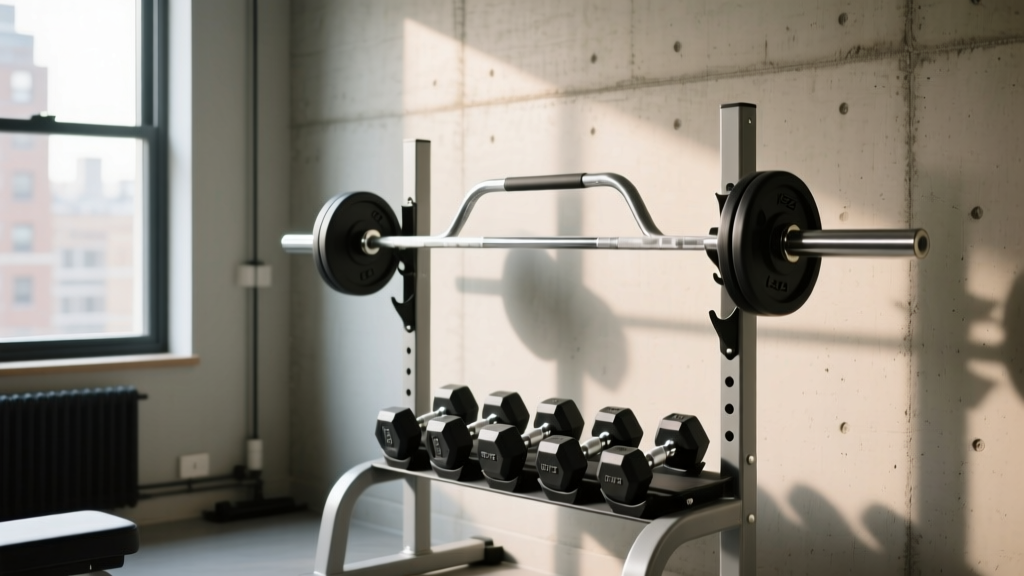
EZ vs Straight Bar & Weight Lifting Exercises with Dumbbells
Compare EZ curl bars vs straight bars for small home gyms. Discover space-saving layouts and the best weight lifting exercises with dumbbells.

The Spatial Dilemma: Designing the Modern Micro-Gym
As home fitness spaces continue to evolve in 2026, the trend has shifted heavily toward 'micro-gyms'—highly optimized layouts in spare bedrooms, apartment corners, and single-car garages. When designing these constrained environments, lifters face a critical spatial conflict: the equipment they want versus the square footage they have. Nowhere is this more evident than in the debate between the traditional Olympic straight bar, the cambered EZ curl bar, and the strategic use of adjustable dumbbells.
A standard 7-foot Olympic barbell requires massive lateral clearance, often dominating an entire wall. Conversely, an EZ bar offers a compact footprint but limits biomechanical versatility. When lateral clearance falls below 90 inches, lifters must pivot to weight lifting exercises with dumbbells or opt for specialized shorter bars to maintain a functional training space. This guide breaks down the exact spatial footprints, biomechanical trade-offs, and layout strategies for optimizing your arm and upper-body training in tight quarters.
The Spatial Footprint: Exact Measurements & Clearance
To design an efficient layout, we must look beyond the rack itself and calculate the 'active clearance zone'—the total width required to perform a rep without striking a wall or mirror with your plates or knuckles.
Active Clearance Matrix (2026 Standards)
- Standard Olympic Straight Bar: 86.75 inches long. With two 45lb bumper plates (approx. 10.5 inches wide each), you need a minimum of 108 inches (9 feet) of lateral wall clearance to safely perform standing curls or skull crushers.
- Olympic EZ Curl Bar (Standard 47-inch): 47 inches long. With plates loaded, the total active width is roughly 68 inches (5.6 feet). Ideal for narrow alcoves or walk-in closets converted into gym spaces.
- Adjustable Dumbbells (e.g., Nuobell 80s / PowerBlock Pro): Require only 18 to 24 inches of lateral clearance, making them the undisputed champions of micro-gym space optimization.
If your training space is less than 8 feet wide, a straight barbell is functionally obsolete for isolation movements. You are forced into a binary choice: downsize to an EZ bar or transition entirely to dumbbell variations.
Biomechanics in Tight Quarters: EZ Bar vs. Straight Bar
When space forces you to abandon the straight bar, is the EZ curl bar an adequate replacement? According to biomechanical analyses reviewed by the National Strength and Conditioning Association (NSCA), the angle of the wrist and elbow joint drastically alters muscle recruitment and joint stress.
| Feature | Straight Olympic Bar | EZ Curl Bar (Cambered) |
|---|---|---|
| Wrist Position | Full Supination (Palms up) | Semi-Supinated (Angled grips) |
| Joint Stress | High valgus stress on wrists/elbows | Reduced stress; more natural carry angle |
| Muscle Focus | Biceps Brachii (Short & Long Head) | Brachialis & Brachioradialis emphasis |
| 2026 Avg Price | $150 - $295 (e.g., Rogue Ohio Bar) | $45 - $145 (e.g., Rogue Curl Bar) |
The Verdict: The EZ bar is superior for lifters with pre-existing wrist or elbow tendonitis, but it slightly reduces the peak contraction of the biceps brachii compared to the straight bar. To compensate for this loss of direct bicep isolation in a small space, we must integrate targeted dumbbell work.
Integrating Weight Lifting Exercises with Dumbbells for Space Optimization
When an EZ bar cannot provide the full supination required for maximum bicep peak development, or when you simply lack the 68 inches needed to swing an EZ bar, weight lifting exercises with dumbbells become your primary tool. Modern adjustable dumbbells, such as the PowerBlock Elite or Nuobell 80, offer a footprint of just 15x8 inches while providing up to 80 lbs of resistance per hand.
The 'No-Bar' Arm Hypertrophy Protocol
Replace your barbell movements with these space-efficient dumbbell alternatives that require zero lateral clearance beyond your own shoulder width:
- Supinating Dumbbell Curls: Mimics the straight bar's full supination. Start with a neutral grip (hammer position) and twist the pinky upward at the top of the movement. This replicates the biceps brachii activation of a straight bar without the 9-foot wall clearance.
- Cross-Body Hammer Curls: Replaces the EZ bar's brachialis focus. Curl the dumbbell across your torso toward the opposite shoulder. This is highly joint-friendly and can be performed in a hallway or tight corner.
- Overhead Dumbbell Tricep Extensions: Replaces the EZ bar skull crusher. Lying on a floor mat or a compact adjustable bench, a single heavy dumbbell held with both hands provides the same long-head tricep stretch without the risk of dropping a steel barbell on your forehead in a cramped space.
'In spaces under 80 square feet, the barbell becomes a liability. Adjustable dumbbells and a single 47-inch EZ curl bar provide 95% of the hypertrophic stimulus of a full Olympic setup while preserving the room's primary function.' — 2026 Home Gym Layout & Ergonomics Report
Storage Solutions & Rack Compatibility
Space optimization isn't just about the active clearance zone; it's about where the equipment lives when you aren't using it. Storing a 7-foot straight bar vertically requires a specialized barbell holder with a 9-inch base and over 85 inches of vertical ceiling clearance—often impossible in basement gyms with low HVAC ducting.
Optimal Layout Configurations
- The Wall-Mounted Foldable Rack: Systems like the PRx Performance Profile ONE fold flat against the wall (just 4 inches deep). When folded, you can hang an EZ curl bar horizontally on the J-cups, utilizing dead air space 6 feet off the ground.
- Under-Bench Storage: Most adjustable benches (like the Rogue Adjustable Bench 3.0) have a rear wheel and handle. An EZ curl bar can be slid directly underneath the bench frame, completely eliminating its visual and physical footprint.
- Dumbbell Cradles: Never leave adjustable dumbbells on the floor where they can be kicked, which is the primary failure mode for dial-based mechanisms. Wall-mounted cradles keep them at hip height, requiring only 18 inches of wall space.
Troubleshooting Edge Cases & Failure Modes
⚠️ Warning: Equipment Limitations in Tight Spaces
- Plate Loading Clearance: Even if you have 68 inches of space to use an EZ bar, do you have space to load it? If your rack is flush against a corner, you may not have the 12 inches of lateral sleeve access required to slide on 45lb plates. Solution: Use 25lb and 10lb fractional plates to build weight without exceeding the sleeve's spatial limits.
- Knurling & Wall Scuffing: Aggressive Olympic knurling on straight bars will tear through drywall if you misjudge a lateral movement. In tight spaces, always install 1/2-inch rubber horse stall mats on the walls behind your lifting zone.
- Adjustable Dumbbell Drop Failures: Unlike cast iron hex dumbbells, modern adjustable dumbbells contain complex internal locking pins. If you fail a rep in a tight space and drop them to the floor, the dial or pin mechanism can shatter. Always use them over a thick rubber mat and never drop them from shoulder height.
Final Verdict: Designing Your Layout
Choosing between an EZ curl bar, a straight bar, and dumbbells is ultimately a geometry problem. If your lateral clearance exceeds 108 inches, the straight bar remains the gold standard for heavy, two-arm compound isolation. If you are constrained to 60-80 inches, the EZ curl bar is a mandatory downgrade that saves your drywall and your elbows. However, for the ultimate space-optimized micro-gym, investing in high-quality adjustable dumbbells and mastering weight lifting exercises with dumbbells yields the highest return on investment per square inch, completely eliminating the need for barbell storage while delivering superior, joint-friendly hypertrophy.
More gear to consider
All reviews
How Heavy Are the Dumbbells You Lift Machio? Rack Setup Guide

Barbell Knurling & Front Lateral Raises with Dumbbells Fixes

Golf Dumbbell Workout vs. Barbell: Weight & Knurling Mistakes
Power Rack vs Squat Stand Setup for Bodyweight and Dumbbell Workout

Olympic Barbell Setup: Knurling, Weight & Rear Delt Dumbbell Fly GIF
