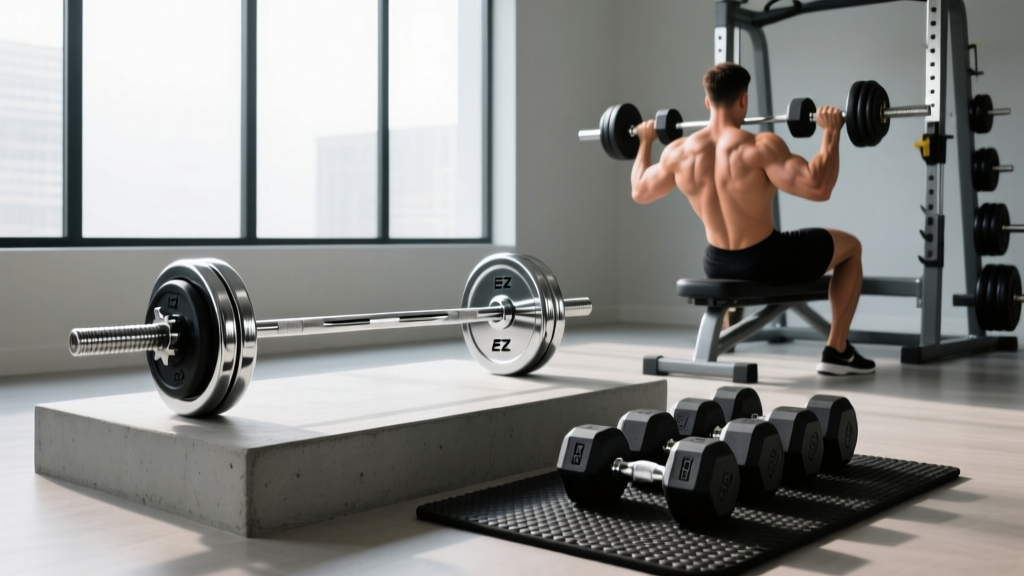
EZ vs Straight Bar Care & Upper Back Exercises with Dumbbells
Compare EZ curl vs straight bar maintenance, prevent rust, and learn why upper back exercises with dumbbells extend your barbell's lifespan in 2026.

The Metallurgical Showdown: EZ Curl Bar vs. Straight Bar Vulnerabilities
When outfitting a home gym in 2026, lifters often debate the biomechanics of an EZ curl bar vs straight bar comparison for arm development. However, from a maintenance and longevity perspective, these two implements face vastly different structural threats. Understanding these failure modes is critical to protecting your investment, especially when premium Olympic bars now easily exceed $300 to $400.
A standard 20kg Olympic straight bar (like the Rogue Ohio Bar or Titan T2) features a continuous 28-29mm shaft with center knurling. The primary longevity threat here is center knurling corrosion. Sweat, dead skin, and chalk become impacted in the deep volcano knurl pattern during squats and rows. If left uncleaned, the trapped moisture bypasses the protective chrome or cerakote finish, leading to sub-surface oxidation that eventually causes the knurl peaks to flake off.
Conversely, an EZ curl bar (typically 10-15kg with a 25-28mm shaft) faces stress-point fatigue and sleeve misalignment. The angled bends of the shaft create natural weak points. On budget EZ bars, the chrome plating often micro-fractures at the apex of these bends, allowing rust to bloom beneath the coating. Furthermore, because EZ bars have shorter sleeves, the bushings or needle bearings are positioned closer to the bending forces of the shaft, making them highly susceptible to chalk dust ingress and premature seizing if used for exercises they were not designed for.
Finish & Corrosion Matrix: What You Own Dictates Your Care
Not all barbells require the same maintenance schedule. The coating applied to your straight or EZ bar determines how aggressively you must fight oxidation. According to Garage Gym Reviews, environmental humidity plays a massive role, but the finish is your first line of defense.
| Barbell Finish | Oxidation Resistance | Maintenance Frequency | Recommended Cleaning Agent |
|---|---|---|---|
| Stainless Steel | Exceptional | Monthly | Brass brush + light mineral oil |
| Cerakote (Ceramic) | High | Bi-Weekly | Nylon brush + mild soap (No oil on coating) |
| Hard Chrome | Moderate | Weekly | Brass brush + 3-in-One oil |
| Black Oxide | Low | After Every Session | Brass brush + heavy oil coating |
The Biomechanical Hack: Upper Back Exercises with Dumbbells Save Your Barbells
Here is a non-obvious longevity secret that most lifters ignore: your exercise selection directly impacts your equipment's lifespan. Heavy barbell pulling movements—specifically Pendlay rows and bent-over barbell rows—are notoriously destructive to straight bar center knurling. The repeated dragging of the bar against the torso, combined with massive amounts of chalk and sweat, accelerates knurl degradation by up to 40% compared to pressing movements.
Even worse is the temptation to use an EZ curl bar for heavy upright rows or bent-over rows. The asymmetrical torque placed on the shorter sleeves of an EZ bar during heavy rowing will quickly warp the bronze bushings, leading to a gritty, uneven sleeve spin that ruins the bar for its intended purpose: isolation curls and triceps extensions.
The Solution: Transition your heavy pulling volume away from the barbell. By strategically programming upper back exercises with dumbbells, you dramatically extend the lifespan of both your straight bar and your EZ curl bar. Heavy single-arm dumbbell rows (using 100lb+ hex or urethane dumbbells), chest-supported incline dumbbell rows, and dumbbell pullovers allow you to overload the lats and rhomboids without subjecting your barbell shafts to abrasive friction or lateral sleeve torque.
As noted in the exercise directories at ExRx.net, unilateral dumbbell movements provide an equal or greater range of motion for the latissimus dorsi and mid-traps compared to barbell rows, while simultaneously sparing your lower back and your barbell's knurling. When you prioritize upper back exercises with dumbbells during high-volume hypertrophy blocks, your straight bar remains pristine for heavy deadlifts and squats, and your EZ bar is preserved strictly for joint-friendly arm work.
The 2026 Sleeve & Shaft Rehabilitation Protocol
If your bars have already suffered from neglect, follow this step-by-step rehabilitation protocol to restore them. This process applies to both straight and EZ curl bars, though EZ bars require extra attention around the angled bends.
- The Dry Brush Phase: Using a stiff brass brush (never steel, which will strip chrome and cerakote), vigorously scrub the entire shaft, paying special attention to the knurling. For EZ bars, use a smaller detail brush to reach the inside crevices of the bends where chalk accumulates.
- The Solvent Wipe: Spray a microfiber towel with a 50/50 mix of isopropyl alcohol and water. Wipe down the shaft to lift dissolved sweat salts and oils. Do not spray liquid directly onto the sleeves, as it can seep into the bushings and attract dust.
- Sleeve End-Play Check: Grip the shaft and try to wiggle the sleeve laterally. A healthy Olympic bar should have less than 1mm of lateral end-play. If your EZ bar or straight bar has excessive play, the internal snap rings (C-clips) may be worn, or the bushings are degraded. You will need snap-ring pliers to open the sleeve, clean the internal bore, and repack it with white lithium grease.
- The Oil Cure: Apply 4-5 drops of 3-in-One oil or mineral oil directly onto the shaft. Use a clean rag to buff it into the knurling. The oil will displace microscopic moisture and create a hydrophobic barrier against ambient humidity.
Dumbbell Maintenance: The Forgotten Counterparts
Since we highly recommend shifting to upper back exercises with dumbbells to save your barbells, it is only logical to address dumbbell maintenance. In 2026, urethane-coated dumbbells (like those from Rogue or Rep Fitness) are the gold standard for home gyms due to their lack of odor and high impact resistance. However, the steel handles of urethane dumbbells are often finished in basic hard chrome or black oxide, which can rust rapidly if you are sweating heavily during single-arm rows.
Wipe down dumbbell handles with a dry towel immediately after your pulling sessions. If you use chalk for heavy dumbbell rows, a monthly scrub with a nylon brush and warm soapy water will prevent the chalk from turning into a cement-like paste in the handle knurling, ensuring your grip remains secure and your equipment stays hygienic.
Expert Verdict: Building a Sustainable Pulling Arsenal
The debate between an EZ curl bar vs straight bar shouldn't just be about bicep activation angles; it must encompass how you care for the steel. Straight bars are workhorses that require rigorous knurl cleaning to prevent sweat-induced oxidation. EZ bars are specialized tools with structural vulnerabilities at their bends and sleeves, demanding careful handling and strict adherence to their intended isolation movements.
By adopting a smart programming strategy—leveraging heavy upper back exercises with dumbbells to handle your rowing volume—you effectively eliminate the primary sources of barbell wear and tear. Combine this intelligent exercise selection with a disciplined, weekly oiling and brass-brushing routine, and your free weights will easily outlast your lifting career. For deeper dives into barbell metallurgy and care, BarBend's maintenance guides offer excellent supplementary reading on preserving specialized Olympic weightlifting bars.
More gear to consider
All reviews
Standard vs Olympic Plates: Upgrading Your 40lb Dumbbell Set

How to Choose Adjustable Dumbbells for a Triceps Workout at Home (2026)
Cast Iron vs Competition Kettlebells & Chest Supported Dumbbell Row

Senior Dumbbell Storage & Seated Dumbbell Exercises for Seniors PDF Guide
Top Dumbbell Racks 2026: Setup for the Dumbbell Back Fly
