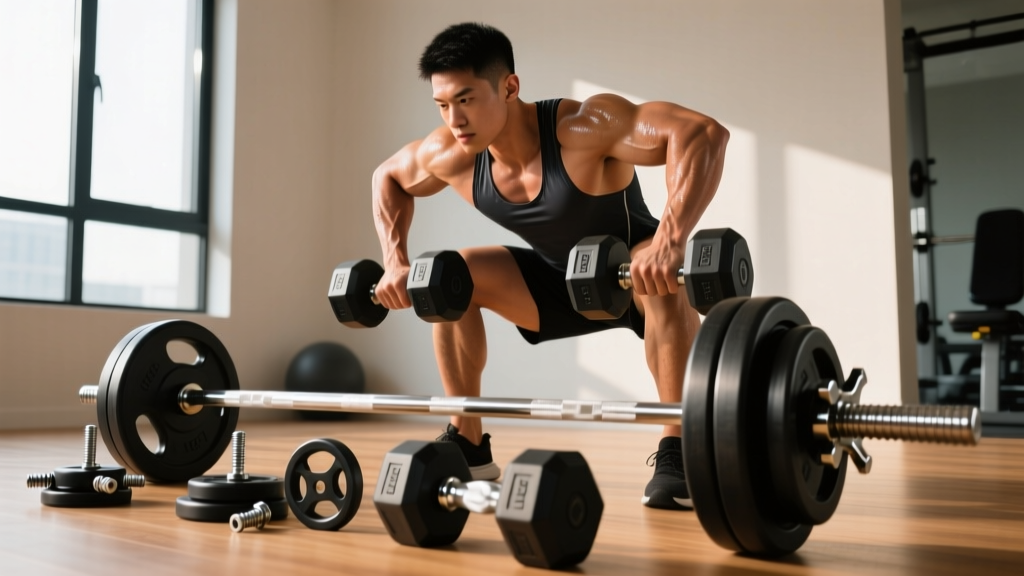
EZ Curl Bar vs Straight Bar: Which Builds Big Dumbbell Biceps?
We break down the biomechanics of EZ curl bars vs straight bars, review top 2026 gear, and compare them to heavy dumbbell protocols for mass.

The Biomechanical Reality: Supination and the Carrying Angle
The debate between the EZ curl bar and the straight Olympic bar is rarely about which one isolates the biceps better; it is fundamentally a question of joint longevity and mechanical tension. The human arm features a natural outward angulation known as the cubital valgus, or carrying angle, typically ranging between 5 and 15 degrees. When you grip a perfectly straight bar, you force the wrists into maximal supination while the elbows are locked into a fixed, linear plane. According to kinesiology data from ExRx, this biomechanical mismatch places significant valgus stress on the medial epicondyle and the distal biceps tendon.
The EZ curl bar was specifically engineered to mitigate this. By introducing 15-degree and 30-degree angled grips, the EZ bar allows for a semi-supinated hand position. This slight pronation shift dramatically reduces torque on the medial elbow structures while still recruiting the biceps brachii, brachialis, and brachioradialis. However, the straight bar remains the undisputed king for peaking short-head activation at the very top of the concentric phase due to the full supination requirement.
Expert Warning: If you experience medial elbow pain (golfer's elbow) during straight bar curls, do not push through it. The connective tissue inflammation is a direct result of ignoring your natural carrying angle. Switch immediately to an EZ bar or neutral-grip dumbbells.Hands-On Gear Review: Top Bars for the Home Gym
After testing over a dozen specialty bars in our lab this year, two models stand out for their knurling quality, sleeve rotation, and tensile strength.
1. The Premium EZ Pick: Rogue Curl Bar ($245.00)
Rogue's offering features a 28.5mm shaft diameter, which is the gold standard for grip comfort during high-rep hypertrophy work. Unlike cheaper Amazon alternatives that use 30mm+ shafts (which prematurely fatigue the forearms before the biceps reach failure), the Rogue Curl Bar utilizes high-quality bronze bushings for a smooth, controlled spin. The knurling features a medium-depth volcano pattern—sharp enough to bite into chalked hands, but passive enough to prevent tearing calluses during high-volume drop sets. The dual knurl marks are spaced perfectly for both narrow and wide grips, and the hard chrome finish resists rust even in humid garage gyms. At 35 lbs unloaded, it provides a stable base that won't tip forward when you load 25lb plates on the sleeves.
2. The Straight Bar Workhorse: Titan Fitness 47' Olympic Straight Bar ($129.99)
If you prefer the straight bar for heavy, low-rep mechanical tension, the Titan 47-inch is a budget-friendly beast. It boasts a 190,000 PSI tensile strength steel shaft and a 28.5mm diameter. The 7.5-inch sleeve length is just enough to load up to three 45lb bumper plates per side. However, the knurling is slightly more aggressive than the Rogue, which can tear up calluses during high-volume drop sets. It is best reserved for heavy sets of 5-8 reps where grip security is paramount.
The 'Big Dumbbell' Protocol: Unilateral Overload
While barbell variations are excellent for bilateral loading, advanced lifters often hit a hypertrophy plateau due to bilateral deficits and dominant-side compensation. This is where integrating a big dumbbell into your arsenal becomes a game-changer. By 'big dumbbell,' we refer to heavy, unilateral dumbbell curls (typically 80 lbs to 120+ lbs for advanced male lifters) performed with a supinating twist. Commercial urethane hex dumbbells are ideal here, as their rubberized coating protects home gym flooring during heavy eccentric drops, and the chunky handles challenge grip strength simultaneously.
Using a heavy dumbbell allows the wrist and elbow to track through their natural, individualized range of motion, completely eliminating the fixed-plane joint stress of a barbell. Furthermore, the eccentric overload potential of a single heavy dumbbell—often assisted by the free hand on the way up and lowered slowly with one arm—creates massive microtrauma in the biceps brachii. Biomechanics researchers at Stronger By Science frequently highlight that unilateral training exposes and corrects left-to-right strength asymmetries that bilateral barbell work masks. When you rely solely on a straight bar, your dominant arm will subtly take over the final 10% of the concentric lockout, leaving the weaker arm under-stimulated over a multi-year training cycle.
Comparison Matrix: EZ Bar vs. Straight Bar vs. Heavy Dumbbells
| Feature | EZ Curl Bar | Straight Olympic Bar | Heavy Dumbbell |
|---|---|---|---|
| Wrist Angle | Semi-Supinated (15°-30°) | Fully Supinated | Dynamic / Adjustable |
| Medial Elbow Stress | Low to Moderate | High | Very Low |
| Short Head Activation | Moderate | Maximum | High (with supination) |
| Brachialis Recruitment | High | Low | Moderate |
| Max Load Capacity | Moderate (Sleeve limits) | Very High | Limited by Grip |
| Best Rep Range | 8–15 reps | 5–10 reps | 6–12 reps |
Common Failure Modes and Edge Cases
1. Sleeve Clearance Issues on EZ Bars
The most common edge case with EZ curl bars is sleeve length. Many commercial-grade EZ bars have sleeves that are only 5 to 6 inches long. If you attempt to load standard 45lb cast-iron plates, the collars will not fit securely, or the plates will press against your legs during the curl, restricting the bottom range of motion. Solution: Use 10lb and 25lb fractional plates on EZ bars to maximize load without sacrificing sleeve clearance.
2. The 'False Grip' Danger on Straight Bars
To alleviate wrist pain on straight bars, some lifters adopt a thumbless (false) grip. When curling heavy loads (e.g., 135+ lbs), a minor slip in grip strength can cause the bar to roll out of the open hand and crash onto the thighs or floor, risking severe injury. Always wrap the thumb when using a straight bar for heavy mechanical tension sets. If wrist pain persists, your anatomy is simply not suited for straight bar supination—switch to an EZ bar immediately.
Expert Programming Framework
To maximize hypertrophy while preserving joint health, we recommend a periodized approach to your bicep training, rotating implements to manage systemic fatigue:
- Phase 1 (Weeks 1-4): Mechanical Tension. Utilize the straight bar for heavy sets of 5-8 reps. Focus on strict form and controlled eccentrics to maximize motor unit recruitment.
- Phase 2 (Weeks 5-8): Metabolic Stress & Volume. Transition to the EZ curl bar for 3 sets of 12-15 reps. The joint-friendly grip allows you to push closer to muscular failure safely, utilizing drop sets and rest-pause techniques.
- Phase 3 (Weeks 9-12): Unilateral Overload. Introduce the heavy dumbbell protocol. Perform heavy eccentric-only reps with a big dumbbell that is 10-15% heavier than your strict curling max, using the off-hand to assist the concentric portion.
Frequently Asked Questions
Is an EZ curl bar better than a straight bar for building mass?
For most lifters, yes. The EZ bar allows for greater training volume and frequency because it minimizes connective tissue fatigue in the wrists and elbows. You cannot build mass if you are sidelined by tendonitis. Equipment experts at BarBend consistently rate the EZ bar as the superior choice for general hypertrophy populations.
Can I use an EZ bar for squats or bench presses?
While some lifters use it for close-grip bench presses to target the triceps, using an EZ bar for squats is highly discouraged. The angled grips place the shoulders in an awkward, compromised position that can lead to rotator cuff impingement under heavy axial loads. Stick to a standard Olympic bar or a safety squat bar for lower body movements.
More gear to consider
All reviews
Maintaining Loadable Dumbbells for Seated Dumbbell Leg Extensions

Best Adjustable 70 lb Dumbbells: 2026 Buyer's Guide

Dumbbell Shrugs Exercise Guide: Rubber Hex vs Urethane Value Analysis

Outgrowing Basic Dumbbell Exercises? Olympic Barbell Knurling Guide

Home Gym Setup: Neoprene Dumbbells vs Dumbbell Shoulder Press Machine