EZ Curl Bar vs Straight Bar: Gym Layouts for Dumbbell Deadbugs
Optimize your home gym layout by comparing EZ curl bar vs straight bar footprints, ensuring safe floor clearance for dumbbell deadbugs and core work.

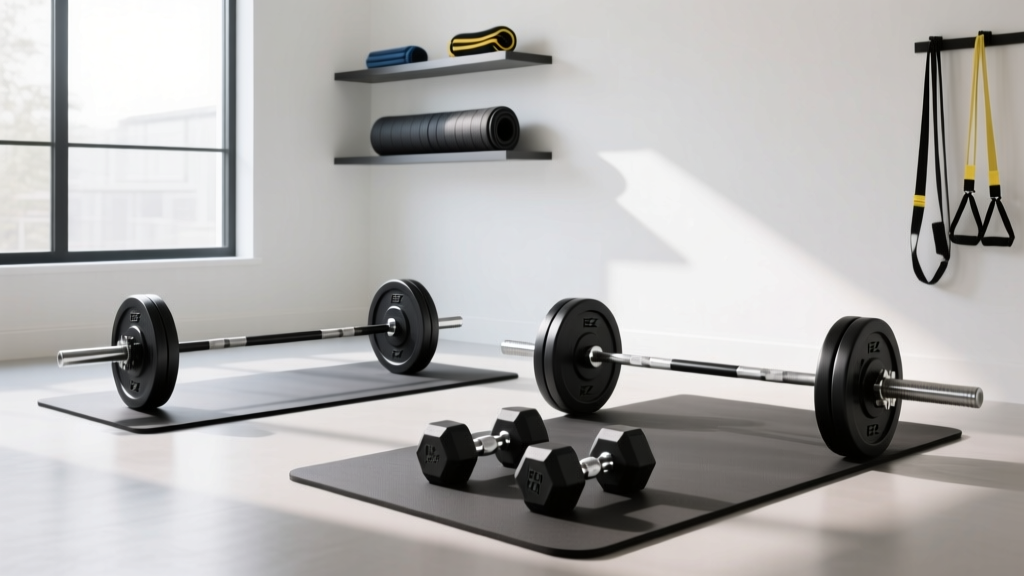
When designing a compact home gym, every square inch of floor and wall space dictates your training flow. While most lifters debate the EZ curl bar vs straight bar based purely on wrist ergonomics and bicep isolation, few consider the profound impact these tools have on spatial layout and multi-use floor zones. If your garage gym is under 200 square feet, the storage footprint of your barbells directly interferes with supine floor movements. Specifically, if you want to safely perform dumbbell deadbugs without smashing your knuckles against stored iron, your barbell selection and mounting strategy must be meticulously planned.
The Spatial Footprint: Straight Bar vs. EZ Curl Bar
The standard Olympic straight bar is a masterpiece of engineering, but it is a spatial bully. Measuring 86 inches (7 feet, 2 inches) in length, a standard straight bar requires significant horizontal or vertical real estate. In contrast, an Olympic EZ curl bar typically spans between 47 and 52 inches. When optimizing a layout, this 34-inch discrepancy is the difference between a cluttered hazard zone and a streamlined training sanctuary.
According to comprehensive facility guides from Garage Gym Reviews, horizontal wall-mounted bar racks protrude anywhere from 14 to 20 inches from the wall. If you mount a horizontal 4-gun rack in a narrow 10x10 room, you instantly consume nearly two feet of your lateral floor envelope. This becomes a critical failure point when transitioning from standing arm work to floor-based core stabilization.
Dimensional & Storage Comparison Matrix
To visualize the spatial tax of each barbell type, review the dimensional breakdown below. These metrics are based on standard 2026 Olympic specifications and popular models like the Rogue Ohio Bar and standard Rogue Curl Bar.
| Bar Type | Total Length | Weight | Vertical Clearance Needed | Horizontal Rack Protrusion | Avg. Price (2026) |
|---|---|---|---|---|---|
| Standard Straight Bar | 86 inches | 45 lbs | 88+ inches | 18 - 22 inches | $250 - $320 |
| Olympic EZ Curl Bar | 47 - 52 inches | 25 - 30 lbs | 54 inches | 10 - 14 inches | $180 - $260 |
| "Shorty" Straight Bar | 69 inches | 35 lbs | 71 inches | 14 - 16 inches | $150 - $200 |
Designing the Core Zone: Clearing Space for Dumbbell Deadbugs
The dumbbell deadbug is a premier anti-extension core exercise. As noted in biomechanical databases like ExRx, supine core stabilization exercises require a full limb extension envelope. To perform a dumbbell deadbug correctly, you lie supine, holding dumbbells (typically 15 to 50 lbs each) with arms extended toward the ceiling, while simultaneously lowering contralateral limbs to the floor.
This movement demands a clear floor space of roughly 3 feet wide by 6 feet long. Here is where the EZ curl bar vs straight bar debate intersects with layout design:
The Knuckle-Strike Failure Mode
Imagine you have a standard 86-inch straight bar stored horizontally on a wall rack. You lay down on your mat 24 inches away from the wall to perform dumbbell deadbugs. As you lower the dumbbells backward toward the floor (the eccentric phase), your arms extend past your head. Because the horizontal bar rack protrudes 20 inches into the room, your dumbbells—or your knuckles—will violently collide with the sleeves of the stored straight bar. This not only ruins the exercise's tempo but poses a severe injury risk to your wrists and hands.
The EZ Bar Vertical Advantage
By swapping to an EZ curl bar and utilizing a vertical wall hanger, the storage footprint protrudes a mere 6 inches from the wall. You can safely position your lifting mat just 18 inches from the wall, granting you the full 6-foot length required for uninterrupted dumbbell deadbugs, floor presses, and dumbbell pullovers. Furthermore, checking current specs on Rogue Fitness confirms that most Olympic EZ bars feature a central knurled or unknurled shaft that easily hooks into standard vertical J-cups or dedicated wall holsters without damaging the knurling.
Layout Pro-Tip: The "Drop Zone" Mapping
Before mounting any barbell storage, use painter's tape to map out a 3'x6' rectangle on your floor. Lie inside it and simulate dumbbell deadbugs with your heaviest intended dumbbells. Extend your arms fully overhead. If your taped zone intersects with the shadow of your planned horizontal bar rack, you must pivot to vertical EZ bar storage or relocate the rack to an adjacent wall.
2026 Equipment Picks for Space-Constrained Lifters
If your layout demands strict spatial efficiency without sacrificing lifting quality, consider these specific configurations for your home gym:
- Rep Fitness Vertical Bar Holder (Wall-Mounted): Priced around $45, this heavy-duty steel bracket mounts directly to studs. It holds an EZ curl bar securely by the shaft, keeping the floor completely clear for deadbugs and stretching.
- Titan Fitness Shorty Bar (69-inch): If you absolutely refuse to give up the straight bar for heavy compound curls or landmine presses, the 69-inch Shorty bar is the ultimate compromise. At 69 inches, it can be stored vertically in basements with standard 84-inch (7-foot) ceilings, and it leaves enough wall clearance to prevent deadbug collisions.
- Rogue Curl Bar: At 47.25 inches and 30 lbs, its compact sleeves mean it won't catch on nearby power rack uprights if you choose to store it vertically inside your squat rack's uprights via a barbell holder attachment.
Frequently Asked Questions
Can I use an EZ curl bar for dumbbell deadbugs?
No, the dumbbell deadbug specifically requires independent dumbbells to challenge unilateral core stability and allow for natural wrist rotation. However, you can perform a "barbell deadbug" or supine floor press with an EZ curl bar, taking advantage of its ergonomic grips to reduce wrist strain while lying on the floor.
How do I store a 7-foot straight bar in a basement with low ceilings?
If your ceiling height is under 88 inches, you cannot store a standard straight bar vertically using traditional hooks. Your only space-optimizing options are: 1) Mounting it horizontally high on the wall (which consumes lateral space and interferes with floor exercises), or 2) Using a specialized pivoting vertical wall mount that stores the bar at a 15-degree angle, reducing the required vertical clearance to roughly 82 inches.
What is the best mat thickness for dumbbell deadbugs near equipment?
For supine core work near steel storage racks, use a high-density EVA foam or rubber mat that is at least 3/4-inch thick. This provides enough cushioning for your spine during the deadbug's hollow-body hold, while also dampening the sound and impact if a dumbbell accidentally grazes the floor near your barbell storage zone.
More gear to consider
All reviews
Troubleshooting Light Dumbbell Workouts With Neoprene Coated Sets

Cap Barbell Cast Iron Hex Dumbbell vs Rubber & Urethane: Care Guide

Iron vs Bumper Plates & Dumbbell Chest Supported Upright Row Budget
Compact Gym Layouts: Loadable Dumbbells for Arnold Dumbbell Curls

Rubber Hex vs Urethane: Value & What Muscles Do Dumbbell Curls Work
